In view of the holy month of Ramadan, schools in Karnataka and Andhra Pradesh have modified school timings so as to facilitate students of Urdu and other minority language schools to observe the month without comprising academics.
Schools in Karnataka and Andhra Pradesh change school timings on occasion of Ramadan. (File image) (Photo by Kunal Patil/ Hindustan Times)
A circular issued by the Directorate of Urdu and Other Minority Language Schools in Karnataka changed the timings of junior, senior, and high school schools from 8 AM to 12:45 PM during the month of Ramadan. The circular asked the schools to take necessary actions in this regard.
Likewise, the Andhra Pradesh School Education Department changed the timings from 8 AM to 1:30 PM in Urdu medium primary, upper primary, high schools, parallel sections, and Urdu Medium DIETS across the state with effect from March 12th to April 10th, 2024.
As informed in the circular, the decision was taken after the Minority Teachers Association appealed authorities to change the timings on occasion of Ramadan. The notice further stated that the change in timings will not affect the SSC Public Examinations or other exams.
The Graduate Advising Manager plays a key role within the Advising and Student Services team in the School of Nursing’s Office of Academic Affairs by providing comprehensive advising and student services to graduate nursing students. This position oversees a broad range of student services specifically for graduate students in the School of Nursing, including students in the Doctor of Nursing Practice (DNP) program, students in the PhD program, and students in certificate programs. Working collaboratively with students, faculty, and staff, as well as working very independently at times, the Graduate Advising Manager is an integral part of the student’s academic journey and success.
Responsibilities:
Manages and executes the development and implementation of the administrative and student services activities of graduate degree program(s) and/or certificate(s). Performs activities which may include recruitment, admissions, new student orientation, academic advising, monitoring of progress towards the degree, course and/or enrollment management, diversity, equity and inclusion initiatives, course and/or program assessment, and academic program review. Supervises unit staff and/or manages an advising services portfolio. Strives to create a welcoming, equitable, and inclusive work environment.
20% Participates in the campus-wide advising community, graduate community, etc. providing input to leadership regarding the development of advising, recruitment, and co/curricular programs offered by the school/college
10% Supervises unit staff and/or plans, organizes, allocates resources, assesses performance, and leads the operational activities of a function within the advising or academic services portfolio, such as program management and/or curriculum management
20% Coordinates and executes the development and implementation of programming, services, and events to promote professional development and academic success. Performs services and program evaluation and assessments and use data to inform changes.
5% Coordinates with leadership the development of policy and procedure recommendations and/or modifications
20% Serves as a primary resource for graduate applicants, current students, faculty, staff, and other stakeholders of an academic program
5% Maintains compliance with graduate program(s), school/college, and university requirements and technology systems related to admissions, assessment, academic degree progress/requirements, and program review
10% Advises and maintains expertise on programs, curriculum, graduate education and university policies and procedures. Provides information and resources about educational options and graduate academic requirements; assists with identifying and assessing interests, skills, and values to match appropriate field of study/career options and refers students to appropriate institutional resources.
5% Maintains confidentiality and accurate student records and processes and responds to academic inquiries according to established institutional and Family Educational Rights and Privacy Act (FERPA) policies
5% Monitors degree progress and assists students in navigating resources and systems throughout the student lifecycle from matriculation to degree completion
Tasks:
Access and manage student data via the student information system, degree audit software, databases, and other electronic means.
Coordinate, oversee and manage, with considerable independence of action, the school’s interactions with the graduate school. Serve as a consultant/liaison to the university’s Graduate School.
Develop, coordinate, oversee and implement, with considerable independence of action, the school’s assistantship (TA and PA) training.
Develop, coordinate, oversee, and implement student services programming in support of all graduate programs and certificates.
Formulate, interpret, and monitor policies and/or program directions as appropriate on behalf of the faculty. Provide specific, accurate, and current information about curricular requirements and other items that pertain to academic progress.
Maintain communication with faculty regarding the academic needs and concerns of students and serve as a resource for faculty and staff on advising and student support services.
Participate in the planning, implementation, and evaluation of the academic advising program’s goals and objectives.
Provide comprehensive advising for graduate programs and certificates including but not limited to out-of-the classroom learning experiences, academic progress and performance, professional development, and degree completion.
Serve as an academic advisor for admitted graduate nursing students including support with enrollment, curricular/degree requirements, educational opportunities, and academic policy/regulation interpretation.
Serve as the expert resource for students, faculty, staff, and other stakeholders of the graduate programs and certificates.
Support Career and Student Success programming for graduate students.
Support policy recommendations and review in conjunction with faculty program directors.
Support student services operations for all nursing students including but not limited to scholarship review, coordination with the Nursing Learning Center, support of SOAR activities, and support of all events.
Understand, utilize, and collaborate with campus units and appropriately refer students to academic and learning support resources, as well as mental and physical health resources.
Institutional Statement on Diversity:
Diversity is a source of strength, creativity, and innovation for UW-Madison. We value the contributions of each person and respect the profound ways their identity, culture, background, experience, status, abilities, and opinion enrich the university community. We commit ourselves to the pursuit of excellence in teaching, research, outreach, and diversity as inextricably linked goals.
The University of Wisconsin-Madison fulfills its public mission by creating a welcoming and inclusive community for people from every background – people who as students, faculty, and staff serve Wisconsin and the world.
For more information on diversity and inclusion on campus, please visit: Diversity and Inclusion
Education:
Preferred Master’s Degree
Qualifications:
* Minimum of one year experience in academic affairs, academic advising, student services, internships applicable. * Excellent written and oral communication, presentation, interpersonal, organizational, and computer skills, including proficiency with related systems and databases. * Familiarity with current research and best practices regarding academic advising, as well as student well-being. * Ability to use Microsoft applications and other student information systems at a practitioner level, as well as utilize new software technologies to provide efficient, accurate advising services. * Knowledge of academic policy and graduate curricula. * Ability to serve as an articulate spokesperson for the mission and values of the School of Nursing. * Strong communication and project management skills. * Ability to think, reason, and make sound judgments on how responsibilities are completed in compliance with school and university standards. * Ability to work well in a multiethnic, multicultural environment with students, faculty, and staff. * A high degree of professionalism, discretion, and judgement.
Work Type:
Full Time: 100%
This position requires most work to be performed in-person, onsite, at a designated campus work location. The person in this position may request and be considered for a formal remote work agreement based on guidelines set forth by the School of Nursing, and/or may be provided with remote work flexibility as needed and approved by the supervisor.
Appointment Type, Duration:
Ongoing/Renewable
Salary:
Minimum $55,000 ANNUAL (12 months) Depending on Qualifications The expected salary for this position starts at a rate of $55,000. Actual pay will depend on experience and qualifications. In addition to base pay, the employee in this position can expect to receive benefits such as generous vacation, holidays, and other paid time off, competitive insurances and savings accounts, and employer sponsored retirement benefits.
Additional Information:
For 100 years, the University of Wisconsin-Madison’s School of Nursing (SoN) has been committed to enhancing healthcare through teaching and research. With a mission to develop leaders for the profession and society; we make discoveries, enhance systems, and improve health through research, education, and practice for Wisconsin and beyond. The School of Nursing strives to achieve inclusive excellence and fosters an academic environment that welcomes diversity in students, faculty, staff, and the curriculum.
In the course of employment with the School of Nursing (SoN), dependent upon position and job responsibilities, employees may have access to PHI (personal health information) to fulfill the duties of their position. As part of the UW-Madison Health Care Component (HCC), all SoN faculty, staff, students, volunteers, and unpaid affiliates are required to complete HIPAA training as part of their orientation.
Successful candidates are responsible for ensuring their eligibility to work in the United States (i.e. a citizen or national of the United States, a lawful permanent resident, a foreign national authorized to work in the United States without need of employer sponsorship) on or before the effective date of appointment.
A criminal background check will be conducted prior to hiring.
How to Apply:
To apply for this position, please click Apply Now, from jobs.wisc.edu, to begin the application process. You will be asked to submit the following (PDF file format is strongly encouraged and preferred):
1) A letter of interest highlighting relevant work experience and referencing PVL #294810 2) A resume/CV
References will be requested from finalists only and are not required with initial application. For questions regarding this position, please contact Darby Sugar, Advising & Student Services Director, drsugar@wisc.edu.
Online applications must be received by 11:55pm on the application deadline to ensure consideration. Failure to submit complete application materials may result in ineligibility for consideration for this position.
The University of Wisconsin-Madison is an Equal Opportunity and Affirmative Action Employer.
Qualified applicants will receive consideration for employment without regard to, including but not limited to, race, color, religion, sex, sexual orientation, gender identity, national origin, age, pregnancy, disability, or status as a protected veteran and other bases as defined by federal regulations and UW System policies. We promote excellence through diversity and encourage all qualified individuals to apply.
Employment will require a criminal background check. It will also require you and your references to answer questions regarding sexual violence and sexual harassment.
The University of Wisconsin System will not reveal the identities of applicants who request confidentiality in writing, except that the identity of the successful candidate will be released. See Wis. Stat. sec. 19.36(7).
The Annual Security and Fire Safety Report contains current campus safety and disciplinary policies, crime statistics for the previous 3 calendar years, and on-campus student housing fire safety policies and fire statistics for the previous 3 calendar years. UW-Madison will provide a paper copy upon request; please contact the University of Wisconsin Police Department.
UW-Madison is an equal opportunity/affirmative action employer. We promote excellence through diversity and encourage all qualified individuals to apply.
Shoulders, biceps, back, chest, triceps and core — this Upper Body HIIT Workout with weights is a complete arm workout at home. Strength exercises to tone your arms are paired with upper body HIIT exercises to raise your heart rate and burn calories.
I love an efficient workout routine, which is why I love the combination of strength training and HIIT exercises, like you’ll find in today’s upper body HIIT workout.
Pairing upper body strength exercises with high intensity interval training (HIIT) makes shorter workouts more efficient.
This combination also increases the intensity of a workout. Performing “strictly strength” exercises, like an overhead shoulder press, becomes more difficult when your heart rate is elevated.
If you want to build toned arms and break a sweat at home, this is the workout for you!
35-Minute Upper Body HIIT Workout
Build upper body strength and raise your heart rate in around 35 minutes with this upper body HIIT workout.
Add upper body workouts like this one to yourhome training program1-2 times a week to build muscle mass and increase endurance.
Workout Equipment:
Medium to Heavy Set of Dumbbells.I suggest anywhere from 8-25 lbs. I used 15-20 lb dumbbells for this arm workout.
Timed Intervals (perform each exercise for 30 seconds, then rest 10 seconds)
Repeat Each Circuit x3 Sets
Between Each Circuit is a Push Up and Cardio Push (30 seconds work, 10 seconds rest, repeat x2 sets)
Note: we re-filmed this workout to improve video and sound quality (and changed up some of the moves). You can find the original best upper body HIIT exercises here if you’d like to compare them.
Workout Outline
CIRCUIT ONE:
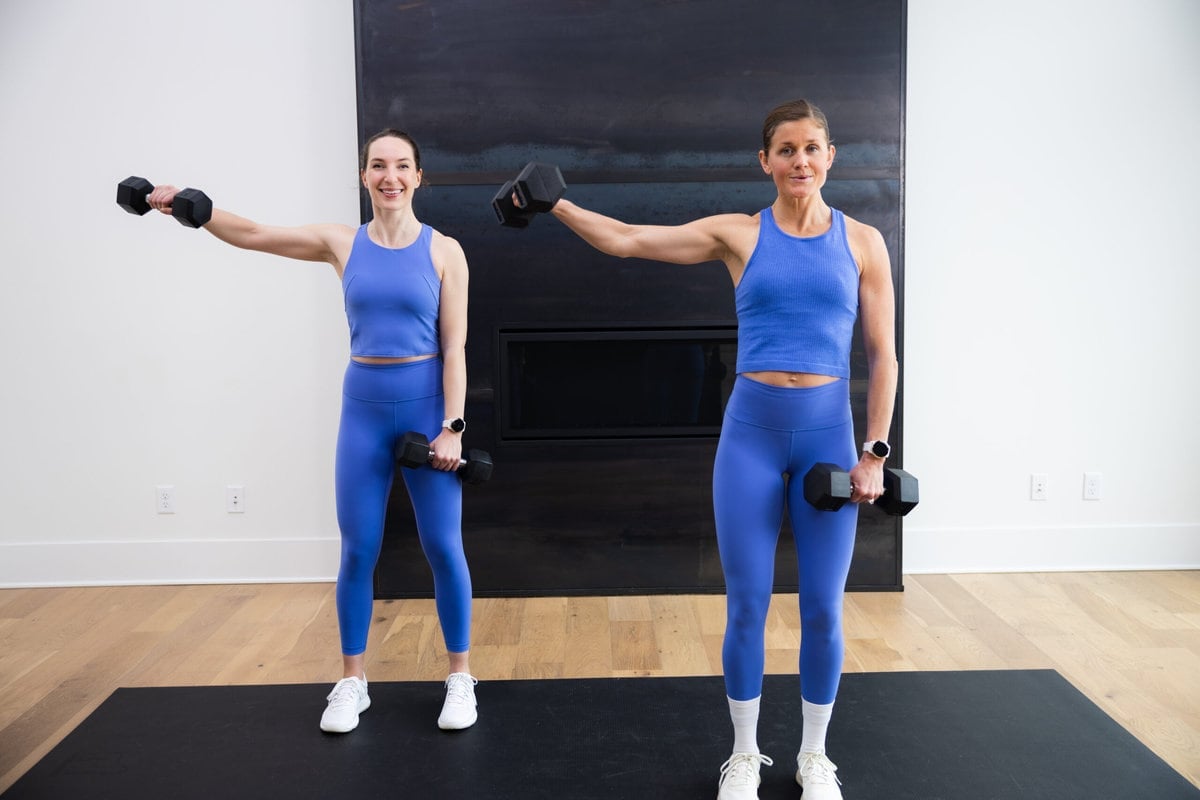
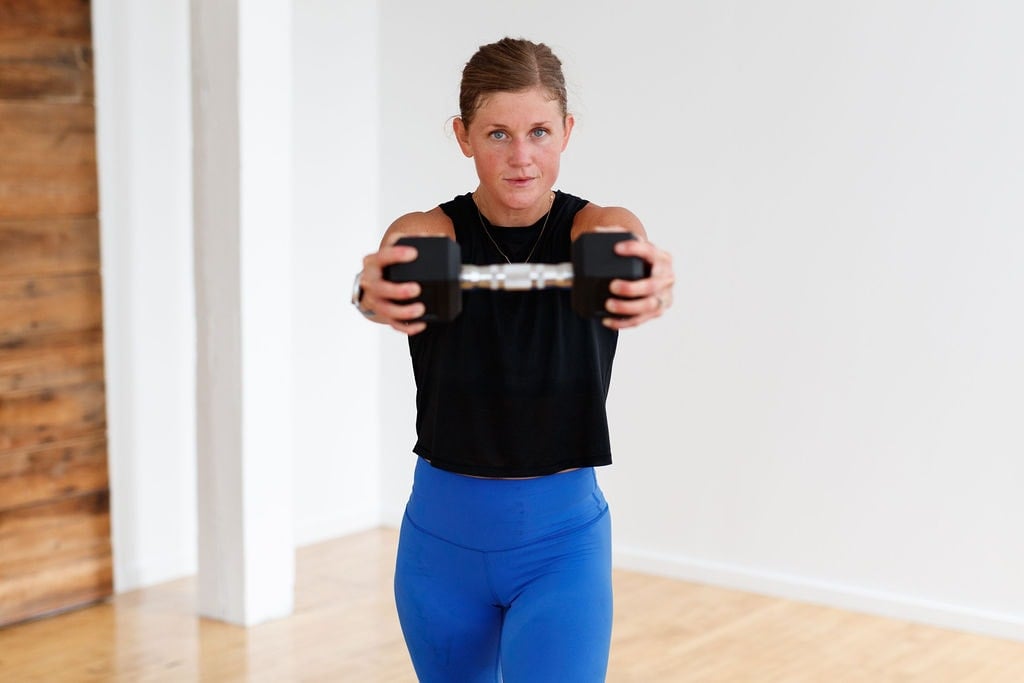
Single, Single, Double Lateral Raise
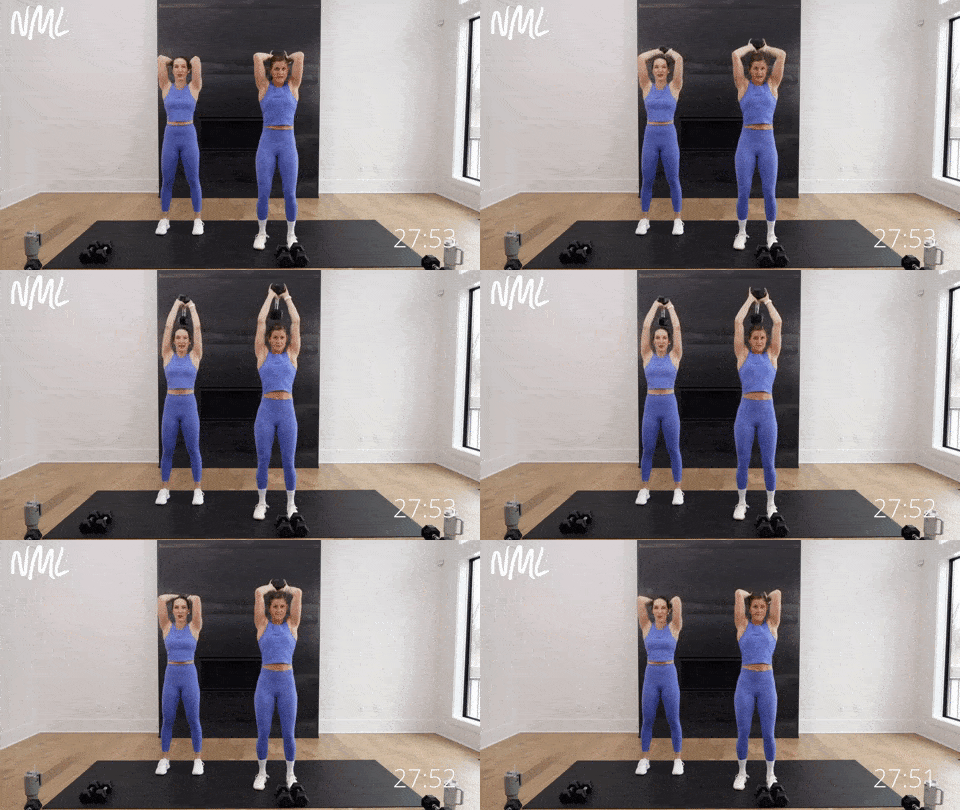
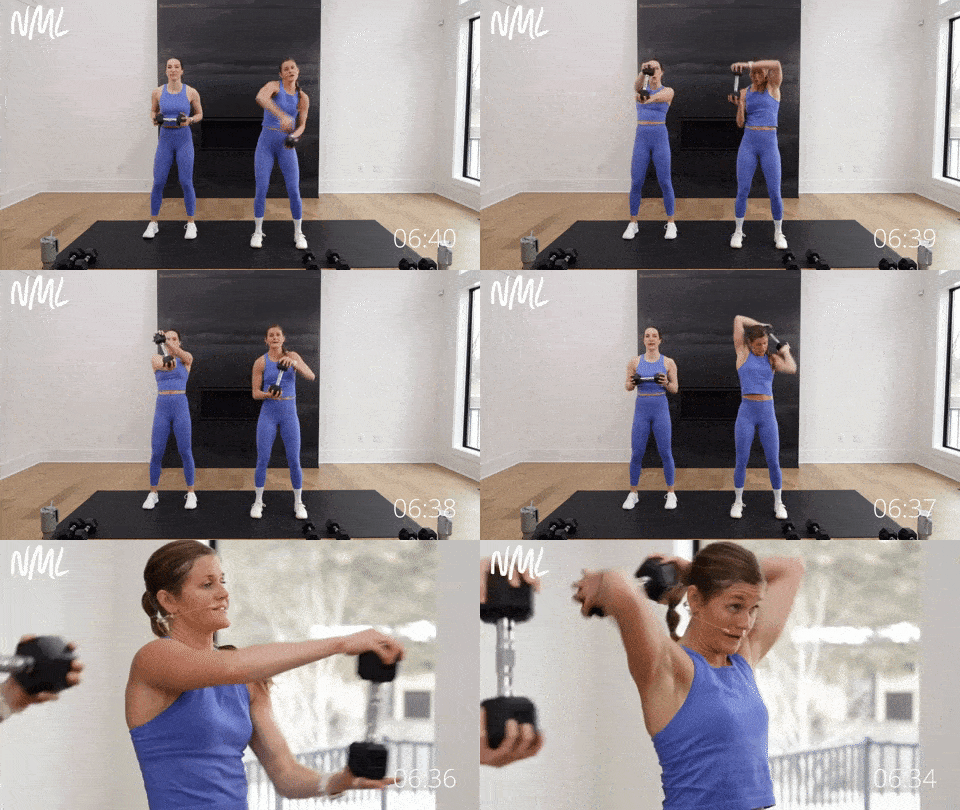
Overhead Tricep Extension
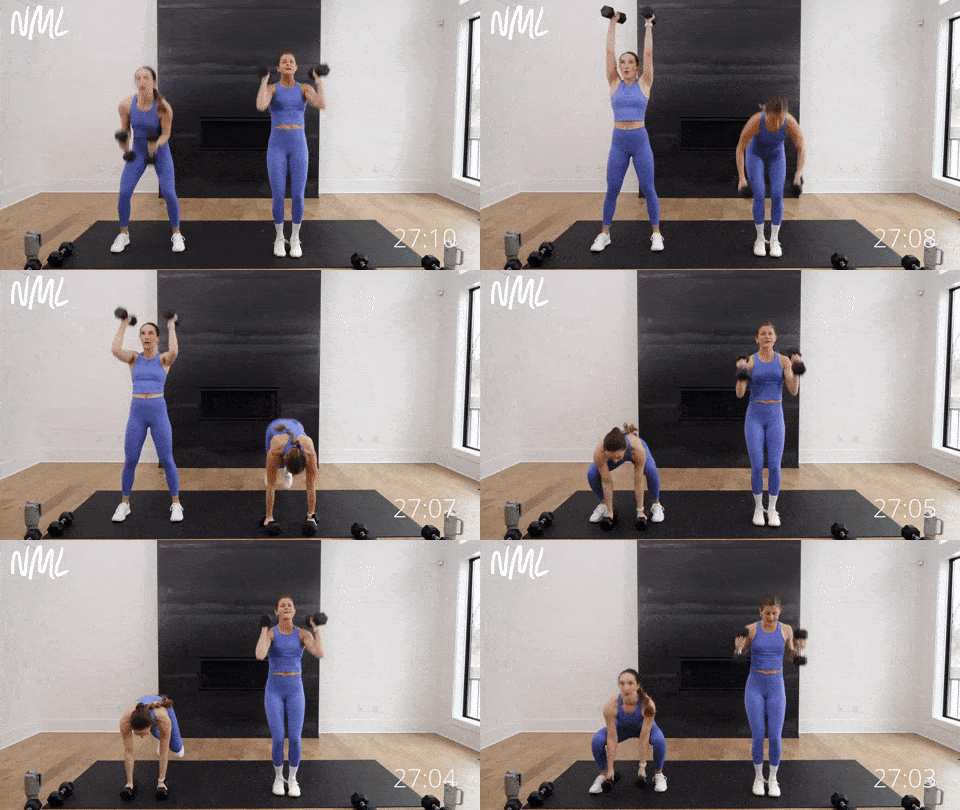
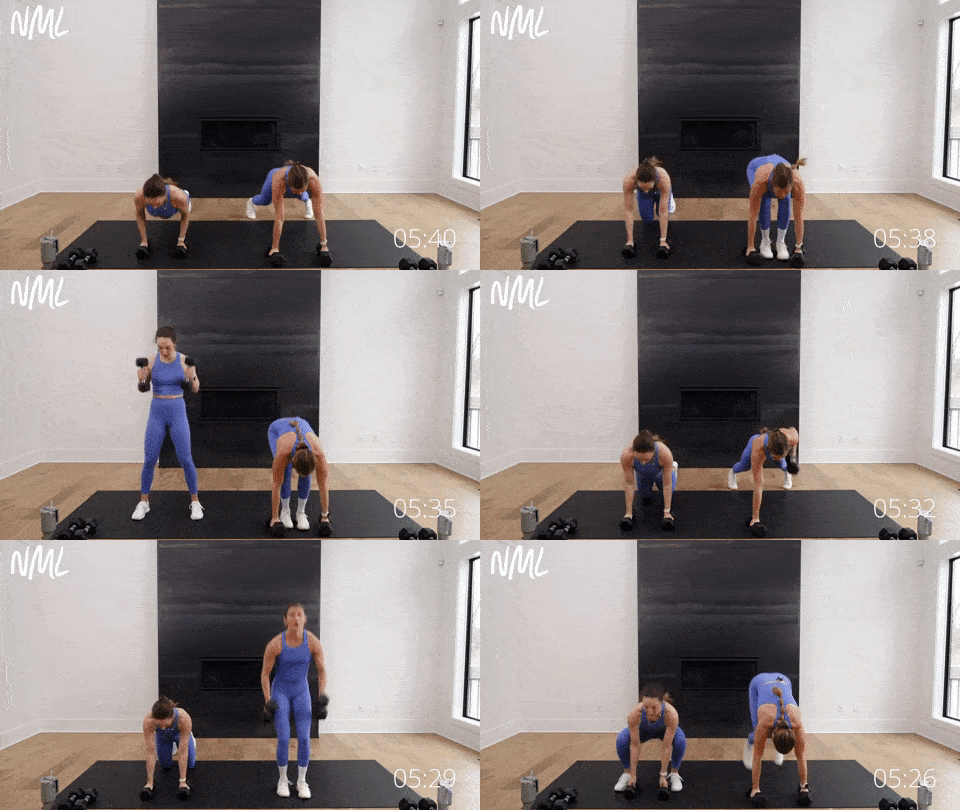
Burpee and Push Press
Push Ups and Cardio:
Push Up and Dumbbell Drag
Lateral Shuffle
CIRCUIT TWO:
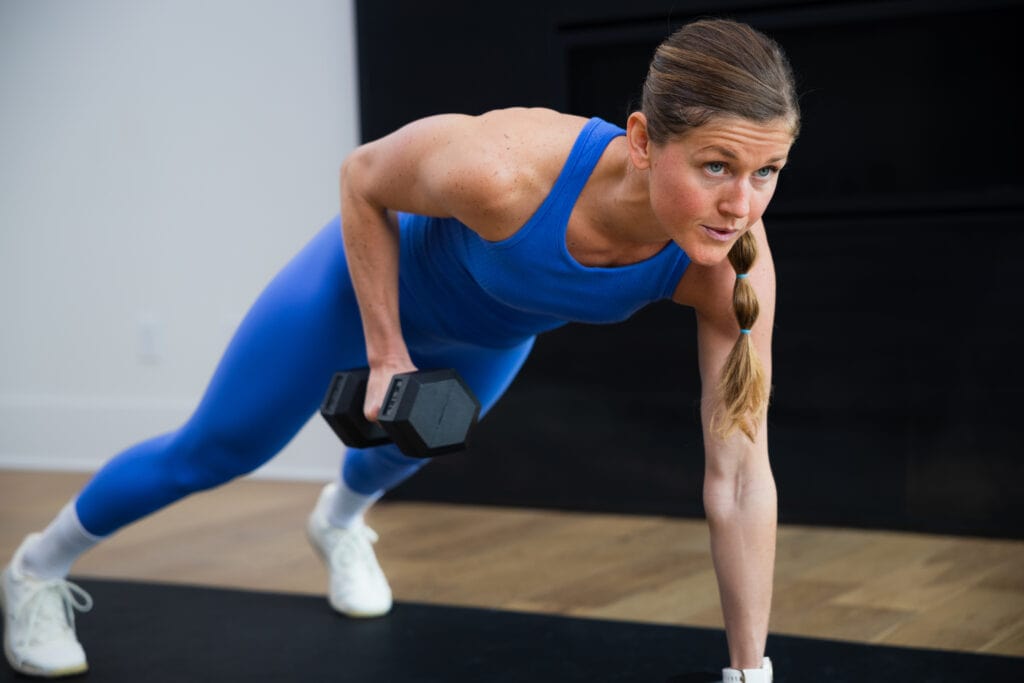
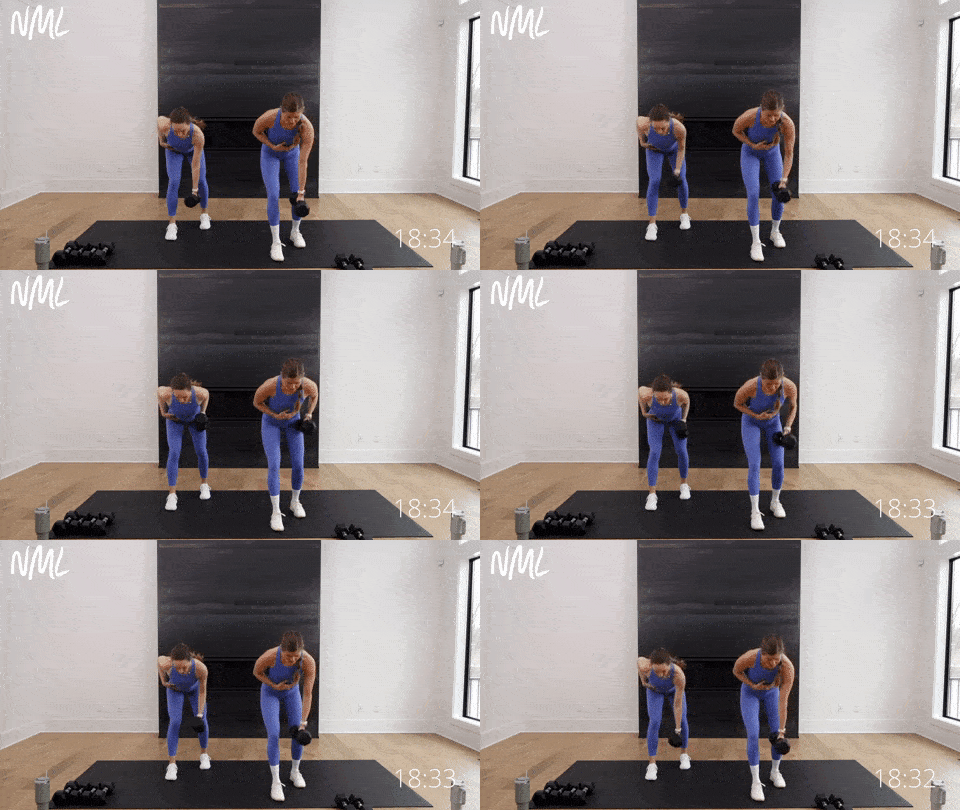
Single Arm Row
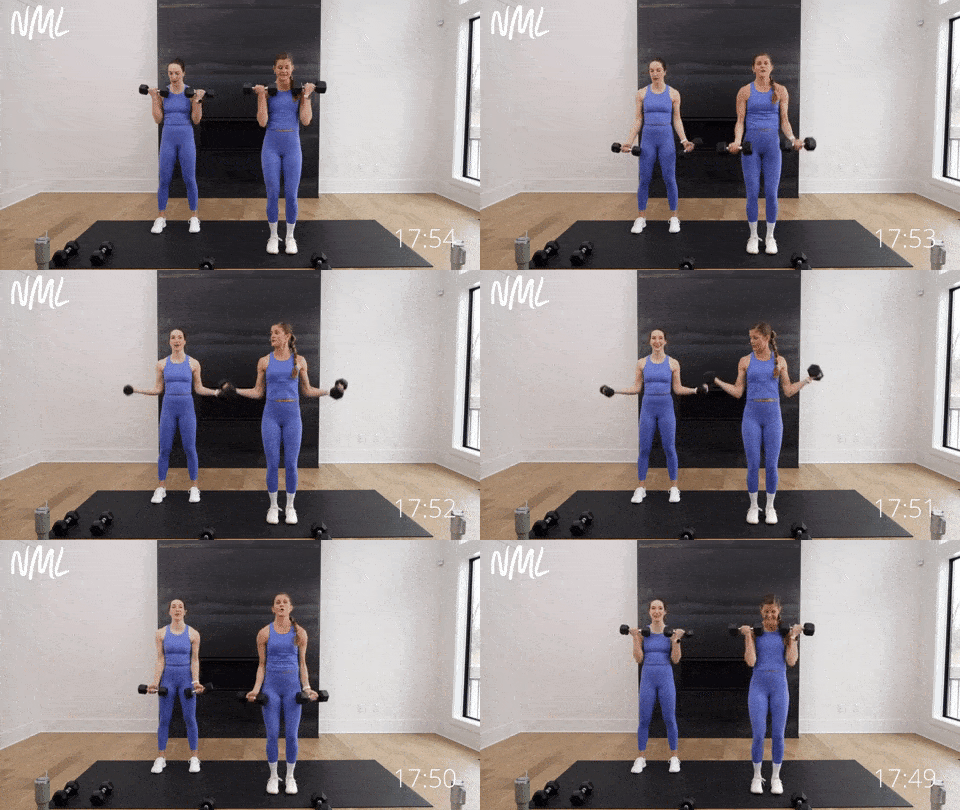
W-Curls (Standard Curl and Wide Curl)
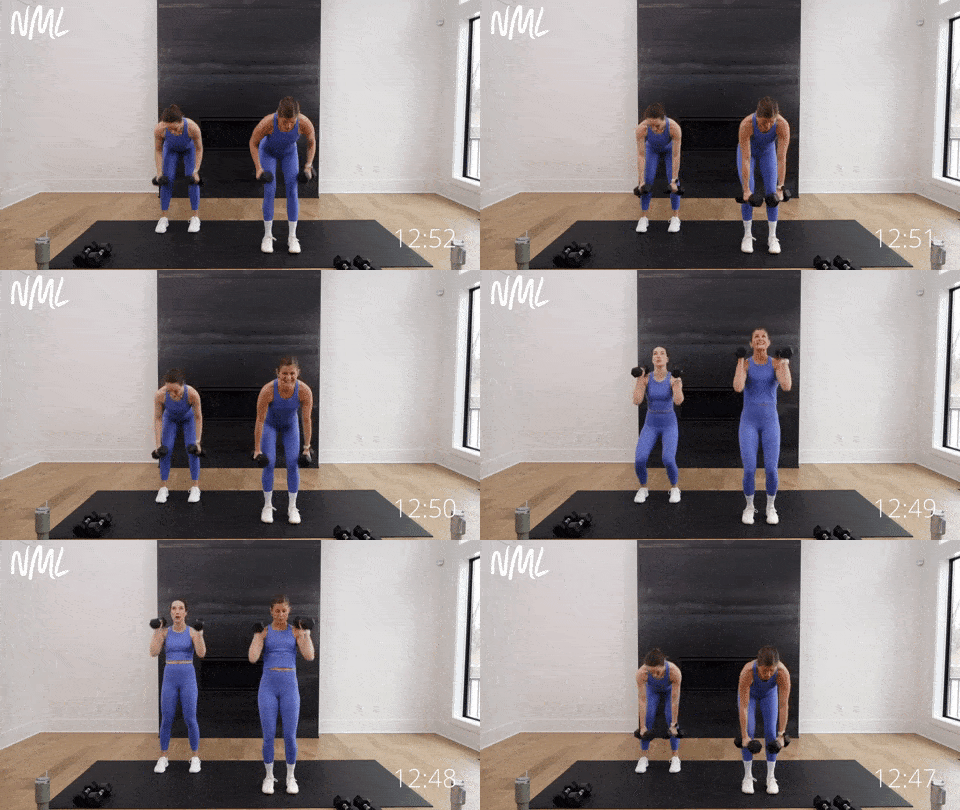
Dumbbell Row, Clean and Overhead Press
Push Ups and Cardio:
Push Up and Dumbbell Row
Ladder Drill
CIRCUIT THREE:
Woman Maker
Halo and Vertical Press Out
Push Ups and Cardio:
Push Ups
Mountain Climbers
8 Best Upper Body HIIT Exercises
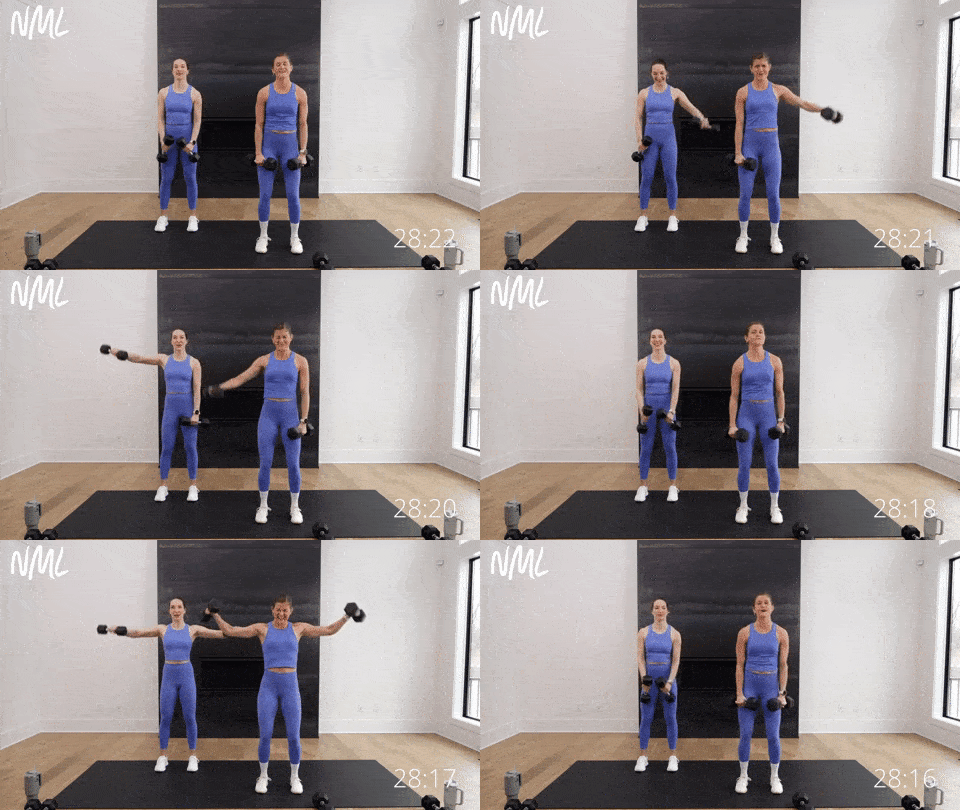
Single, Single, Double Lateral Raise
Targets: All three heads of the shoulder muscles — primarily the lateral head of the deltoid, but also engages the anterior and posterior heads (or rear delts).
How To Do Single, Single, Double Lateral Raises
Stand with feet shoulder-width apart, slight bend in your knees, holding a dumbbell in each hand at hip level, palms slightly out.
With a slight bend in each arm at the elbow, squeeze to lift the dumbbell in your right hand out towards the right in an arc shape, lifting to shoulder height. With control, lower the dumbbell to your hips.
Repeat, this time lifting the dumbbell in your left hand out towards the left in an arc shape, before returning to starting position.
Then, perform a “double” lateral raise by lifting both arms at the same time, raising the dumbbells out away from your body at approximately a 45-degree angle. Lift dumbbells just to shoulder height, then lower with control.
Overhead Tricep Extension
Targets:The triceps (back of the arm). This move also engages all the stabilizing muscles in the shoulders, core, glutes and lower back muscles.
How To Do Overhead Tricep Extensions
Start standing with feet hip-width apart, core engaged and knees slightly bent. Hold one dumbbell vertically between your palms overhead.
Slowly bend your elbows to a 90-degree angle, bringing the dumbbell behind your head. Think ‘hide the dumbbell, show the dumbbell’, if you were watching yourself in a mirror. Keep your elbows close to your ears throughout the entire movement (don’t let your elbows flare out as you fatigue).
Squeeze through the back of your arm as you exhale, pressing the dumbbell overhead, arms fully extended.
Burpee and Push Press
Targets:Shoulders, back, glutes, hamstrings, lower back, abs and core.
This complex full body move adds explosive power to strength movements.
How To Do Burpees and Push Presses
Stand with feet shoulder-width apart, holding a set of dumbbells in your hands with palms facing in towards each other at your hips.
With a soft bend in the knees, hinge at your hips to lower your torso as you slide the dumbbells down in front of your legs to set the dumbbells on the ground on either side of your feet.
Perform a burpee by jumping your feet back to high plank position. Hands remain on the dumbbells.
Then jump your feet back in and immediately stand tall, driving through the heels as you pull the weights up towards your hips.
Then, curl the dumbbells to shoulder height and perform two shoulder presses, dipping at the knees before pressing the dumbbells straight overhead.
Reverse the curl, lowering the dumbbells to hip level and returning to starting position.
Modification: Perform walking burpees by stepping in and out of plank. Alternatively, you could perform burpees from an incline by placing your hands on a chair or bench.
Single Arm Row
Targets: The latissimus dorsi (or lats); largest back muscle. This unilateral exercise also engages the bicep and core.
How To Do Single Arm Rows
Stand with your feet slightly wider than shoulder-width apart, knees slightly bent. Option to keep feet parallel or take a slightly staggered stance to better support your low back (stepping your right leg slightly behind your left leg).
Hold a dumbbell in your right hand, palm facing in towards your opposite hand (neutral or narrow grip).
Hinge forward at the hips maintaining a flat back, belly button pulled back towards your spine.
Pull the dumbbell back towards your right hip (think of pulling from your elbow joint versus your wrist), as if you were starting a pull-start lawnmower. Stop once your elbow is in line with your rib cage, making a straight line from shoulder to elbow. Hold the row at the top for a moment squeezing your shoulder blade in.
With control, lower the dumbbell back to the starting position and repeat. This is a slow deceleration of the weight through the full range of motion.
W-Curls (Standard Bicep Curl and Wide Bicep Curl)
Targets:The muscles of the forearms, the biceps muscles and rotator cuff.
The external rotation through the shoulder joint also strengthens the rotator cuff muscles and increases shoulder stability.
How To Do Standard and Wide Bicep Curls
Start with feet under hips, core engaged. Hold a dumbbell in each hand in front of you at hip height, elbows by your waist, and palms facing up towards the ceiling.
Curl the dumbbells up to shoulder height, keeping your elbows in place.
With control, lower the dumbbells to your hips.
Then, open through the chest as you rotate the dumbbells out towards the corners of the room, each palm about 45 degrees away from your body.
Hold this external rotation as you curl the dumbbells up towards your shoulders, before lowering to to your thighs (performing a wide bicep curl).
Rotate through the shoulders to pull the dumbbells back in front of your body, returning to starting position.
Dumbbell Row, Clean and Overhead Press
Targets:The lower back and upper back (specifically the lats and rhomboids), hamstrings, hips, glutes, core and shoulders.
How To Do Dumbbell Rows, Cleans and Overhead Presses
Stand with feet hip-width apart, knees slightly bent. Hold one dumbbell in each hand at your hips, palms facing in towards each other.
Hinge forward at the hips, then “row” the dumbbells towards your torso, pulling your elbows towards your ribcage then lowering with control. Repeat twice, performing two narrow rows.
Then, drive through your heels to return to standing, “cleaning” the dumbbells up towards your shoulders. Your heels may pop off the ground. Think about “getting under” the dumbbell to catch it — this is a dumbbell clean. Catch the dumbbells at your shoulders.
Bend your knees, lowering 2-3 inches and then straightening the knees as you push the dumbbells overhead, arms extended straight over shoulders. With control, lower dumbbells back to shoulders.
Repeat this sequence, alternating two back rows with a dumbbell clean and an overhead press.
Woman Maker (Push Up, Row, Squat, Curl and Press)
Targets:Quads, glutes, hamstrings, back, chest, biceps, triceps, shoulders and core.
A big, full-body movement to build strength while also getting your heart rate up.
How To Do Woman Makers
Start in a high plank position, both hands on your dumbbells, shoulders stacked over wrists, core engaged.
Perform a push up by lowering your chest to the ground, letting your elbows fall back towards your hips, then exhale, pushing back up to starting position.
Then, perform a single arm plank row (or renegade row) on each side, pulling first your right elbow to right hip, then planting it on the ground and pulling left elbow to left hip before returning it to the ground.
Then, step or jump your feet up to meet your hands, landing in a low squat position.
Press through your heels to stand tall, pulling the dumbbells up your body as your hips drive forward.
As you stand, curl the dumbbells up to shoulder height, then press overhead, stacking dumbbells over shoulders and keeping your core tight.
Reverse the movement, bringing the dumbbells back to shoulder height, lowering the dumbbells to your hips, and bending your knees to lower into a squat.
Plant the dumbbells on the mat between your feet at the bottom of your squat, and step or hop your feet back, landing in high plank position.
Modification: Step your feet in and out of plank position rather than jumping. And take push ups and rows from your knees.
Halo and Vertical Press Out
Targets:Shoulders, low back, and abdominal muscles.
Stand with your feet under hips, holding a dumbbell vertically at your chest, right hand at the top head of the dumbbell and left hand at the bottom head of the dumbbell.
Brace your core and perform a dumbbell “halo,” pulling the dumbbell in a smooth motion towards your left shoulder and then behind and around your head, ending with the dumbbell centered and vertical at your chest. Left hand is now at the top head of the dumbbell.
Then, press the dumbbell away from your body, keeping it in line with your shoulders. With control, return the dumbbell to your chest.
Repeat, this time changing halo directions. Pull the dumbbell towards your right shouler then behind and around your head, ending with the dumbbell centered and vertical at your chest, right hand on top.
Free 2-Week Strength + HIIT Program
Upper Body HIIT Workout FAQs
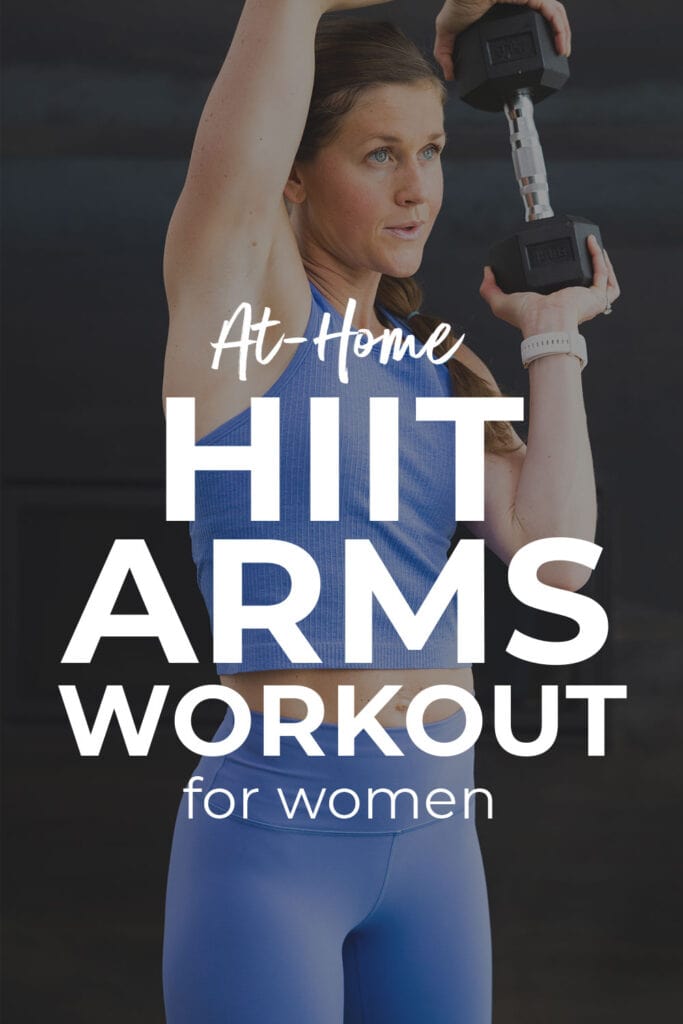
Pin this: Upper Body HIIT Workout for Women
This post includes affiliate links. I do make a small commission for products purchased using these links (at no additional cost to you). Thank you for supporting Nourish Move Love, making the content you see on this blog possible.
The National Testing Agency on Monday started the Common University Entrance Test Postgraduate or CUETA PG 2024. The exam will continue till March 28 and admit cards for exams up to March 13 have been released. Hall tickets for the remaining exams will be released in due course of time on pgcuet.samarth.ac.in.
This year, the exam is being held in three shifts. The first shift is from 9 am to 10:45 am, the second one is from 12:45 pm to 2:30 pm and the third shift is from 4:30 to 6:15 pm.
Hindustan Times – your fastest source for breaking news! Read now.
Candidates must reach the exam venue as per the reporting time mentioned on the admit cards. No candidate will be allowed to enter the exam hall after the gate closing time. In addition to exam centre details and paper timings, the admit card also contains important guidelines for the exam day, which candidates must follow before, during and after the examination.
The government recognised this fact back in 2019, with publication of an ambitious International Education Strategy, seeking to increase annual education exports to £35 billion per annum and global student intake to 600,000.
What a difference a few years makes. In recent months, we’ve heard a regrettable ramping up of rhetoric among some politicians intent on restricting access to our world-leading higher education institutions and English language schools. The trend has emerged at a moment when we should be doing all we can to arrest flatlining economic growth.
In December, the government announced plans for a formal review of the Graduate Visa, a route which enables UK-based global students to stay in the country for two years post course completion, and for up to three if they’ve attained a PHD. It formed a central part of the 2019 strategy, and was only introduced in 2021.
Plans for the review came amid enforcement of wider measures aimed at restricting access to opportunities in the UK. They include the removal of the right to bring dependents for international students and a significant jump in the salary threshold for skilled worker visas.
The result? A 37% drop in international acceptances for UK postgraduate courses at the start of this year compared to the same period in 2023, according to new stats from Enroly.
Corollary surveys show similar levels of drop-off in applications for other study visas.
Here at BusinessLDN, these figures are a real cause for concern – not just because we represent some of the world’s leading universities based in the capital, but because London’s success hinges on its ability to attract talented people from around the world.
For the UK economy more widely, a single cohort of international students is estimated to add more than £40bn to economic output over the course of their studies, with London being the single largest contributor.
Those who go on to work and start-up businesses create jobs in our local communities and contribute billions to the public purse in national insurance contributions, income tax and VAT.
For the sector, a prolonged fall in international student applications could push its funding model to breaking point.
UK universities are already struggling with funding challenges – tuition fees for domestic students have been frozen for the last five years – and many rely on international cohorts to cross-subsidise their domestic intake and bolster their valuable research output.
“When we spoke with a cross-section of our members in February, half said they have hired staff with the Graduate Visa”
Our research also shows that the Graduate Visa is valued by businesses across a range of industries, providing an opportunity to evaluate performance over two to three years before making longer-term commitments.
When we spoke with a cross-section of our members in February, half said they have hired staff with the Graduate Visa, and the same proportion said they plan to do so over the next 12 months. Nine in 10 of these firms said the Graduate Visa made it easier to hire from UK universities.
It’s the business community, then, not just the higher education sector, which is anxious about potential changes to the graduate route. This speculation comes at a cost, with the uncertainty already impacting UK university competitiveness.
Rather than continuing down this damaging path, policymakers should be mindful of the accelerating global race to attract talent and recommit to the 2019 International Education Strategy. Axing, pausing or heavily capping usage of the Graduate Visa would serve as a significant setback for our growth prospects, cultural dynamism and soft power.
As we edge closer to a general election here in the UK, politicians of all stripes should recognise and celebrate the contribution international students make to our economy and local communities.
The current anti-international rhetoric from certain quarters serves only to harm our global reputation as a place to learn, invest and do business.
About the author: Mark Hilton is Policy Delivery Director at BusinessLDN.
As a Learning & Development Intern, you will have the opportunity to gain hands-on experience in various aspects of employee growth, contributing to the overall success of our Human Resources (HR) initiatives.
This internship is designed to provide exposure to recruitment, employee relations, talent development, and other essential HR functions. You will work closely with our HR team and support key projects to enhance your understanding of HR practices in a real-world business setting.
This is a fully remote role. Interns are expected to work approximately 35 hours per week for the full duration of the internship program (June 10 – August 16, 2024).
About the Internship
In partnership with The Community Solution, our 10-week internship program offers students real-world experience working for an innovative organization within higher education. Interns are given the opportunity to build experience, gain exposure, and make a valuable impact on our organization.
Lead the development of resource guides for recruitment and new hire onboarding processes.
Lead the development of training curricula for employee skill development.
Assist in the recruitment process, including job posting, resume screening, and coordinating interviews.
Contribute to the development and implementation of HR policies and procedures.
Collaborate on talent development initiatives, including training program development.
Other responsibilities, as needed.
Qualifications
Currently pursuing an undergraduate degree in business, human resources, higher education leadership, or a similar field.
Demonstrated interest in higher education administration, operations, or strategy.
Strong interpersonal and communication skills, with an ability to synthesize key takeaways for executive-level stakeholders.
Strong project management skills, with an ability to work independently to carry a project from idea to deliverable.
Detail-oriented with excellent organizational abilities.
Ability to maintain confidentiality and handle sensitive information.
About the Chicago School
This intern will be allocated to support The Chicago School. The Chicago School educates the next generation of change-makers in innovative theory and culturally competent practice to strengthen the integrated health of individuals, organizations, and communities. We enroll over 6,000 students across 40+ academic programs culminating in a bachelor’s, master’s, or doctoral degree or a professional certificate, and our unique approach to impact-focused education has made us a leading nonprofit university for more than 40 years.
As an intern at The Chicago School, you can become a member of a university community committed to true inclusion and equity. At The Chicago School, we celebrate individuals of all backgrounds and identities for who they are and what they can contribute. We take pride in hiring and retaining the most dynamic, talented, and passionate professionals who will help us continue to innovate for decades to come.
The Community Solution offers a generous compensation and benefits package, as well as the opportunity to work for a leader in the field of education. To learn more about our competitive benefits and additional rewards, including generous paid time-off, medical and dental insurance coverage, life and disability insurance, retirement plan with employer contribution, multiple flexible spending accounts, tuition reimbursement, click the link below.
I have a strange habit when I train at a new gym. One of the first things I do is look around at how much space is occupied by worthless equipment. It’s my way of “grading” the place. You see, not all gym machines are created equal. There is a continuum from best to worst. And if lame equipment fills every corner, there’s no room for the good stuff.
The problem is, what is the good stuff? Of course, there are the bodybuilding staples everyone knows and loves, but other machines are underrated or falsely villainized for no reason.
In this article, I dissect the gym machine landscape, unveiling the top five winners who excel at muscle growth alongside the bottom five who only take up space. Whether you’re a gym vet or just starting, this guide will help you navigate the flooded gym floor, maximizing your muscle gains and time.
Table of contents:
The 5 Best Machines at the Gym for Muscle Growth
The 5 Worst Machines at the Gym for Muscle Growth
Pros and Cons of Machine Training
Tips to Get the Most Out of Machine Training
The 5 Best Machines at the Gym for Muscle Growth
Let’s start on a positive note. Here are five of the best gym machines for muscle growth. A few may surprise you.
1: The Smith Machine
The Smith machine is on almost every list. However, it is usually in the worst category, which isn’t right.
Dumping on the Smith machine is nothing new. Trainers have been doing it for years. I probably did, too, at some point. If so, I’m sorry because I was wrong.
The Smith machine is one of the best muscle-building machines at the gym. There, I said it. And the most significant benefit is actually what people use to discredit its ability to build muscle—stability.
It’s no secret that the Smith machine is more stable than a barbell. In a sports or functional context, this is a disadvantage because you want to train all of the little stabilizing muscles. However, getting jacked is not as clear. Many people find that a Smith machine allows them to get a better mind-muscle connection on the target muscle. For example, not balancing the bar on a shoulder press allows them to focus more on pressing with their shoulders.
Keep in mind that I’m not comparing a barbell to a Smith machine. Data suggests that barbells are still king when it comes to muscle activation.¹
Figure 1: Schick, E. E., et al. (2010)
However, in terms of machines, the Smith machine is hard to beat as a solid variation. I mean, you can train your entire body on it.
My favorite Smith machine exercises include incline bench presses, seated shoulder presses, single-arm shrugs, rows, standing calf raises, hip thrusts, and Bulgarian split squats. Throwing one of these exercises into your routine will provide a nice variation to keep things interesting.
2: Cable Machine
The cable machine has to be on the list. Like the Smith machine, it’s one piece of equipment that can train the entire body. Moreover, the cable’s design ensures that resistance remains consistent throughout the range of motion, creating a continuous tension that maximizes muscle engagement. Constant tension is arguably the most significant advantage of cable machines. In many free-weight movements, like the dumbbell lateral raise, gravity causes the strain to be higher at different points in the lift. That’s not the case for cable lateral raises.
It could be a placebo effect or a product of the constant tension, but I always get nasty pumps on cable machines. I like to end most upper-body sessions with one or two cable exercises.
Cables are great for arm and shoulder work, but as I said, you can train your entire body with a cable machine. If you need help with ideas, here are the 18 best cable machine exercises.
3: Hack Squat
The hack squat might be one of the most underrated pieces of equipment in the gym. Yes, it’s less versatile than the first two machines on the list, but it’s excellent at what it does. The hack squat is one of the quintessential muscle-building leg machines in the gym. It allows you to load up substantial weight in a fixed motion, targeting the quads while engaging the glutes and hamstrings in a way that’s typically safer and more controlled than free-weight squats. This safety feature is especially true for those with lower back issues.
My favorite aspect of a hack squat is it allows lifters to train close to failure without the balance concerns inherent in traditional squats. Since we know training close to failure is vital for muscle building, it’s hard to argue the value of the hack squat.
4: Chest Supported Row
I may like the chest-supported row more than most. It’s one of my favorite machines because it hits the upper back hard while minimizing strain on the lumbar region. After deadlifting, the last thing I want to do is barbell rows. That is a recipe for lower back pain.
Aside from safety, another benefit of the chest-supported row is that it’s hard to cheat. Many back exercises, particularly rows, are commonly butchered. People cut their range of motion, use every muscle but their back, and then wonder why they can’t build muscle. Sound familiar?
Stabilizing the chest against the pad allows for a full range of motion without sacrificing form. Keeping your chest against the pad makes using momentum to move the weight almost impossible. This targeted approach ensures that the upper back muscles, including the lats, traps, and rhomboids, are maximally engaged throughout each rep.
With the abundance of back machines in most gyms, this machine is easy to overlook. Don’t make that mistake.
You may have never used a pullover machine. It’s a shame, but old-school pullovers are rare these days. I haven’t seen one in a gym in years. However, if I walk into a gym with one, I must use it. Even if I’m training legs, I will throw in a couple of sets at the end. If you see one out in the wild, follow my lead and use it.
A favorite of six-time Mr. Olympia Dorian Yates, the pullover machine is a unique back exercise that isolates the lats while minimizing biceps involvement. Think about it: what is the weak link in most back exercises? It’s the biceps. Often, your arms fatigue before your lats do.
We need to start a movement to bring back pullover machines. It’s easily a top-five muscle-building machine, even though most gyms don’t have one. Few back exercises train the lats in this range of motion. It’s excellent for back and chest development, the serratus, and shoulder mobility.
Okay, now let’s get to the fun part. Here are five machines you won’t catch me dead on. I’m joking but also kind of serious.
1: Vertical Leg Press
(Image credit to Titan Fitness)
The leg press. Oh boy, where do we begin? Do you want to know what’s worse than a regular leg press? A vertical leg press.
Look, I have a love-hate relationship with these machines. I wouldn’t say I like most leg presses, but a few are serviceable. The vertical leg press is not one of them. It’s easily the worst.
While seemingly appealing for its uniqueness and ease of use, the vertical leg press machine lacks traditional leg press machines’ biomechanical advantages and safety features. Its upright position places excessive strain on the lower back and spine, increasing the risk of injury, particularly for individuals with preexisting back issues. Additionally, the limited range of motion and lack of proper support diminish its effectiveness in targeting the lower body muscles, ultimately making it a suboptimal choice for leg strength and muscle building.
What to do instead:Back Squat, Front Squat, Hack squat, belt squat, goblet squat, Bulgarian split squat, lunges, or regular leg presses
2: Seated Ab Rotation
(Image credit to MuscleD Fit)
If you are unfamiliar with the seated ab rotation machine, it’s the one where you sit down and twist side to side against resistance. It’s not a terrible exercise, but it falls under what I consider a waste of space. There are too many better exercises that do the same thing.
If you want to train your obliques, pick one of the exercises below.
What to do instead:Band or Cable Palof Press, Bicycle Crunches, Medicine Ball Russian Twists, Weighted Side Bends, Side Plank, Suitcase Carries
3: Reverse Hyper
(Image credit to Mathias Method)
A reverse hyper is a specialized machine designed to target the posterior chain. It’s unique because it allows the legs to move in a controlled arc behind the body while the torso is supported on a padded platform. Powerlifting legend Louie Simmons of Westside Barbell created it.
There was a time when saying anything bad about the reverse hyper would have kicked me out of the fitness industry. Luckily, I think that time has passed. RIP, Louie Simmons, but the reverse hyper is one of the most overrated machines in the gym. Joe Rogan played a part in this. Years ago, he used to sing the praises of the reverse hyper on his podcast, saying it cured his back pain.
While it may strengthen the lower back and glutes to some extent, it lacks the muscle activation capacity of other exercises like back extensions, leg curls, or hip thrusts, which are more effective for overall muscle development.
In a 2019 study comparing a back extension with a reverse hyper, muscle activity was significantly greater in back extensions for the glutes and hamstrings.²
Figure 2: Lawrence, Michael A. (2019)
If your gym happens to have a reverse hyper, the good news is that it makes an excellent standing desk for your training notebook and shaker bottle.
What to do instead:Weighted Back Extensions, Glute Ham Raises, Leg Curls, Romanian Deadlifts, hip thrusts
4: Ab Coaster
This one might make a few people mad. The ab coaster has a dedicated fan base. If you know how to use it correctly, it can be effective. The problem is that 90% of people do it wrong. Most people swing back and forth, letting momentum take over. Doing it this way is entirely ineffective for your abs. At this point, it is little more than an amusement park ride.
Using it correctly involves contracting your abs to raise yourself from the starting position, lowering yourself under control, and stopping. Don’t let momentum keep you moving. For every repetition, begin at a dead stop. Even then, a cheap $10 ab wheel is better.
What to do instead:Ab Wheel, Plank, Weighted Sit Ups, Decline Sit Up, Cable Crunches, Hanging Leg Raises
5: 4-Way Neck Machine
(Image credit to CSCCa)
I once trained at a gym with limited floor space, but they had a huge Hammer Strength 4-way neck machine. The machine literally took up as much space as a small squat rack. I trained at this place for three years and never saw anyone use the neck machine – not one person.
Look, this is not me bashing neck training. A thicker neck can be an impressive feature of your physique. And if you are involved in grappling sports, a strong neck is a must. That said, I can’t think of a bigger waste of gym space than a neck machine.
A well-rounded neck program should include neck curls and weighted neck extensions with a harness. That’s it. No machines are necessary.
What to do instead:Weight Plate Neck Curls, Weight Plate Neck Extensions, Neck Harness Extensions.
Bonus: Your Cell Phone
Okay, I know a cell phone is not a piece of gym equipment, but hear me out. We must prevent our phones from ruining our workouts.
I’m not old, but no one took their cell phone out on the gym floor when I started training. We kept it in the locker room. Before you applaud, leaving a Nokia Track phone in your locker doesn’t take much self-discipline. As you can imagine, the smartphone has changed everything.
Scrolling wastes time and is distracting. The good news is that there is an easy fix to this problem. And, no, you don’t need to leave your phone in the locker room.
I want you to start timing your workouts. In fact, you can use your phone to do this. As soon as you start training, begin the clock. When you finish the last set, hit stop and record the time. Just being mindful that you are timing the workout helps limit phone use.
It’s not a race, but most workouts should only take 60-90 minutes. If you take considerably longer than this, you spend too much time on Instagram and TikTok. Please stop it. Your workouts will be more effective if you do.
What to do instead:During a workout, only use your phone for music and as a timer. Track your workouts the old-school way in a composition notebook. Trust me, that text can wait.
Pros and Cons of Machine Training
A 2023 study showed no differences between free weights and machines in terms of muscle-building potential.³ The researchers concluded that it comes down to personal preferences. That said, machine training does have advantages and disadvantages. Here are a few to keep in mind.
Pros
Safety: I have a rule. If I’m going to get hurt in the weight room, it can’t be on an assistance movement. Of course, you never want to get injured. But, if you are going for a new max on a squat, bench press, or deadlift, at least you got hurt going for something big. On the flip side, it’s not worth it if you get banged up doing a skull crusher (how do you think it got that name?) or a barbell row. There are too many good machine exercises you could have done instead.
Ease of Use: Machine exercises are easy to learn. Even a beginner can jump on a machine and do it right on the first or second try. As an intermediate or advanced lifter, since machines are easy to use, your form is less likely to break down when you get fatigued. This feature is valuable toward the end of a hard workout.
Cons
Does Not Fit Your Body Properly: I’m a relatively short guy. For most things in the weight room, this is an advantage. However, some machines don’t fit me well. I’m sure tall people have the same problem in the other direction. That said, if you spend time adjusting the machine, you can mitigate much of the problem.
Limited Amount of Weight: If you are freakishly strong, you can run out of weight on some machine and cable exercises. It’s not a problem many people face, but it’s a problem we all should strive for.
Tips to Get the Most Out of Machine Training
Here are my three favorite ways to utilize machine training.
1. Train Close To Failure
As mentioned, machines are relatively safe. So, take advantage of their safety and train close to failure. For example, pushing a set of hack squats close to failure is much safer than doing that with back squats.
2. Use Drop Sets
With machine training, quickly changing weights is easy. Take advantage of it and incorporate drop sets. I like to reduce the weight by 50% and double the reps. So, if my set were 100 pounds for 10 reps, I would cut the weight to 50 pounds on the drop set and aim to do 20 reps.
3. Use Supersets
Similar to drop sets, machine training makes it easy to do supersets. The key is picking two machine exercises next to each other. One of my favorite supersets is a cable curl with a cable triceps press down. These two exercises are complementary, so while you are doing curls, your triceps get rest, and when you are doing press downs, your biceps get rest.
Wrap Up
Well, there you have it – the best and worst exercise machines for building muscle. Understanding the nuances of gym machinery is paramount in crafting an effective muscle-building program. While some, like the Smith and cable machine, stand out for their versatility and effectiveness, others, like the vertical leg press and seated ab rotation, fall short. If you prioritize the best machines and limit the worst, you will be well on your way to a better physique.
Are you looking to start a new workout program? We created the ultimatehypertrophy programto take your physique to the next level.
References:
Schick, E. E., Coburn, J. W., Brown, L. E., Judelson, D. A., Khamoui, A. V., Tran, T. T., & Uribe, B. P. (2010). A comparison of muscle activation between a Smith machine and free weight bench press. Journal of strength and conditioning research, 24(3), 779–784.https://doi.org/10.1519/JSC.0b013e3181cc2237
Lawrence, Michael A.1; Chin, Andrew2; Swanson, Brian T.3. Biomechanical Comparison of the Reverse Hyperextension Machine and the Hyperextension Exercise. Journal of Strength and Conditioning Research 33(8):p 2053-2056, August 2019. | DOI: 10.1519/JSC.0000000000003146
Haugen, M.E., Vårvik, F.T., Larsen, S. et al. Effect of free-weight vs. machine-based strength training on maximal strength, hypertrophy and jump performance – a systematic review and meta-analysis. BMC Sports Sci Med Rehabil 15, 103 (2023). https://doi.org/10.1186/s13102-023-00713-4