Fitness news Archives - Page 9 of 13 - cablebuzznewsmeta name="google-site-verification" content="6a1diVfBBjrtLHOs0wceITdcAeKPOV6tx6NhXqyRKPs" /

cablebuzznews

Category: Fitness news

Fitness can be depicted as a condition that helps us with looking, feel and set forth some courageous energy. Real Fitness incorporates the presentation of the heart and lungs, and the muscles of the body.

  • The Top 5 Must-Have Vaccines for Your Little Ones: Protecting Their Health and Well-Being

    view

    person holding white ballpoint pen

    Introduction

    As a parent, ensuring the health and well-being of your little ones is a top priority. One crucial aspect of safeguarding their health is through vaccinations. Vaccines play a vital role in protecting children from various diseases and infections, helping to prevent serious complications and even save lives. In this blog post, we will discuss the top 5 must-have vaccines for your little ones. By ensuring they receive these vaccines, you are taking a proactive step towards protecting their health and providing them with a strong foundation for a healthy future.

    1. Measles, Mumps, and Rubella (MMR) Vaccine: The MMR vaccine is one of the most important vaccines for your child. It protects against three highly contagious diseases – measles, mumps, and rubella. Measles can lead to severe complications such as pneumonia and encephalitis, while mumps can cause swelling of the salivary glands and lead to meningitis. Rubella, also known as German measles, can be particularly dangerous for pregnant women, as it can cause birth defects. The MMR vaccine is typically administered in two doses, with the first dose given at 12-15 months of age and the second dose between 4-6 years.

    2. Diphtheria, Tetanus, and Pertussis (DTaP) Vaccine: The DTaP vaccine protects against three serious bacterial infections – diphtheria, tetanus, and pertussis (whooping cough). Diphtheria can cause a thick coating in the back of the throat, leading to difficulty breathing and even heart failure. Tetanus, also known as lockjaw, can cause severe muscle stiffness and spasms. Pertussis is a highly contagious respiratory infection that can be life-threatening, especially for infants. The DTaP vaccine is typically given in a series of five doses, with the first dose at 2 months of age and the final dose between 4-6 years.

    3. Haemophilus Influenzae Type B (Hib) Vaccine: The Hib vaccine protects against a bacteria called Haemophilus influenzae type b, which can cause serious infections such as meningitis, pneumonia, and epiglottitis. Meningitis is an infection of the brain and spinal cord lining, while epiglottitis is a severe throat infection that can block the airway. The Hib vaccine is typically administered in a series of three or four doses, with the first dose at 2 months of age and the final dose at 12-15 months.

    4. Polio Vaccine: The polio vaccine protects against polio, a highly contagious viral infection that can cause paralysis and even death. Polio mainly affects children under the age of 5 and can lead to permanent disabilities. The polio vaccine is typically given in a series of four doses, with the first dose at 2 months of age and the final dose between 4-6 years.

    5. Hepatitis B Vaccine: The hepatitis B vaccine protects against the hepatitis B virus, which can cause liver disease and potentially lead to liver cancer. Hepatitis B is transmitted through blood and other body fluids, and infants can be infected during childbirth if the mother is infected. The hepatitis B vaccine is typically given in a series of three doses, with the first dose at birth, the second dose at 1-2 months, and the final dose at 6-18 months.

    By ensuring that your child receives these top 5 must-have vaccines, you are providing them with the best possible protection against dangerous diseases and infections. Vaccines have been extensively researched and proven to be safe and effective in preventing illnesses. Talk to your child’s pediatrician to ensure that they are up-to-date on their vaccinations and to address any concerns or questions you may have. Remember, vaccination is not just about protecting your child, but also about protecting the community as a whole by preventing the spread of diseases.

    1. Measles, Mumps, and Rubella (MMR) Vaccine

    The Measles, Mumps, and Rubella (MMR) vaccine is a combination vaccine that protects against three highly contagious diseases: measles, mumps, and rubella. These diseases can lead to severe complications, including pneumonia, encephalitis, and even death. By ensuring your child receives the MMR vaccine, you are not only protecting them from these diseases but also helping to prevent the spread of these illnesses to others.

    Measles, mumps, and rubella are viral infections that can easily spread from person to person through respiratory droplets. Measles, for example, is one of the most contagious diseases known to humanity, with an infected person capable of infecting up to 18 others. It is characterized by a high fever, rash, cough, runny nose, and red, watery eyes. Complications from measles can be severe, especially in young children, pregnant women, and individuals with weakened immune systems.

    Mumps is another highly contagious disease that primarily affects the salivary glands, causing painful swelling in the cheeks and jaw. It can also lead to complications such as meningitis, encephalitis, and deafness. Rubella, also known as German measles, is less severe but can be dangerous for pregnant women, as it can cause miscarriage, stillbirth, or birth defects.

    The MMR vaccine is a safe and effective way to protect against these diseases. It contains weakened or inactivated forms of the viruses, which stimulate the immune system to produce antibodies. These antibodies help the body recognize and fight off the actual viruses if exposed in the future. By vaccinating your child, you are not only safeguarding their health but also contributing to the overall community immunity.

    Community immunity, also known as herd immunity, occurs when a significant portion of the population is immune to a particular disease. This makes it difficult for the disease to spread, protecting those who are unable to receive vaccines due to medical reasons, such as infants, pregnant women, or individuals with certain medical conditions. It also helps to prevent outbreaks and epidemics, as the virus cannot find enough susceptible individuals to sustain its transmission.

    However, community immunity can only be achieved if a high percentage of the population is vaccinated. This is why it is crucial for parents to ensure their children receive the MMR vaccine according to the recommended schedule. The Centers for Disease Control and Prevention (CDC) recommends two doses of the MMR vaccine, with the first dose given at 12-15 months of age and the second dose at 4-6 years of age.

    It is important to note that the MMR vaccine is safe for the vast majority of children. Serious side effects are rare, and the benefits of vaccination far outweigh the risks. Common side effects may include mild fever, rash, or soreness at the injection site, which typically resolve on their own within a few days.

    By choosing to vaccinate your child with the MMR vaccine, you are not only protecting their health but also contributing to the well-being of the entire community. Vaccines have played a crucial role in reducing the incidence of infectious diseases and saving countless lives. It is our responsibility as parents to ensure that our children receive the recommended vaccines to keep them safe and healthy.

    2. Diphtheria, Tetanus, and Pertussis (DTaP) Vaccine

    The Diphtheria, Tetanus, and Pertussis (DTaP) vaccine is another essential vaccine for children. Diphtheria is a bacterial infection that can cause severe respiratory problems, while tetanus, also known as lockjaw, is caused by a bacterial toxin that affects the muscles and nerves. Pertussis, commonly known as whooping cough, is a highly contagious respiratory infection that can be particularly dangerous for infants. By ensuring your child receives the DTaP vaccine, you are protecting them from these potentially life-threatening diseases.

    The DTaP vaccine is typically administered in a series of five doses, starting at two months of age and concluding with a final booster shot around the age of four to six years. Each dose contains a combination of inactivated toxins or components from the diphtheria, tetanus, and pertussis bacteria. These components stimulate the immune system to produce protective antibodies, which help prevent infection and the development of severe symptoms.

    Diphtheria is caused by the bacterium Corynebacterium diphtheriae, which primarily affects the respiratory system. The bacteria release a toxin that can cause a thick, grayish coating to form in the throat and nose, leading to difficulty breathing and swallowing. In severe cases, the toxin can spread through the bloodstream and affect other organs, leading to potentially fatal complications.

    Tetanus, on the other hand, is caused by the bacterium Clostridium tetani, which is commonly found in soil, dust, and animal feces. The bacteria enter the body through open wounds, where they release a powerful toxin that affects the nervous system. This toxin causes muscle stiffness and spasms, often starting in the jaw (hence the name “lockjaw”) and then spreading to other parts of the body. Without prompt medical treatment, tetanus can lead to respiratory failure and death.

    Pertussis, or whooping cough, is caused by the bacterium Bordetella pertussis, which spreads through respiratory droplets when an infected person coughs or sneezes. The infection initially presents with cold-like symptoms but can progress to severe coughing fits that can last for weeks or even months. Infants are particularly vulnerable to pertussis and may experience complications such as pneumonia, seizures, or even death.

    The DTaP vaccine is considered safe and effective, with the majority of children experiencing only mild side effects such as redness or swelling at the injection site, low-grade fever, or fussiness. Severe allergic reactions are rare but can occur. It is important to follow the recommended vaccination schedule to ensure optimal protection against these diseases.

    By vaccinating your child with the DTaP vaccine, you are not only safeguarding their health but also contributing to the overall community immunity. Vaccination helps reduce the spread of these diseases, protecting vulnerable individuals who may not be able to receive the vaccine due to medical reasons. It is an essential step in ensuring the well-being of your child and the health of the broader population.

    Since the introduction of the polio vaccine, the number of polio cases has drastically declined. In fact, the World Health Organization (WHO) estimates that the number of polio cases has decreased by more than 99% since the launch of the Global Polio Eradication Initiative in 1988. This initiative aimed to immunize every child against polio and to ultimately eradicate the disease.

    The polio vaccine is typically administered in multiple doses to ensure maximum protection. The most common form of the vaccine is the inactivated polio vaccine (IPV), which is given as an injection. This vaccine contains killed poliovirus and stimulates the immune system to produce antibodies against the virus. These antibodies provide immunity and protect against future infections.

    One of the remarkable aspects of the polio vaccine is its ability to confer long-lasting immunity. Once a child receives the recommended doses of the vaccine, they are generally protected for life. This means that they are at a significantly lower risk of contracting polio and experiencing its devastating consequences.

    The success of the polio vaccine can be attributed to the collaborative efforts of governments, international organizations, and healthcare professionals worldwide. Through extensive immunization campaigns, millions of children have been reached and protected from this debilitating disease.

    However, despite the significant progress made in polio eradication, challenges still remain. There are still a few countries where polio is endemic, meaning that the virus continues to circulate and cause infections. In these areas, intensified vaccination efforts are crucial to interrupt the transmission of the virus and eliminate it completely.

    In addition to the challenges posed by endemic countries, there are also other obstacles to overcome. These include vaccine hesitancy, limited access to healthcare, and conflict-affected areas where vaccination campaigns may be disrupted. Efforts are being made to address these challenges and ensure that every child has access to the polio vaccine.

    The polio vaccine serves as a shining example of the power of vaccination in preventing the spread of infectious diseases. It has not only saved countless lives but has also brought us closer to achieving global polio eradication. By continuing to prioritize immunization and supporting vaccination programs, we can ensure a polio-free future for generations to come.

    4. Haemophilus Influenzae Type B (Hib) Vaccine

    The Haemophilus Influenzae Type B (Hib) vaccine is an essential immunization that protects against a bacterium called Haemophilus influenzae type b. This bacterium can cause severe infections, including meningitis, pneumonia, and other serious illnesses. Hib primarily affects children under the age of 5, and the vaccine has been highly effective in reducing the incidence of these infections.

    Meningitis, one of the potential complications of Hib infection, is the inflammation of the protective membranes covering the brain and spinal cord. It can lead to symptoms such as high fever, headache, neck stiffness, and even seizures. In severe cases, it can cause permanent brain damage or even be fatal. Pneumonia, another common complication, is an infection that affects the lungs and can cause symptoms such as cough, difficulty breathing, chest pain, and fever.

    Before the introduction of the Hib vaccine, Haemophilus influenzae type b was a leading cause of meningitis and other invasive diseases in young children. However, since the vaccine became widely available, the incidence of these infections has dramatically decreased. Vaccinating your child against Hib is crucial to protect them from these potentially life-threatening illnesses.

    The Hib vaccine is typically administered as a series of doses, starting at 2 months of age. The exact number of doses and the schedule may vary depending on the specific vaccine used. It is important to follow the recommended schedule to ensure optimal protection for your child.

    Like any vaccine, the Hib vaccine may cause some mild side effects, such as redness or swelling at the injection site, low-grade fever, or fussiness. These side effects are usually temporary and resolve on their own. Serious side effects are rare but can include severe allergic reactions. It is important to discuss any concerns or questions you may have with your child’s healthcare provider.

    In conclusion, the Haemophilus Influenzae Type B (Hib) vaccine is a crucial immunization that protects against a bacterium that can cause severe infections in young children. By ensuring your child receives the Hib vaccine, you are providing them with essential protection against these potentially life-threatening illnesses. Talk to your child’s healthcare provider to learn more about the vaccine and its benefits.

    5. Hepatitis B Vaccine

    Hepatitis B is a viral infection that affects the liver and can lead to chronic liver disease, liver cancer, and even death. The Hepatitis B vaccine is typically given to infants shortly after birth and is a crucial step in preventing the transmission of the virus from mother to child. By ensuring your child receives the Hepatitis B vaccine, you are protecting them from this potentially serious and long-lasting infection.

    One of the main reasons why the Hepatitis B vaccine is administered to infants shortly after birth is because the virus can be easily transmitted from an infected mother to her baby during childbirth. This vertical transmission can occur through contact with the mother’s blood or other bodily fluids. The vaccine helps to prevent this transmission by stimulating the body’s immune system to produce antibodies that can fight off the virus.

    It is important to note that the Hepatitis B vaccine is not just for infants. It is also recommended for older children and adults who may be at risk of contracting the virus. This includes individuals who live in areas with high rates of Hepatitis B infection, healthcare workers who may come into contact with infected blood or bodily fluids, and individuals who engage in high-risk behaviors such as unprotected sex or sharing needles.

    The Hepatitis B vaccine is safe and effective, with minimal side effects. Common side effects include soreness at the injection site, mild fever, and fatigue. These side effects are usually temporary and resolve on their own within a few days. Serious side effects are rare but can include allergic reactions. It is important to discuss any concerns or questions you may have with your healthcare provider before getting the vaccine.

    By ensuring that your child receives the Hepatitis B vaccine, you are not only protecting them from the immediate risks of the infection but also reducing their chances of developing chronic liver disease or liver cancer later in life. The vaccine provides long-term protection against the virus, allowing your child to grow and develop without the fear of Hepatitis B-related complications. It is a simple and effective way to safeguard your child’s health and well-being.

    In conclusion, the Hepatitis B vaccine is a crucial tool in the prevention of Hepatitis B infection. By vaccinating your child, you are taking a proactive step in protecting them from the potentially serious and long-lasting effects of this viral infection. Talk to your healthcare provider today to ensure that your child is up to date with their Hepatitis B immunizations.

    view

  • “Breaking News: WHO Unveils Bold Plan to Eradicate Malaria by 2030! Get the Inside Scoop Now!”

    view

    In a groundbreaking announcement, the World Health Organization (WHO) has revealed its ambitious plan to eliminate malaria from the face of the earth by 2030. This monumental initiative marks a significant milestone in the global fight against one of humanity’s oldest and deadliest diseases.

    The WHO’s Global Malaria Programme (GMP) has crafted a comprehensive operational strategy for the years 2024 to 2030, outlining strategic levers aimed at controlling and ultimately eradicating malaria. At the heart of this strategy are four key pillars: norms and standards, new tools and innovation, strategic information for impact, and leadership.

    But what does this mean for the future of global health? It means a renewed commitment to saving lives and safeguarding communities from the devastating effects of malaria. It means harnessing the power of innovation and collaboration to develop new tools and strategies for prevention, diagnosis, and treatment. It means empowering communities with the knowledge and resources to combat malaria at every level.

    The WHO’s plan doesn’t just stop at controlling malaria—it aims for nothing less than complete eradication. By leveraging lessons learned from past successes and failures, the GMP is poised to lead the charge towards a malaria-free world.

    But the road ahead won’t be easy. Challenges such as drug resistance, insecticide resistance, and funding gaps remain formidable obstacles to overcome. However, with unwavering determination and global solidarity, the goal of malaria eradication is within reach.

    Now is the time for action. Governments, organizations, and individuals must rally together to support the WHO’s bold vision and turn the tide against malaria once and for all. The opportunity to make history and save countless lives is within our grasp—let’s seize it together.

  • 5 Best Barbell Bicep Exercises to Pack on Mass

    visit


    When it comes to building impressive biceps, nothing beats the effectiveness of barbell exercises. Barbell movements allow you to lift heavy weights, targeting the biceps from various angles for optimal muscle growth. Whether you’re a seasoned lifter or a beginner looking to sculpt stronger arms, incorporating these five best barbell bicep exercises into your routine can help you pack on mass and achieve those coveted gains.

    1. Barbell Curl:
    The barbell curl is a classic bicep exercise that primarily targets the biceps brachii muscle. To perform this exercise, stand with your feet shoulder-width apart, grip a barbell with an underhand grip (palms facing upwards), and curl the barbell towards your shoulders while keeping your elbows stationary. Lower the weight back down under control to complete one repetition. Aim for 3-4 sets of 8-12 reps to stimulate muscle growth effectively.

    2. Reverse Grip Barbell Curl:
    The reverse grip barbell curl shifts the focus onto the brachialis muscle, which lies underneath the biceps. This variation helps add thickness to your arms, contributing to a more aesthetic appearance. To execute the reverse grip curl, grab the barbell with an overhand grip (palms facing downwards), and curl the weight towards your shoulders while maintaining proper form. Perform 3-4 sets of 8-12 reps with moderate to heavy weights to maximize muscle stimulation.

    3. Standing Barbell Preacher Curl:
    The standing barbell preacher curl isolates the biceps by eliminating any momentum or cheating movements, making it an excellent exercise for targeting the peak of the biceps. Set up a preacher bench or use a squat rack with an adjustable safety bar. Position yourself against the angled pad, grip the barbell with an underhand grip, and curl the weight upwards, focusing on squeezing the biceps at the top of the movement. Aim for 3-4 sets of 8-12 reps with controlled movements to feel the burn in your biceps.

    4. Wide-Grip Barbell Curl:
    The wide-grip barbell curl emphasizes the outer portion of the biceps, helping to create width and thickness in your arms. Grab the barbell with a grip slightly wider than shoulder-width apart, and perform curls while keeping your elbows tucked in and your upper arms stationary. Focus on contracting the biceps throughout the movement to maximize muscle engagement. Incorporate 3-4 sets of 8-12 reps into your workout routine for well-rounded bicep development.

    5. Zottman Curl:
    The Zottman curl is a versatile exercise that targets both the biceps and forearms, promoting balanced muscle growth and forearm strength. Begin by holding a barbell with an underhand grip (palms facing upwards), curl the weight towards your shoulders, then rotate your wrists at the top of the movement to switch to an overhand grip (palms facing downwards), and lower the weight back down. Perform 3-4 sets of 8-12 reps to challenge your biceps and forearms effectively.

    Conclusion:
    Incorporating these five best barbell bicep exercises into your workout routine can significantly enhance your arm development and help you achieve your muscle-building goals. Remember to maintain proper form, focus on the mind-muscle connection, and progressively overload your muscles with heavier weights over time. With dedication and consistency, you’ll be on your way to packing on mass and sculpting impressive biceps that command attention.

    Aside from chest day, is there any day better than arm day? Sure, it’s
    great to bench press, but little can compare to a nice arm pump. The bicep
    muscles are arguably the most important muscle group for aesthetics, as
    nothing beats pumped-up bicep muscles bulging out of your tee shirt. One of
    the best ways to gain size and strength in the biceps is with barbell
    exercises. Science has shown that free weights are more effective than
    machines for muscle growth, so barbells are essential, regardless of the
    muscle group or workout routine. In this article, we will teach you the five
    best biceps exercises using a barbell, which are all bicep curl
    variations. 
    vist

    Table of Contents

    • 5 Best Bicep Barbell Exercises
    • Other Bicep Exercises
    • Anatomy of the Biceps
    • Programming Tips

    5 Best Bicep Barbell Exercises

    In this section, we will explain the best biceps exercises to take your
    bicep workout to the next level and help those arm muscles grow to another
    level. For all of the exercises, you can use a regular barbell and add
    weight or a fixed-weight barbell. 

    standing barbell biceps curl exercise

    1. Standing Barbell Curl

    Just as the squat is the king of leg exercises and bench press is the king
    of chest exercises, the
    barbell biceps curl
    is the king of biceps exercises. The barbell bicep curl is a variation of
    the classic dumbbell curl, primarily targeting the biceps brachii. It also
    involves the brachialis, brachioradialis, and various forearm muscles. The
    forearm muscles include the flexor and extensor muscles to help stabilize
    the wrist and maintain a strong grip. 

    Instructions:

    1. Stand tall with your feet shoulder-width apart.
    2. Grab the barbell with an underhand (palms facing out) grip, hands slightly
      wider than shoulder-width apart. Keep your arms straightened so the barbell
      hangs near your thighs.
    3. To help keep the body stable, keep your elbows close to your body, shoulder
      blades pulled back, and core engaged.
    4. Exhale your breath and slowly curl the barbell upward towards your chest by
      flexing the elbow. Keep your entire body and upper arms steady, moving only
      your forearms.
    5. Squeeze the biceps as much as possible at the top of the lift to feel the
      contraction. Be sure to maintain control of the weight without using your
      body for momentum, like by swaying the back.
    6. Inhale while slowly lowering the barbell back down to the starting position.
      Focus on the stretch of this negative portion of the lift as well. Ensure
      you fully extend your arms to get the maximum range of motion.
    7. Repeat for reps anywhere in the five to twelve range.

    Barbell Preacher Curl

    2. Barbell Preacher Curl

    Another excellent barbell biceps exercise is the barbell
    preacher curl. The barbell preacher curl primarily targets the biceps brachii, with
    secondary work to the brachialis, brachioradialis, and forearm muscles. The
    exercise requires a preacher bench, or you can create one using an incline
    bench.

    Instructions:

    1. Adjust the preacher bench so your body fits, so your chest is pushed against
      the top of the pad, and your triceps are firmly placed on the angled
      pad.
    2. While sitting (or kneeling), grab the barbell with an underhand or supinated
      grip and hands slightly wider than shoulder-width apart. Your arms should be
      fully extended.
    3. Exhale and slowly curl the weight toward your forehead by flexing your
      elbows. Focus on squeezing the muscle at the top of the contraction. Keep
      your upper arms still, and only use your forearms during the lift.
    4. Keep your shoulders pulled back, core tight, and elbows planted against the
      pad throughout the motion.
    5. Inhale and slowly lower the weight as far as possible without locking out
      our elbows. Focus on feeling the negative portion while you lower the
      barbell.
    6. Repeat for desired reps.

    Barbell Drag Curl

    3. Barbell Drag Curl

    The barbell drag curl is a lesser-known movement than the standard or
    preacher curl, but it is just as effective at building biceps muscle. The
    barbell drag curl is a variation of the straight barbell curl, where the
    barbell is dragged along the torso rather than being curled upward in a
    linear motion like a normal barbell curl. Even though it is a shorter range
    of motion, it removes momentum from other muscles like the shoulders to
    place more time under tension on the biceps. It also primarily targets the
    biceps brachii, with secondary work to the brachialis, brachioradialis, and
    forearm muscles. 

    Instructions:

    1. Stand tall with your feet shoulder-width apart.
    2. Grab the barbell with a supinated grip, with your hands against your
      upper thighs, slightly closer than a regular curl. Keep your arms
      straightened so the barbell hangs near your thighs. 

    • You can also use an overhand grip, but underhand is the standard and more
      comfortable.
    • Keep your elbows close to your body, shoulders pulled back, and core engaged
      to help keep the body stable.
    • Exhale and slowly start the curl by flexing your elbows and dragging the
      barbell along your torso upwards toward your shoulders. The bar should be
      touching your body throughout.
    • Squeeze the biceps at the top of the curl to feel the contraction. The lift
      should be controlled, so avoid swinging the body or other movements to
      generate momentum.
    • Inhale and slowly lower the barbell to the starting position. During the
      negative portion, focus on keeping the tension in the biceps.
    • Repeat for desired reps.

    Barbell Spider Curl

    4. Barbell Spider Curl:

    Another great barbell biceps exercise is the barbell
    spider curl, a unique variation with a preacher-like movement. Like all the other curl
    variations, spider curls primarily work the biceps, with accessory work to
    the brachialis, brachioradialis, and forearm muscles. The angle of the body
    allows for a greater range of motion and creates shoulder flexion. Exercises
    like this with shoulder flexion put more emphasis on the short head of the
    biceps. The shoulder flexion puts the long head in a disadvantageous
    position, so the short head takes the bulk of the lift. 

    Instructions:

    1. Set up an incline bench to either 30 or 45 degrees. 
    2. Stand so that you are facing the inclined bench, with one foot on each side
      of the seat on the bench. Lean forward so that your chest is against the
      inclined padded bench.
    3. Have someone hand you the barbell, or take your set-up position holding the
      barbell with an underhand grip, hands slightly outside your shoulders. Your
      arms should be fully extended straight down so that the barbell is below
      your shoulders, but keep a slight bend in the elbows to avoid locking them
      out.
    4. Keep your chest against the bench pad at all times and your feet flat on the
      floor. Exhale and slowly curl the bar upwards towards your shoulders by
      flexing the elbow. Make sure you keep your elbows and triceps against the
      pad throughout.
    5. Squeeze the biceps at the top of the curl to get the maximum muscle
      contraction.
    6. Inhale and slowly lower the barbell back down to the starting position, but
      avoid locking out your elbows. Focus on the biceps time under tension as you
      slowly lower the bar.
    7. Repeat for reps.

    Reverse Barbell Curl

    5. Reverse Barbell Curl:

    The
    reverse barbell curl
    is a bicep curl variation where you use a reverse grip so that your palms
    are facing the ground while performing barbell curls. The barbell reverse
    curl primarily targets the brachioradialis, which is technically not part of
    the biceps muscles but is important for building biceps strength. It also
    works the biceps, the brachialis, and other forearm muscles secondarily.
    This exercise should be done towards the end of the biceps workout, after
    the straight barbell curl and other bicep exercises, since it primarily
    focuses on the forearms. If your forearms and brachioradialis are
    pre-exhausted, your biceps training will suffer because they will give out,
    even though you have the biceps strength. 

    Instructions:

    1. Stand tall with your feet shoulder-width apart.
    2. Grab the barbell with an underhand grip, with your hands in line with your
      feet and shoulders. Keep your arms straightened so the barbell hangs near
      your thighs.
    3. Keep your elbows tight next to your body, shoulder back, and core engaged.
    4. Exhale and curl the barbell upward towards your shoulders by flexing the
      elbow. Focus on squeezing the brachioradialis to lift the weight.
    5. Just like a normal biceps curl, maintain control of the weight without using
      your body.
    6. Inhale and slowly lower the barbell back down to the starting position.
      Fully extend your elbows without locking them.
    7. Repeat for reps.

    bicep workouts with barbell 

    Other Biceps Exercises

    The five barbell bicep exercises above should be the staple of all biceps
    workouts, but it’s important to use isolation exercises to maximize biceps
    muscle growth. 

    Some great bicep isolation exercises include:

    Isolation bicep exercises should be performed at the end of the workout as
    a way to target a specific head of the biceps, upper arms, or forearms,
    especially if you are doing a complete arm workout (rather than just
    biceps). These types of bicep exercises should be done at a higher
    repetition range, ideally in the ten to fifteen range, using a moderate
    weight that can be completed in a controlled manner with a full range of
    motion.

    bicep barbell workout

    Anatomy of the Biceps

    The biceps brachii is one of the two main muscles of the upper arm along
    with the triceps. The origin of the word is derived from the Latin words
    “bi” and “ceps,” which means “two heads.” This is because there are two
    biceps heads, the long head and the short head. 

    1. Long head – The
      long head
      of the biceps starts from the supraglenoid tubercle of the scapula (shoulder
      blade), which is just above the shoulder joint. The long head is the top
      portion of the biceps that someone might touch as you flex or the peak of
      the muscle.
    2. Short head – The
      short head
      of the biceps starts from the coracoid process of the shoulder blade, which
      is on the front of the scapula close to the shoulder joint. The short head
      is the portion you see below the long head, which runs in towards the
      armpit.

    The two heads combine to form the biceps brachii, connecting the upper arm
    to the radius bone on the forearm. 

    Functions:

    • Elbow flexion: The main purpose of the biceps is literally
      flexing…of the elbow joint. The bicep’s primary function is flexion of the
      elbow joint to allow the hands to move closer to the shoulders.
    • Forearm rotation: The biceps also assist in the rotation of
      the palm upward or forward, which is called forearm supination.
    • Stabilizer: The last primary purpose of the biceps is
      to stabilize the shoulder joint. This mainly applies to the long head of the
      biceps because it starts at the scapula. Stabilization is especially
      important for overhead movements or lifting heavy items.

    Accessory Muscles

    Every exercise that targets the biceps also involves the brachialis and
    brachioradialis because these muscles work in unison with the biceps during
    elbow flexion. Although they aren’t technically part of the same muscle
    group, they are closely related. 

    • Brachialis: The
      brachialis, a muscle under the biceps, is the strongest elbow flexor. It starts at
      the bottom of the humerus (upper arm bone) and connects to the ulna bone of
      the forearm.
    • Brachioradialis: The brachioradialis is the long
      muscle on the lateral (outer) side of the forearms that helps flex the
      elbow, especially from a semi-pronated or neutral grip. You can see this
      muscle flexed during any curling exercise.

    Forearm muscles are divided into two categories:

    1. Anterior forearm flexors
    2. Posterior forearm extensors

    Forearm flexors are on the palm side (anterior) of the arm and help to flex
    the wrist and fingers, as well as forearm pronation. The forearm extensors
    are on the back of the forearm (posterior) and help to extend the wrist and
    fingers, as well as forearm supination. All of these forearm muscles play a
    key role in maintaining grip strength and stabilizing the
    wrists during the barbell curl and other curl variations.
    bar bicep workout

    Programming Tips

    1. Barbell exercises first: Research has shown that training
      large muscle groups with compound movements is more effective first, then
      progressing to smaller muscles.¹
      An example is training the forearms last after your biceps
      workout. This is also why you should do barbell exercises first, then
      progress to machines or isolation movements, like the dumbbell curl. You
      want your muscles to be fresh for the most important exercises.
    2. Form > Weight: While true for any muscle group,
      it’s especially important when training biceps to focus on form rather than
      heavy weights. You will make significantly better progress if you use
      lighter weights with a full range of motion in a controlled
      manner rather than using heavier weights with bad form. The biceps are small
      muscles; they don’t need extreme resistance to grow.
    3. Hand position: Hand positioning is crucial when training
      any muscle group, especially for a bicep exercise. Studies have shown
      significantly more muscular activity of the brachioradialis during elbow
      flexion with an overhand (pronated) grip compared to a neutral or underhand
      (supinated) grip.² 
      Any bicep curl with an overhand (pronated) grip primarily works the short
      head, while underhand targets the long head of the biceps. Exercises like
      the hammer curl that utilize a neutral grip (palms facing each other)
      primarily hit the brachialis.

    biceps workout barbell

    Outro

    Biceps training is essential for building arm muscles and overall
    upper-body development. Depending on your routine split, you likely do the
    bicep workout as part of an arm workout or upper body day. Regardless of
    when you train, your bicep workout should be centered around the barbell
    curl and other barbell workouts. Some of the most effective biceps exercises
    include the barbell curl, preacher curl, drag curl, spider curl, and reverse
    barbell curl. 

    If you want bigger biceps, add these exercises to your biceps workout and
    perform the compound barbell lifts first, then isolation exercises at the
    end to sculpt lacking areas of the upper arms. Focus on having perfect form
    with a full range of motion where you can squeeze the contraction as much as
    possible rather than ego lifting with bad form. Lastly, pay attention to
    your hand positions and change them occasionally to build a complete bicep
    muscle. 

    Conclusion:
    Incorporating these five best barbell bicep exercises into your workout routine can significantly enhance your arm development and help you achieve your muscle-building goals. Remember to maintain proper form, focus on the mind-muscle connection, and progressively overload your muscles with heavier weights over time. With dedication and consistency, you’ll be on your way to packing on mass and sculpting impressive biceps that command attention.

    Top References

    1. Sheikholeslami-Vatani, Dariush, et al. “Comparison of the Effects of
      Resistance Exercise Orders on Number of Repetitions, Serum IGF-1,
      Testosterone and Cortisol Levels in Normal-Weight and Obese Men.” Asian
      Journal of Sports Medicine, vol. 7, no. 1, 1 Mar.
      2016, https://doi.org/10.5812/asjsm.30503.

    2. Kleiber, Tim, et al. “Muscular Coordination of Biceps Brachii and
      Brachioradialis in Elbow Flexion with Respect to Hand Position.”
      Frontiers in Physiology, vol. 6, 6 Aug. 2015, www.ncbi.nlm.nih.gov/pmc/articles/PMC4526813/https://doi.org/10.3389/fphys.2015.00215.


  • The Only 3 Exercises You Need for Posterior Delts

    The posterior, or rear, delts don’t seem to get much love among gymgoers. They’re often trained as an afterthought, with a few sets of rear delt raises thrown in at the end of a grueling shoulder pressing and side raise session to hit the more showy front and side delts.

    Yet, you will never get a truly impressive upper body unless you give the rear delts the attention they deserve. This muscle completes the rounded cap of your delts and ties into your traps and lats. Guys who ignore it look much narrower and thinner than the ones who do it justice.

    But to grow impressive rear delts, you must do the right exercises the right way. In this article, I’ll lay out the three best exercises (spoiler: Rear delt cable fly, lying supine cable crossover, and bent over one arm cable rear delt raise) for the rear delts, explaining the physics of why they’re all you need and putting them together into a workout that works.

    The Best Rear Delt Exercise: Rear Delt Cable Fly

    rear delt cable fly

    The best rear delt exercise will have you holding resistance in each hand with your hands together in front of your scapula. You then move your arms down and back in an upside-down ‘V’ motion, ending with your hands out to the sides of your waist.

    The best exercise to do that is the cable rear delt fly.

    You will need a double pulley machine to perform the rear delt cable fly. If you only have access to a single pulley machine, you can do the exercise on it one side at a time.

    Step-by-Step

    1. Set the pulleys on a double pulley cable machine to their highest setting. Remove the handles from the ends of the cables.
    2. Stand facing the machine about three feet in front of it and grab the ends of the cable crossover so your right hand is holding the left cable and vice versa.
    3. In the starting position, your hands should be crossed over at the level of your sternum.
    4. Extend your arms down and slightly back in an upside-down ‘V’ motion until fully extended to the sides of your waist.
    5. Contract your rear delts in this position.
    6. Return to the start position under control. Do not bring your hands higher than your sternum.

    It should be noted that the rear deltoids are a relatively small muscle. As a result, it doesn’t need a lot of weight to be maximally stimulated. I recommend using just a single plate on the pin weight stack for your first set and adjusting from there. I use fractional plates that can be added to the weight stack to get the right weight for the number of reps I’m doing.

    The Second Best Rear Delt Exercise: Lying Supine Cable Crossover

    lying supine cable crossover

    The lying supine cable crossover is similar to the previous exercise, except it involves lying on a bench placed in the middle of the cable crossover machine. This makes for a stricter exercise, as you cannot use back-swing to introduce momentum to the movement. It also reduces strain on the lower back. This might be a tough exercise to pull off in a crowded gym, so I’ve also provided some alternate exercises further down in the article.

    Step-by-Step

    1. Place a flat bench in the center of the cable crossover machine. Set the pulleys at your shoulder level when standing.
    2. Grab the opposite cable handles and lie on the bench.
    3. In the starting position, your arms should be extended directly above your chest with your hands together.
    4. Bring your arms down and out without bending your elbows.
    5. In the bottom position, your hands should be in line with your ribcage.
    6. Return to the start position under control.

    The Third Best Rear Delt Exercise: Bent Over One Arm Cable Rear Delt Raise

    bent over one arm cable rear delt raise

    The bent-over-one-arm cable rear delt raise allows you to focus on each side of the rear delts. Even though the action is opposite to the previous two exercises, with the arm coming up diagonally, it still follows the ideal angle of resistance because the cable pulley is set low.

    Step-by-Step

    1. Set the pulley on a cable pulley machine to its lowest position.
    2. Stand side-on to the machine, about a foot away from it.
    3. Bend over so your torso is parallel to the floor.
    4. Grab the cable with your outside arm.
    5. In the start position, your outside arm should be reaching across so that it is just in front of your opposite shin.
    6. Pivot from the shoulder joint to extend your arm back and slightly outward in a diagonal action.
    7. Lower under control and repeat.

    Rear Delt Anatomy

    Shoulder anatomy

    The rear delt muscle originates on the upper ridge of the scapula and inserts at the top of the upper arm (humerus), right behind the insertion of the lateral delts. The muscle’s main job is to pull the upper arm back and down. It also assists in the external rotation of the upper arm. 

    The rear delt muscle fibers run diagonally from the origin to the insertion point. The ideal exercise for this muscle will simulate this muscle fiber direction. That direction causes the upper arm to move down and back when you are in a standing position. In the top position, your hands would be together at sternum level; in the bottom position, they would be extended to your sides at waist level. The arm movement would be down and slightly back.

    That is not what you see with most conventional rear delt exercises. Instead, they emphasize having the arms either coming up from a low position, as in the rear delt raise, or perpendicular to the body, as on the rear delt machine. Those movements do not allow you to perform the natural action of the rear delts through its full range of motion, which is to extend the upper arms down and back in a diagonal sweeping motion.

    Why The Cable Pulley is Best for Rear Delts

    We have established that the best exercises to target the rear delts will involve a direction of resistance that aligns with the direction of movement of the muscle in its natural function. It should also align with the direction of the muscle fibers. In each case, that direction is diagonally down.

    When you use a free weight, such as a dumbbell or a barbell, the direction of resistance is only ever straight down, in accordance with gravity. So, there is no way you can effectively work your rear delts with free weights.

    When you use a cable pulley machine, however, you are able to set the direction of cable resistance. By setting the pulleys at their highest position and then grabbing the opposite cable ends so that your left hand is grabbing the right cable and your right hand is holding the left cable, you are able to create resistance through the ideal downward diagonal range of motion.

    We love the cable machine for rear delts so much that we dedicated an entire article to the Best Cable Rear Delt Exercises.

    Rear Deltoid Workout

    I recommend working your posterior deltoids along with your front and side delts. Each of these three segments of your deltoid is a relatively small muscle, so they do not require a huge volume of work. I have found that around six sets for each head is ideal, giving you a total of 18 sets for your shoulders.

    As we have identified, the rear delt cable fly is the single best exercise to work your rear delts. As a result, this exercise should be done for all six sets.

    The rear delts respond best to higher reps. I have been using the following rep scheme with my bodybuilding personal training clients for decades with great results:

    Rear delt rep scheme

    Each time you decrease the reps, you should slightly increase the resistance. Make use of fractional plates if your gym has them.

    The other two cable exercises are not as good as the rear delt cable fly because they do not allow for as natural a range of motion. However, they are useful if you want to inject some variety into your workout. I recommend throwing one or the other in every fourth workout.

    What if you Don’t Have a Cable Machine?

    So far, I’ve laid out the three best rear delt exercises in terms of muscle hypertrophy and strength development. But what if you don’t have access to a cable pulley machine? Maybe you’re working out in your home gym and need to do dumbbell rear delt exercises. Or it could be that your gym doesn’t have a double pulley machine. Perhaps it’s got one, but the time you visit the gym, it’s almost impossible to find it available.

    The following exercises are not as good as the three cable moves in the last section. However, they will still work your rear delts, just not as effectively. They make good alternatives for people who do not have access to a cable pulley machine.

    Reverse Pec Deck Machine

    reverse pec deck machine

    The reverse pec deck machine moves your arms perpendicularly to your torso, which, as we have seen, is not the ideal direction of movement to hit the rear delts. However, it does activate the rear deltoid through the top half of its range of motion. Also, the fact that you are seated takes all the pressure off your lower back.

    Step-by-Step

    1. Set the seat height so that your arms are moving horizontally.
    2. Sit on the reverse pec dec machine facing into it, and grab the handles.
    3. Push back with your delts to move handles together and contract your shoulder blades.
    4. Slowly return and repeat.

      Incline Rear Delt Raises

      incline rear delt raises

      The incline rear delt raise starts low and ends high and, because it uses dumbbells, has a direction of straight down resistance. This means you’re fighting gravity as well as the weight.

      Step-by-Step

      1. Set an incline bench to a 45-degree angle.
      2. Grab a pair of dumbbells and lie face down on the bench so your arms are hanging over the edge with your palms facing each other. Plant your feet firmly on the floor and press your lower back into the spine.
      3. With your elbows slightly bent, pivot from the shoulder joint to bring your arms back and out.
      4. Pause for a moment in the top position as you squeeze the posterior deltoid head.
      5. Lower under control and repeat.

        Bent Over Rear Delt Raise

        bent over rear delt raise

        The bent-over rear delt raise is similar to the previous exercise, with the difference that it doesn’t provide the same level of protection for your lower back. Nor does it ensure that you can’t use momentum to lift the weight.

        However, the bent-over rear delt raise is probably the most convenient posterior deltoid exercise. All you have to do is grab a pair of dumbbells and start repping out.

        Step-by-Step

        1. Grab a pair of dumbbells and stand with your feet shoulder-width apart.
        2. Bend at the hips so your torso is parallel to the floor.
        3. Hang your arms in front of you with your palms facing each other. Your elbows should be slightly bent but locked in position.
        4. Pivot from the shoulder joint to bring your arms back and out (rather than directly up to shoulder level).
        5. Lower under control and repeat.

          Lying One-Arm Delt Raise

          lying one arm delt raise

          The lying one-arm delt raise does a good job of isolating each side of the rear deltoid muscle. This is also a strict movement that prevents momentum.

          Step-by-Step

          1. Lie on a bench on your side with your legs stacked upon each other and a dumbbell-free weight in your top hand. The other hand should be supporting your head or body if you’re positioned at the top of the bench.
          2. Start with the dumbbell extended parallel to your shoulder.
          3. Without bending at the elbow, raise the dumbbell until it points to the ceiling. Bring the weight up in a diagonal movement rather than straight up.
          4. Slowly lower & repeat.

            Benefits of Rear Delt Work

            We’ve talked about how important it is for upper-body muscular development to work your rear deltoid muscle. But there’s more to it than that. Here are four ways that strengthening your posterior delts will improve your health:

            1. Improved Posture

            The stronger your rear delts are, the better able they are to pull your shoulders back and down. This helps to overcome the hunched shoulder look that is so common today as a result of our screen obsession.

            2. Greater Shoulder Stability

            Shoulder stability is crucial when you’re performing compound exercises like the clean and press. The stronger your rear delts are, the more solid your shoulder’s base will be. That will make you far less likely to suffer injury when performing those heavy overhead exercises.

            3. Balanced Muscle Development

            The overemphasis on training the front and side delts and neglecting the muscle’s rear head will result in muscle imbalances. The disproportionate strength and size between the heads that result make a person more susceptible to problems resulting from shoulder instability.

            4. Enhanced Functional Movement

            Virtually every functional movement of the upper body involves your shoulders. Having strong rear delts that are evenly developed in relation to the front and side heads will allow you to perform those functional movements with greater ease. Whether you’re carrying groceries, hauling a suitcase, or using a wheelbarrow, you’ll have greater shoulder strength and endurance to help you perform longer with less discomfort.

            Looking for some shoulder inspiration? Discover how Arnold Schwarzenegger built his Olympia-winning shoulders here.

            Rear Deltoid Training FAQ

            Why should I train the rear delts separately?

            The deltoids are a unique muscle group because each of the three heads has different muscle origin and insertion points. As a result, each head is able to move independently. That means that you need to do separate rear, lateral and front delt exercises to move each head through its full range of motion.

            The range of movement of the front and side delts is different from the rear delts. So, when you are working your front and side delts, your rear delts are getting a free ride. This part of the deltoid will be underdeveloped unless you perform dedicated exercises for the rear delts.

            How often should I train my rear delts?

            You should train your rear delts, along with the front and side deltoids, once or twice per week. Ensure that you allow at least 48 hours between workouts to ensure the muscle recovers fully from the previous workout.

            If you are working your shoulders along with another upper body muscle, hit the other muscle first. If you work your delts first, you’ll exhaust them, providing a weak link when training the second body part.

            Should I go heavy when training my rear delts?

            No, you should not use a weight that is too heavy when training the rear delts. This relatively small muscle head responds best to a lighter resistance with higher reps. You will probably compromise your form if you try to go too heavy.

            You should use a weight on your rear deltoid exercises that allow you to train in the 15-30 rep range. I recommend using fractional weight plates on your cable weight stack if your gym has them available.

            Can I train my rear delts with bodyweight exercises?

            Bodyweight exercises are not enough to specifically target the rear deltoid muscles. However, there are a number of bodyweight moves that effectively work the entire deltoid muscle. These include handstand push-ups, shoulder tap push-ups, and inverted rows. I recommend investing in a set of resistance bands if you don’t have any equipment. This will allow you to replicate the rear delt cable fly exercise.

            How can I prevent shoulder injuries when training my rear deltoids?

            To prevent shoulder injuries when performing rear delt exercises, it is vital that you prioritize proper form. Do not swing or use momentum when doing rear delt exercises. Make sure that you are using a weight that allows you to do the movement without compromising your technique.

            Wrap Up

            The rear deltoid is a muscle head that often gets overlooked. As a result, a lot of people are walking around with only partially developed shoulders. By including dedicated rear delt exercises in your routine, you’ll be able to produce fully capped delts with the mass and detail that marks a superior physique.

            The three best rear delt exercises are all done on a cable machine, with the best of all being the rear delt cable fly. This should be your preferred posterior deltoid exercise if you have access to a double cable pulley machine. If not, choose one of the alternative exercises I’ve outlined in this article.

            Train your rear delts, along with your front and side delts, once or twice per week. I recommend performing six sets, with a descending pyramid rep scheme from 30 down to 15 reps. Avoid going too heavy and keep your form strict for the best results.

            Looking for some ideas to hit those side delts? Check out our article on the Best Lateral Delt Exercises.

            #Exercises #Posterior #Delts

          1. Here’s How Your Nervous System Plays a Major Role In Sports Performance

            Imagine your body as a Ferrari, with your nervous system as the intricate electrical system controlling every move, every breath, and every heartbeat. Just like the Ferrari depends on the efficiency of its wiring, your physical potential is directly linked to how well your nervous system operates.

            For lifters looking to maximize their strength, enhance their mobility, and shed a few stubborn pounds, understanding and optimizing our nervous system isn’t just beneficial—it’s essential. Here, with the help of Tim Anderson of Original Strength and author of The Simple Book Of Strength, we’ll journey into the core of our body’s electrical wiring, helping you unlock your true strength.

            Buckle up and enjoy the ride.

            Understanding Your Nervous System

            The nervous system is at the heart of every biceps curl and is the forgotten hero of your workouts. Please think of the nervous system like air traffic control at the airport, as it directs traffic and ensures messages get from your brain to your muscles swiftly and efficiently, explains Anderson.

            “The nervous system governs everything about us: moving, thinking, and feeling. It controls all our functions and systems. It is the wiring and the operating system for our total physical being.” says Anderson.

            Your nervous system has two major players: the central nervous system (CNS), comprising your brain and spinal cord, and the peripheral nervous system (PNS), which branches out to deliver messages to the rest of your body. Understanding the nervous system’s workings is handy for those focused on strengthening and building muscle.

            Let’s briefly dive in on how they work together.

            The CNS is like the bossman, making the big decisions, while the PNS acts as the diligent worker, carrying out these orders. When they work together in unison, they coordinate every aspect of your workouts, from the initial thought of “I’m going to lift this heavy *&^ weight”  to the complex coordination of muscles needed to do it. As Anderson explains, we are born with it.

            “We are born with specific movement programs in our nervous system designed to wire our brains and knit our bodies together. This is the secret to unfettered strength and our foundation for strength expression,” says Anderson.

            The two systems discussed below determine the types of messages the CNS delivers to the PNS.

            The Sympathetic And Parasympathetic Nervous System  and Their Role In Building Strength

            The sympathetic and parasympathetic nervous systems are branches of the same tree of the CNS and serve as the yin and yang, or like peanut butter and jelly, balancing each other to maintain harmony.

            Here’s a brief description of how they work to ensure better strength and recovery.

            The SNS Your Body’s Turbo Button

            The sympathetic nervous system kicks into high gear when you’re getting after it. This is your turbo button, initiating the fight or flight response that pumps adrenaline through your veins, increases your heart rate, and sends more blood to your working muscles.

            The PNS Is The Unsung Hero of Recovery

            The parasympathetic nervous system is your body’s built-in recovery mode. When you let it take over after the workout, it helps your body to rest, digest, and repair. This system lowers your heart rate, conserves energy, and starts healing, ensuring your muscles recover and grow stronger.

            Balancing these two is critical to unlocking your full strength potential because if we live in one or the other, it is terrible news for our strength, according to Anderson.

            “When it comes to strength training, if we live in a sympathetic state, we will not have full access to our strength potential,” explains Anderson.

            Everyday Tips To Strengthen Your Nervous System

            Physically fit man doing exercises on the beach with a kettlebell and high knee exercise
            Jacob Lund

            Incorporate High-Intensity Interval Training (HIIT)

            Why It Works: HIIT stimulates the SNS, enhancing its ability to kick into high gear when you need that burst of energy and strength. By alternating short, intense bursts of exercise with less intense recovery periods, you’re training your SNS to respond more efficiently.

            How to Do It: There are many ways to go here. Start sprinting at total effort for 30 seconds, followed by a 1-minute walk for recovery. Or use your favorite cardio machine and perform the work-rest intervals like 20/10, 10/20, 30/60, or 20/40. Doing HIIT once or twice a week will get your SNS at the top of its game.

            Man-Meditation-Yard-Grass
            Zdenka Darula / Shutterstock

            Practice Deep Breathing Exercises

            Why It Works: Deep breathing exercises are one of the most effective ways to engage the PNS, which is crucial for initiating the body’s rest-and-recover response. By focusing on slow, deep breaths, you’re sending a signal to your brain to calm down and switch from the high-alert state to a restful PNS state.

            How to Do It: Again, you can go in many ways here, but try the 4-7-8 technique. Breathe deeply through your nose for 4 seconds, hold your breath for 7 seconds, and exhale slowly through your mouth for 8 seconds. Repeat this cycle for 4 minutes or until you feel relaxed.

            Muscular-Man-Deadlifting-Heavy-Weights-Struggling-workout-Partner motivating partner to get over his fitness plateau using the progressive overload method
            Oleksandr Zamuruiev

            Breaking Down Mental Barriers For Improved Strength

            Improving strength is not just a physical challenge; it’s a mental one, too. Fear, anxiety, and stress can be significant barriers to realizing your true strength because you’re living in sympathetic mode, according to Anderson.

            “ When we are there, we cannot thrive. This means our strength training efforts won’t be as fruitful as they would be. When we live in a fight or flight, we cannot rest and recover from the day’s events. When we live in fight or flight, our bodies and lives are out of balance.” explains Anderson.

            For those committed to improving their strength and fitness, tackling these barriers is as crucial as the workout. Stress and anxiety trigger the sympathetic nervous system, priming your body for fight or flight. While this response is beneficial in short bursts, over-activation may impair recovery, reduce performance, and even lead to overtraining.

            Here are two tips to better handle stress and anxiety to improve your state of mind for a better workout.

            overweight man looking into the mirror in the gym trying to fix his bad habits
            Motortion Films

            Recognize and Redirect

            Why It Works: When you realize the presence of fear or anxiety and approach it without judgment, you can redirect your energy toward more productive, positive outcomes. This technique helps reduce the stress response and refocus your mind on training or the task.

            How to Do It: When you notice these feelings popping up,  take a moment to pause and breathe deeply. Acknowledge the feeling, then consciously focus on a positive affirmation such as “I am strong and capable of crushing this workout.” Or, as Ronnie would say, “Lightweight baby, lightweight.

            Master-Planner-Postit-Calendar
            Hoxton/Tom Merton / Getty

            Visualization and Goal Setting

            Why It Works: Visualization and goal setting are potent mind-body tools for improving strength. They help create a clear vision of success, which can motivate and guide you through challenging workouts.

            How to Do It: Spend a few minutes each day visualizing yourself achieving your fitness goals. Imagine how it feels to rip that heavy weight from the floor and pair this with specific, achievable goals for each workout, focusing on your progress towards your overall goal.

            “ What we rehearse in our minds gets expressed through our bodies. This is why rehearsing and practicing positive, true thoughts can be so powerful. This is also why having verses and positive practices is so important – they are information that tells the brain, “I am safe.” When the brain knows we are safe, it grants us access to our strength.” explains Anderson.

            Workouts To Improve Your Nervous System and Reach Your Strength Potential

            Tim Anderson presents some examples of ways to access your full-strength potential. The foundational strength training example is perfect for recovery days between workouts to enhance PNS action, and the brain and body example is a fantastic way to add spice to your conditioning/cardio work.

            Everyday foundational strength training:

            • Practice deep belly breathing for 2 minutes.
            • Practice moving your eyes and head for 2 minutes.
            • Practice rolling on the floor for 2 minutes.
            • Practice rocking back and forth on your hands and knees for 2 minutes.
            • Practice crawling for 2 minutes.

            Everyday brain and body strength training:

            • Leopard Crawl in the direction of your choice for 10 minutes.
            • Suitcase Carries for 10 minutes.
            • Brisk Walk for 30 minutes – swing your shoulders to match the swing of your hips.

            Examples of how this works and what this might look like can be found in A Simple Book of Strength.

            #Heres #Nervous #System #Plays #Major #Role #Sports #Performance

          2. 35-Minute Upper Body HIIT Workout (Video)


            Shoulders, biceps, back, chest, triceps and core — this Upper Body HIIT Workout with weights is a complete arm workout at home. Strength exercises to tone your arms are paired with upper body HIIT exercises to raise your heart rate and burn calories.


            I love an efficient workout routine, which is why I love the combination of strength training and HIIT exercises, like you’ll find in today’s upper body HIIT workout.

            Pairing upper body strength exercises with high intensity interval training (HIIT) makes shorter workouts more efficient. 

            This combination also increases the intensity of a workout. Performing “strictly strength” exercises, like an overhead shoulder press, becomes more difficult when your heart rate is elevated.

            If you want to build toned arms and break a sweat at home, this is the workout for you!

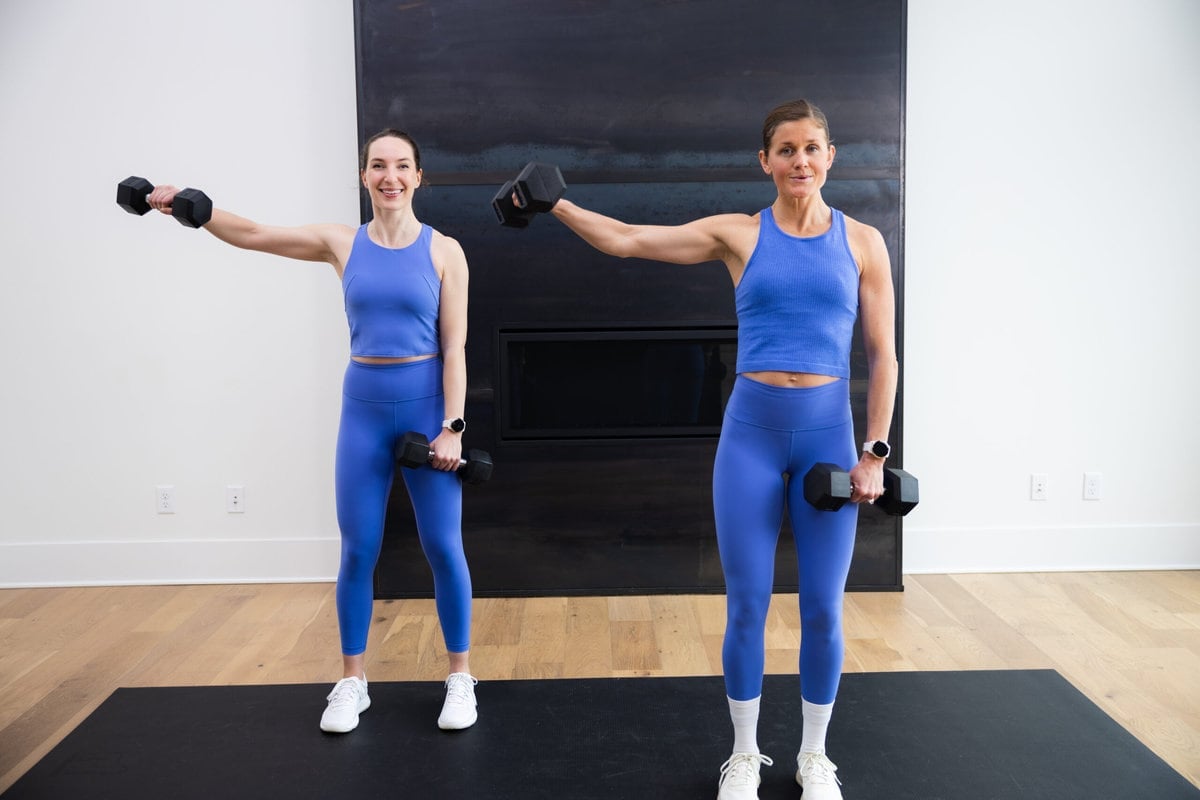
            two women standing performing lateral raises as part of upper body hIIT workout

            35-Minute Upper Body HIIT Workout

            Build upper body strength and raise your heart rate in around 35 minutes with this upper body HIIT workout.

            Add upper body workouts like this one to your home training program 1-2 times a week to build muscle mass and increase endurance.

            Workout Equipment:

            Medium to Heavy Set of Dumbbells. I suggest anywhere from 8-25 lbs. I used 15-20 lb dumbbells for this arm workout.

            Workout Instructions:

            Follow along with the guided HIIT Arm Workout video on YouTube, led by certified personal trainer, Lindsey Bomgren. 

            Your Workout Looks Like This:

            • 3 Circuits (2-3 exercises per circuit)
            • Timed Intervals (perform each exercise for 30 seconds, then rest 10 seconds)
            • Repeat Each Circuit x3 Sets
            • Between Each Circuit is a Push Up and Cardio Push (30 seconds work, 10 seconds rest, repeat x2 sets)

            Note: we re-filmed this workout to improve video and sound quality (and changed up some of the moves). You can find the original best upper body HIIT exercises here if you’d like to compare them.

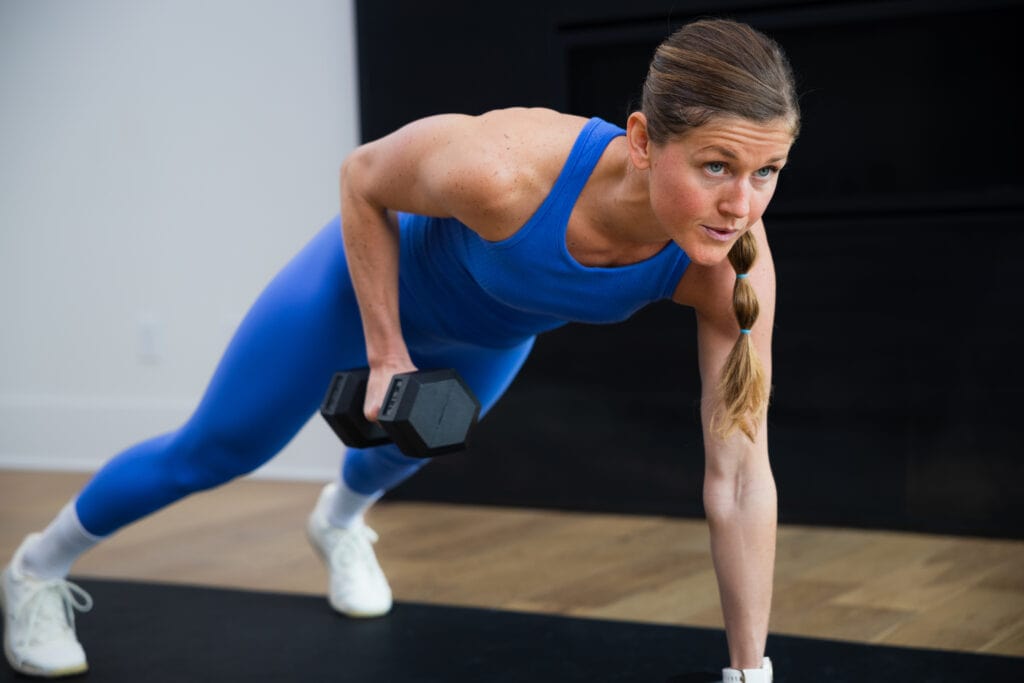
            woman performing a plank and row as part of upper body hiit workout

            Workout Outline

            CIRCUIT ONE: 

            1. Single, Single, Double Lateral Raise
            2. Overhead Tricep Extension
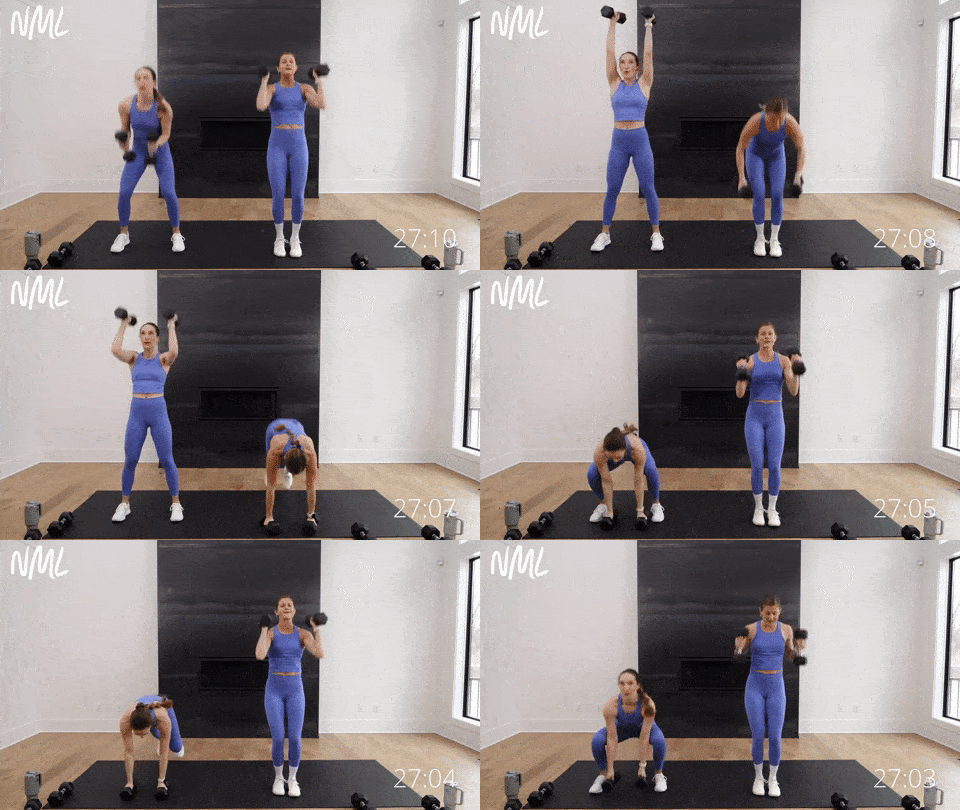
            3. Burpee and Push Press

            Push Ups and Cardio:

            1. Push Up and Dumbbell Drag
            2. Lateral Shuffle

            CIRCUIT TWO: 

            1. Single Arm Row
            2. W-Curls (Standard Curl and Wide Curl)
            3. Dumbbell Row, Clean and Overhead Press

            Push Ups and Cardio:

            1. Push Up and Dumbbell Row
            2. Ladder Drill

            CIRCUIT THREE:

            1. Woman Maker
            2. Halo and Vertical Press Out

            Push Ups and Cardio:

            1. Push Ups
            2. Mountain Climbers

            8 Best Upper Body HIIT Exercises

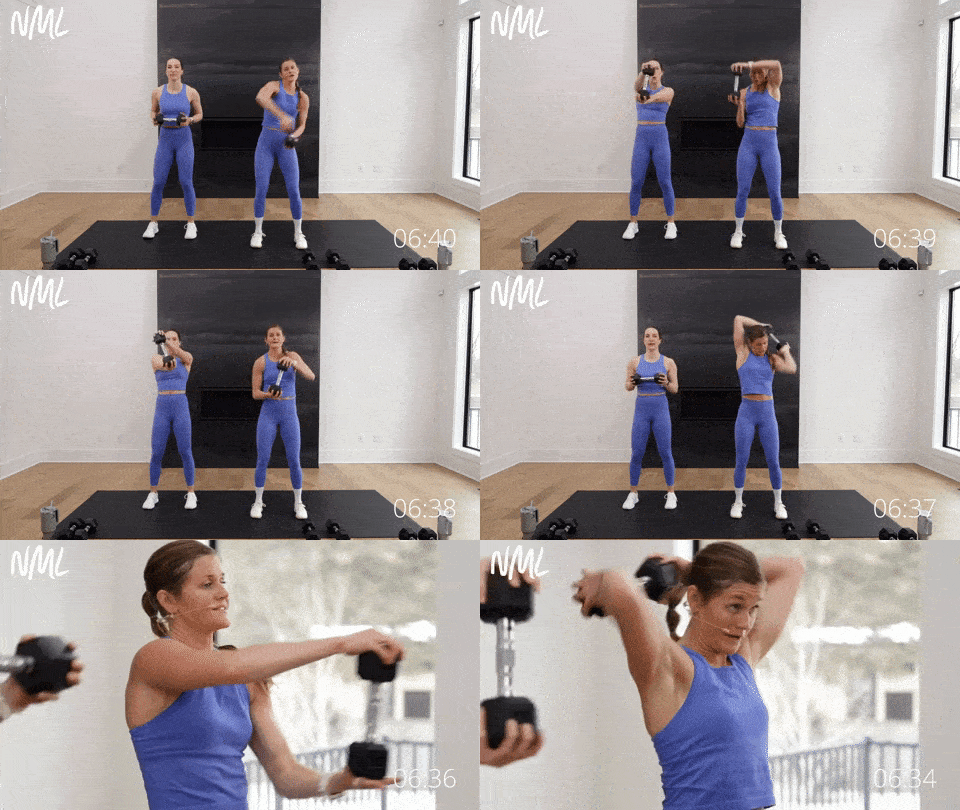
            Single, Single, Double Lateral Raise

            Targets: All three heads of the shoulder muscles — primarily the lateral head of the deltoid, but also engages the anterior and posterior heads (or rear delts).

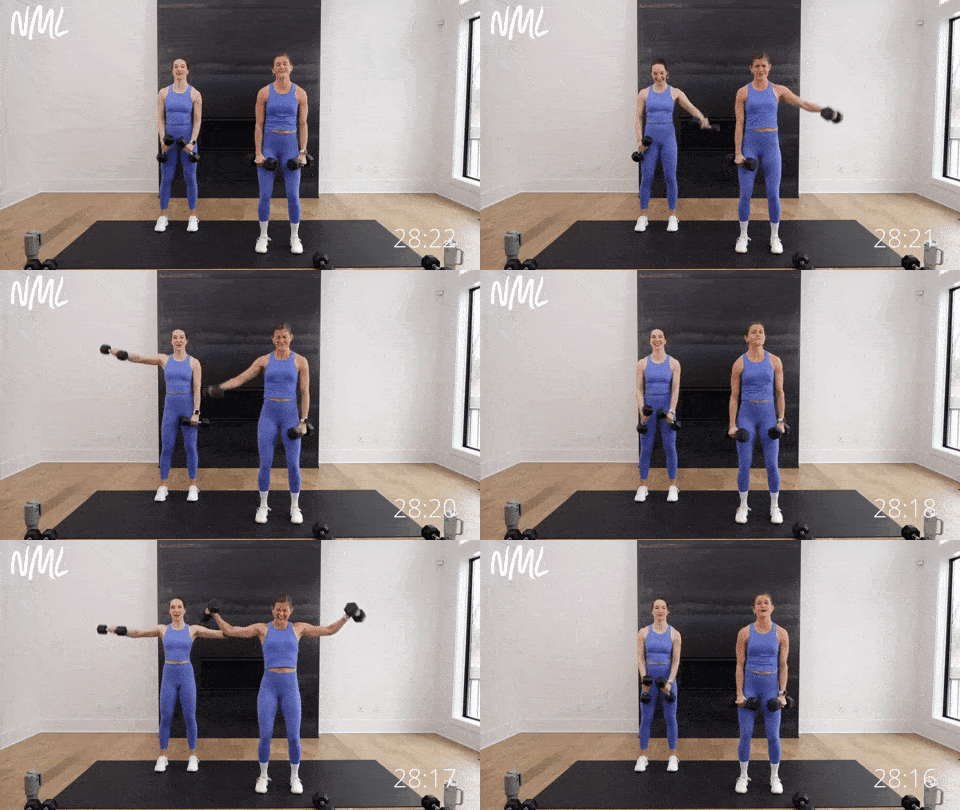
            two women performing lateral raises as part of upper body hiit workout

            How To Do Single, Single, Double Lateral Raises

            1. Stand with feet shoulder-width apart, slight bend in your knees, holding a dumbbell in each hand at hip level, palms slightly out.
            2. With a slight bend in each arm at the elbow, squeeze to lift the dumbbell in your right hand out towards the right in an arc shape, lifting to shoulder height. With control, lower the dumbbell to your hips.
            3. Repeat, this time lifting the dumbbell in your left hand out towards the left in an arc shape, before returning to starting position.
            4. Then, perform a “double” lateral raise by lifting both arms at the same time, raising the dumbbells out away from your body at approximately a 45-degree angle. Lift dumbbells just to shoulder height, then lower with control.

            Overhead Tricep Extension

            Targets: The triceps (back of the arm). This move also engages all the stabilizing muscles in the shoulders, core, glutes and lower back muscles.

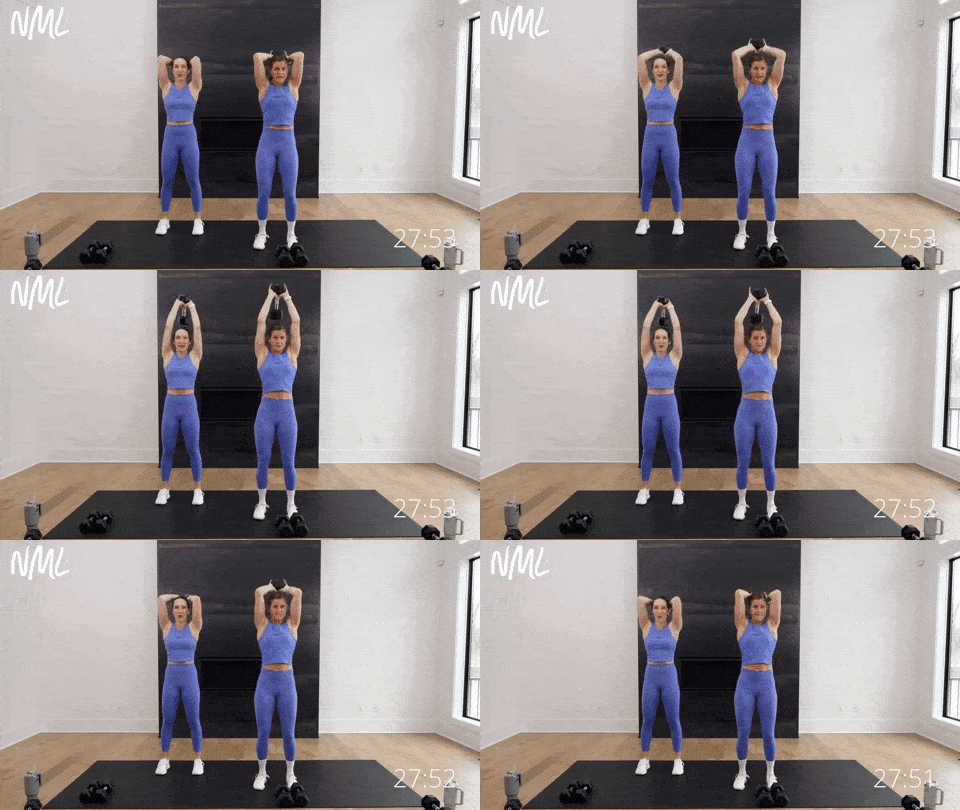
            two women performing overhead tricep extensions to target back of arm

            How To Do Overhead Tricep Extensions

            1. Start standing with feet hip-width apart, core engaged and knees slightly bent. Hold one dumbbell vertically between your palms overhead.
            2. Slowly bend your elbows to a 90-degree angle, bringing the dumbbell behind your head. Think ‘hide the dumbbell, show the dumbbell’, if you were watching yourself in a mirror. Keep your elbows close to your ears throughout the entire movement (don’t let your elbows flare out as you fatigue).
            3. Squeeze through the back of your arm as you exhale, pressing the dumbbell overhead, arms fully extended.

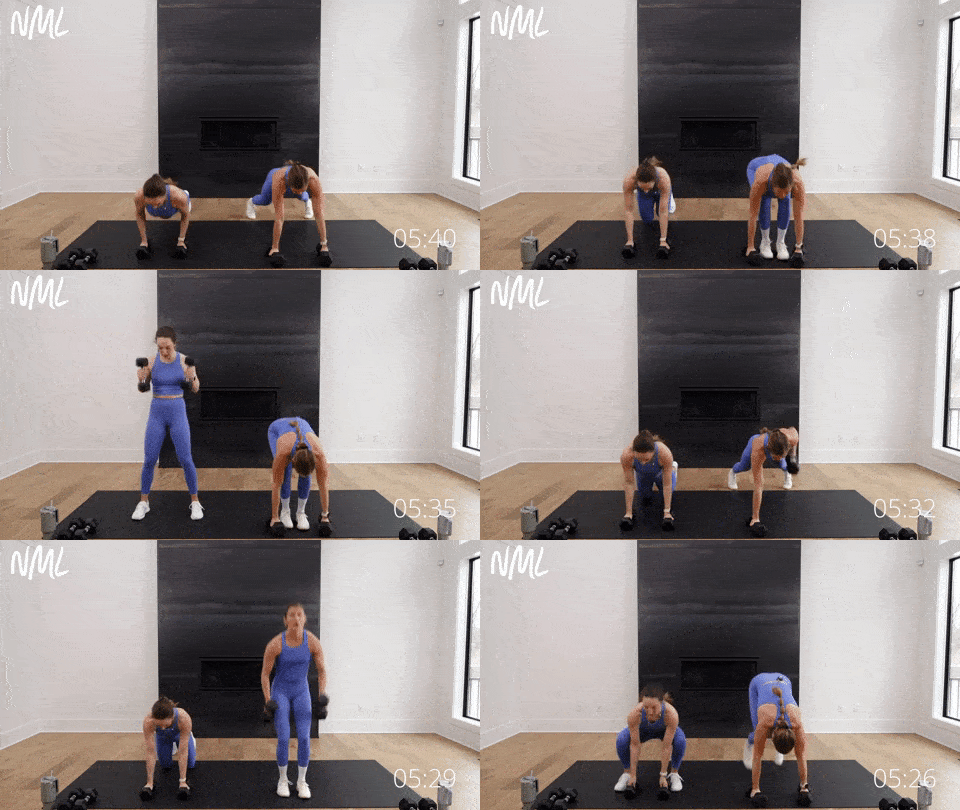
            Burpee and Push Press

            Targets: Shoulders, back, glutes, hamstrings, lower back, abs and core.

            This complex full body move adds explosive power to strength movements.

            two women performing burpee and push press upper body hiit exercise

            How To Do Burpees and Push Presses

            1. Stand with feet shoulder-width apart, holding a set of dumbbells in your hands with palms facing in towards each other at your hips.
            2. With a soft bend in the knees, hinge at your hips to lower your torso as you slide the dumbbells down in front of your legs to set the dumbbells on the ground on either side of your feet.
            3. Perform a burpee by jumping your feet back to high plank position. Hands remain on the dumbbells.
            4. Then jump your feet back in and immediately stand tall, driving through the heels as you pull the weights up towards your hips.
            5. Then, curl the dumbbells to shoulder height and perform two shoulder presses, dipping at the knees before pressing the dumbbells straight overhead.
            6. Reverse the curl, lowering the dumbbells to hip level and returning to starting position.

            Modification: Perform walking burpees by stepping in and out of plank. Alternatively, you could perform burpees from an incline by placing your hands on a chair or bench.

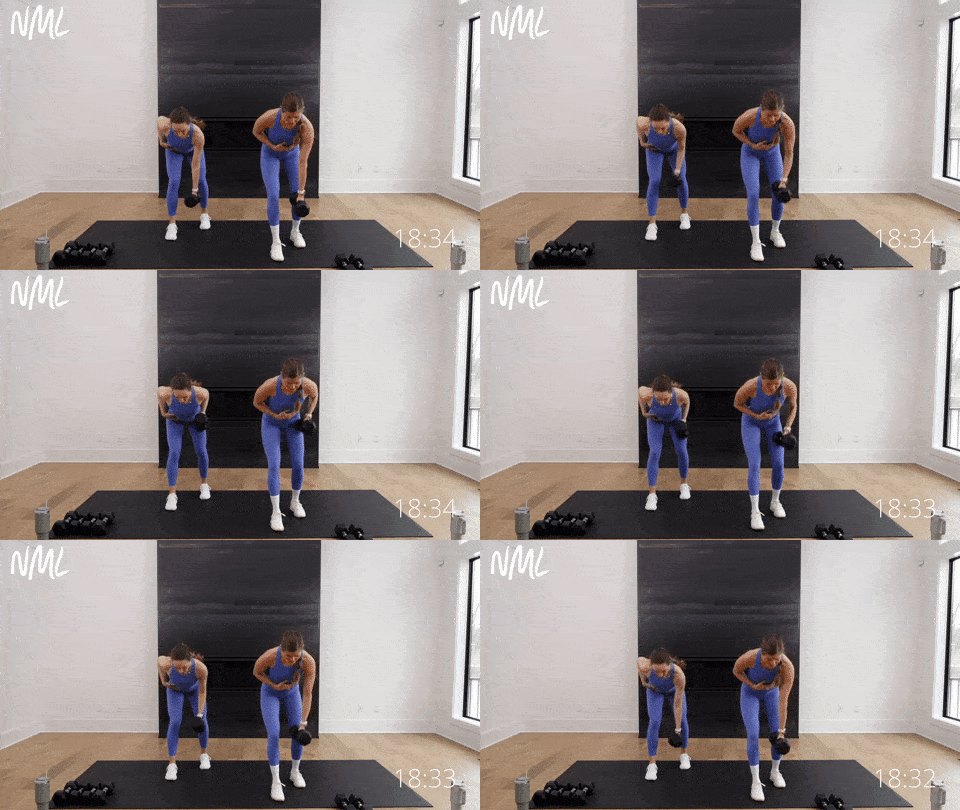
            Single Arm Row

            Targets: The latissimus dorsi (or lats); largest back muscle. This unilateral exercise also engages the bicep and core.

            two women performing single arm back rows with dumbbells

            How To Do Single Arm Rows

            1. Stand with your feet slightly wider than shoulder-width apart, knees slightly bent. Option to keep feet parallel or take a slightly staggered stance to better support your low back (stepping your right leg slightly behind your left leg).
            2. Hold a dumbbell in your right hand, palm facing in towards your opposite hand (neutral or narrow grip).
            3. Hinge forward at the hips maintaining a flat back, belly button pulled back towards your spine.
            4. Pull the dumbbell back towards your right hip (think of pulling from your elbow joint versus your wrist), as if you were starting a pull-start lawnmower. Stop once your elbow is in line with your rib cage, making a straight line from shoulder to elbow. Hold the row at the top for a moment squeezing your shoulder blade in.
            5. With control, lower the dumbbell back to the starting position and repeat. This is a slow deceleration of the weight through the full range of motion.

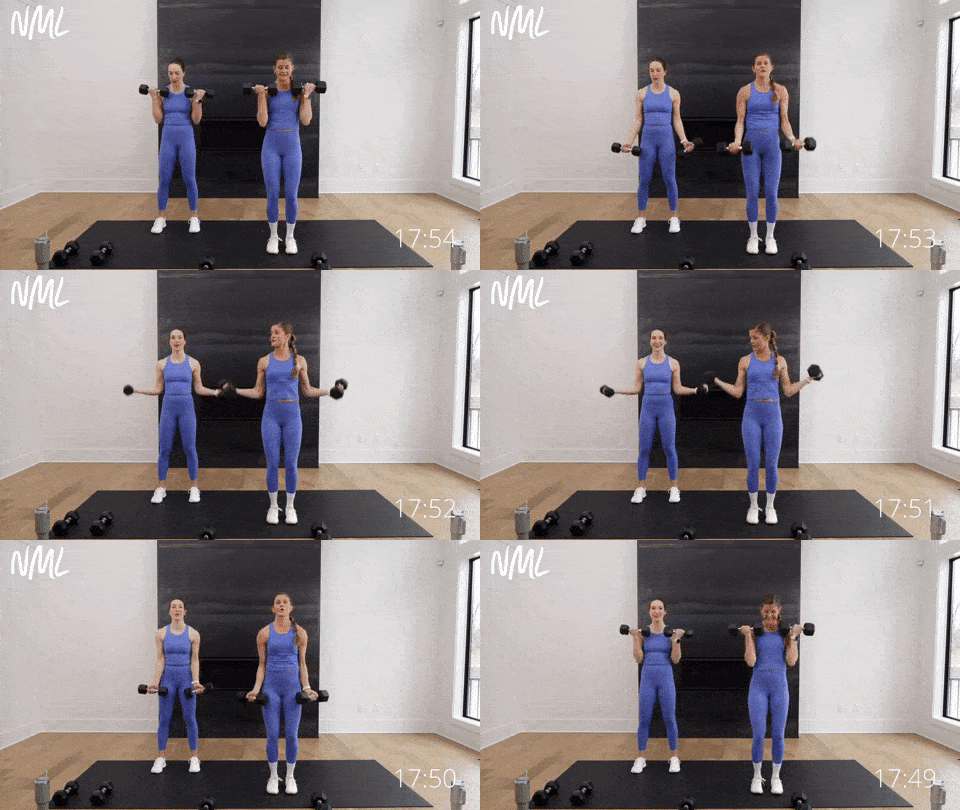
            W-Curls (Standard Bicep Curl and Wide Bicep Curl)

            Targets: The muscles of the forearms, the biceps muscles and rotator cuff.

            The external rotation through the shoulder joint also strengthens the rotator cuff muscles and increases shoulder stability.

            two women performing bicep curls as part of upper body hiit workout

            How To Do Standard and Wide Bicep Curls

            1. Start with feet under hips, core engaged. Hold a dumbbell in each hand in front of you at hip height, elbows by your waist, and palms facing up towards the ceiling.
            2. Curl the dumbbells up to shoulder height, keeping your elbows in place.
            3. With control, lower the dumbbells to your hips.
            4. Then, open through the chest as you rotate the dumbbells out towards the corners of the room, each palm about 45 degrees away from your body.
            5. Hold this external rotation as you curl the dumbbells up towards your shoulders, before lowering to to your thighs (performing a wide bicep curl).
            6. Rotate through the shoulders to pull the dumbbells back in front of your body, returning to starting position.

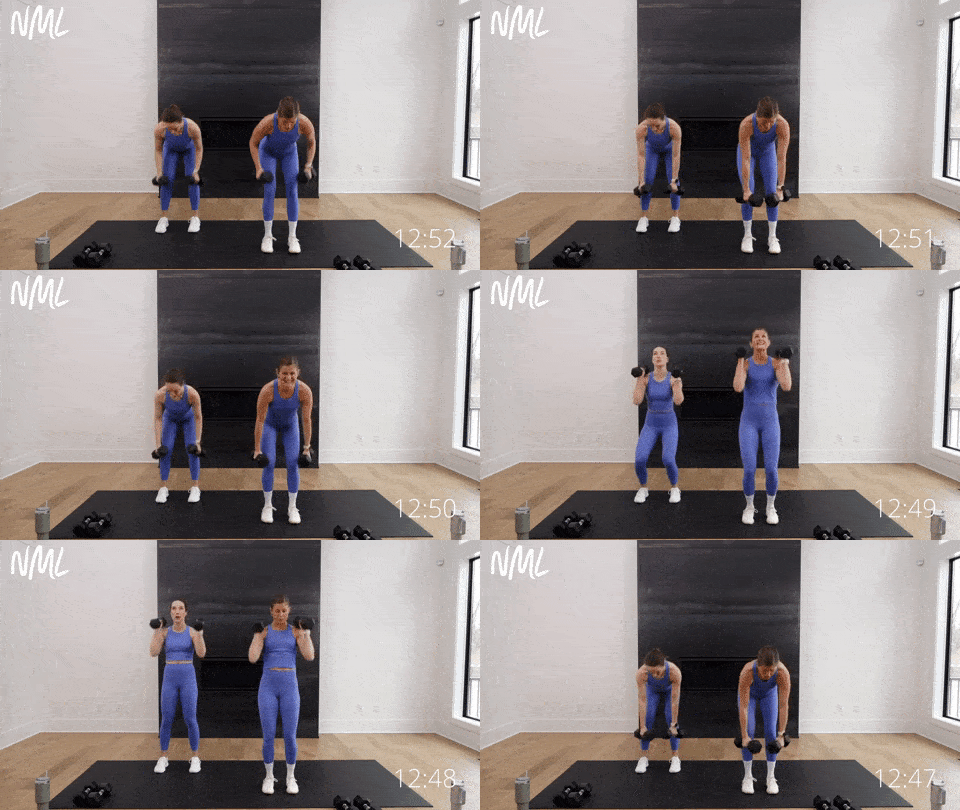
            Dumbbell Row, Clean and Overhead Press

            Targets: The lower back and upper back (specifically the lats and rhomboids), hamstrings, hips, glutes, core and shoulders.

            two women performing dumbbell row, clean and press as part of upper body workout

            How To Do Dumbbell Rows, Cleans and Overhead Presses

            1. Stand with feet hip-width apart, knees slightly bent. Hold one dumbbell in each hand at your hips, palms facing in towards each other.
            2. Hinge forward at the hips, then “row” the dumbbells towards your torso, pulling your elbows towards your ribcage then lowering with control. Repeat twice, performing two narrow rows.
            3. Then, drive through your heels to return to standing, “cleaning” the dumbbells up towards your shoulders. Your heels may pop off the ground. Think about “getting under” the dumbbell to catch it — this is a dumbbell clean. Catch the dumbbells at your shoulders.
            4. Bend your knees, lowering 2-3 inches and then straightening the knees as you push the dumbbells overhead, arms extended straight over shoulders. With control, lower dumbbells back to shoulders.
            5. Repeat this sequence, alternating two back rows with a dumbbell clean and an overhead press.

            Woman Maker (Push Up, Row, Squat, Curl and Press)

            Targets: Quads, glutes, hamstrings, back, chest, biceps, triceps, shoulders and core.

            A big, full-body movement to build strength while also getting your heart rate up.

            two women performing complex upper body hiiit exercise: the woman maker

            How To Do Woman Makers

            1. Start in a high plank position, both hands on your dumbbells, shoulders stacked over wrists, core engaged.
            2. Perform a push up by lowering your chest to the ground, letting your elbows fall back towards your hips, then exhale, pushing back up to starting position.
            3. Then, perform a single arm plank row (or renegade row) on each side, pulling first your right elbow to right hip, then planting it on the ground and pulling left elbow to left hip before returning it to the ground.
            4. Then, step or jump your feet up to meet your hands, landing in a low squat position.
            5. Press through your heels to stand tall, pulling the dumbbells up your body as your hips drive forward.
            6. As you stand, curl the dumbbells up to shoulder height, then press overhead, stacking dumbbells over shoulders and keeping your core tight.
            7. Reverse the movement, bringing the dumbbells back to shoulder height, lowering the dumbbells to your hips, and bending your knees to lower into a squat.
            8. Plant the dumbbells on the mat between your feet at the bottom of your squat, and step or hop your feet back, landing in high plank position.

            Modification: Step your feet in and out of plank position rather than jumping. And take push ups and rows from your knees.

            Halo and Vertical Press Out

            Targets: Shoulders, low back, and abdominal muscles.

            This is also a great exercise to increase shoulder mobility.

            two women performing dumbbell halos to target shoulder muscles

            How To Do Dumbbell Halos and Vertical Press Outs

            1. Stand with your feet under hips, holding a dumbbell vertically at your chest, right hand at the top head of the dumbbell and left hand at the bottom head of the dumbbell.
            2. Brace your core and perform a dumbbell “halo,” pulling the dumbbell in a smooth motion towards your left shoulder and then behind and around your head, ending with the dumbbell centered and vertical at your chest. Left hand is now at the top head of the dumbbell.
            3. Then, press the dumbbell away from your body, keeping it in line with your shoulders. With control, return the dumbbell to your chest.
            4. Repeat, this time changing halo directions. Pull the dumbbell towards your right shouler then behind and around your head, ending with the dumbbell centered and vertical at your chest, right hand on top.
            Upper Body HIIT Workout FAQs

            Pin this: Upper Body HIIT Workout for Women

            Decorative pin for pinterest - a woman performing a dumbbell halo with text overlay describing hiit arm workout for women

            This post includes affiliate links. I do make a small commission for products purchased using these links (at no additional cost to you). Thank you for supporting Nourish Move Love, making the content you see on this blog possible.

            #35Minute #Upper #Body #HIIT #Workout #Video

          3. The 5 Best and 5 Worst Machines at the Gym for Muscle Growth

            I have a strange habit when I train at a new gym. One of the first things I do is look around at how much space is occupied by worthless equipment. It’s my way of “grading” the place. You see, not all gym machines are created equal. There is a continuum from best to worst. And if lame equipment fills every corner, there’s no room for the good stuff.

            The problem is, what is the good stuff? Of course, there are the bodybuilding staples everyone knows and loves, but other machines are underrated or falsely villainized for no reason.

            In this article, I dissect the gym machine landscape, unveiling the top five winners who excel at muscle growth alongside the bottom five who only take up space. Whether you’re a gym vet or just starting, this guide will help you navigate the flooded gym floor, maximizing your muscle gains and time.

            Table of contents:

            • The 5 Best Machines at the Gym for Muscle Growth
            • The 5 Worst Machines at the Gym for Muscle Growth
            • Pros and Cons of Machine Training
            • Tips to Get the Most Out of Machine Training

            The 5 Best Machines at the Gym for Muscle Growth

            Let’s start on a positive note. Here are five of the best gym machines for muscle growth. A few may surprise you.

            1: The Smith Machine

            smith machine

            The Smith machine is on almost every list. However, it is usually in the worst category, which isn’t right.

            Dumping on the Smith machine is nothing new. Trainers have been doing it for years. I probably did, too, at some point. If so, I’m sorry because I was wrong.

            The Smith machine is one of the best muscle-building machines at the gym. There, I said it. And the most significant benefit is actually what people use to discredit its ability to build muscle—stability.

            It’s no secret that the Smith machine is more stable than a barbell. In a sports or functional context, this is a disadvantage because you want to train all of the little stabilizing muscles. However, getting jacked is not as clear. Many people find that a Smith machine allows them to get a better mind-muscle connection on the target muscle. For example, not balancing the bar on a shoulder press allows them to focus more on pressing with their shoulders.

            Keep in mind that I’m not comparing a barbell to a Smith machine. Data suggests that barbells are still king when it comes to muscle activation.¹ free weights vs smith machine

            Figure 1: Schick, E. E., et al. (2010)

            However, in terms of machines, the Smith machine is hard to beat as a solid variation. I mean, you can train your entire body on it.

            My favorite Smith machine exercises include incline bench presses, seated shoulder presses, single-arm shrugs, rows, standing calf raises, hip thrusts, and Bulgarian split squats. Throwing one of these exercises into your routine will provide a nice variation to keep things interesting.

            2: Cable Machine

            cable tower

            The cable machine has to be on the list. Like the Smith machine, it’s one piece of equipment that can train the entire body. Moreover, the cable’s design ensures that resistance remains consistent throughout the range of motion, creating a continuous tension that maximizes muscle engagement. Constant tension is arguably the most significant advantage of cable machines. In many free-weight movements, like the dumbbell lateral raise, gravity causes the strain to be higher at different points in the lift. That’s not the case for cable lateral raises.

            It could be a placebo effect or a product of the constant tension, but I always get nasty pumps on cable machines. I like to end most upper-body sessions with one or two cable exercises.

            Cables are great for arm and shoulder work, but as I said, you can train your entire body with a cable machine. If you need help with ideas, here are the 18 best cable machine exercises.

            3: Hack Squat

            hack squat

            The hack squat might be one of the most underrated pieces of equipment in the gym. Yes, it’s less versatile than the first two machines on the list, but it’s excellent at what it does. The hack squat is one of the quintessential muscle-building leg machines in the gym. It allows you to load up substantial weight in a fixed motion, targeting the quads while engaging the glutes and hamstrings in a way that’s typically safer and more controlled than free-weight squats. This safety feature is especially true for those with lower back issues.

            My favorite aspect of a hack squat is it allows lifters to train close to failure without the balance concerns inherent in traditional squats. Since we know training close to failure is vital for muscle building, it’s hard to argue the value of the hack squat.

            4: Chest Supported Row

            chest supported row

            I may like the chest-supported row more than most. It’s one of my favorite machines because it hits the upper back hard while minimizing strain on the lumbar region. After deadlifting, the last thing I want to do is barbell rows. That is a recipe for lower back pain.

            Aside from safety, another benefit of the chest-supported row is that it’s hard to cheat. Many back exercises, particularly rows, are commonly butchered. People cut their range of motion, use every muscle but their back, and then wonder why they can’t build muscle. Sound familiar?

            Stabilizing the chest against the pad allows for a full range of motion without sacrificing form. Keeping your chest against the pad makes using momentum to move the weight almost impossible. This targeted approach ensures that the upper back muscles, including the lats, traps, and rhomboids, are maximally engaged throughout each rep.

            With the abundance of back machines in most gyms, this machine is easy to overlook. Don’t make that mistake.

            5: Pullover Machine

            pullover machine

            (Image courtesy of Morning Lifter YouTube)

            You may have never used a pullover machine. It’s a shame, but old-school pullovers are rare these days. I haven’t seen one in a gym in years. However, if I walk into a gym with one, I must use it. Even if I’m training legs, I will throw in a couple of sets at the end. If you see one out in the wild, follow my lead and use it.

            A favorite of six-time Mr. Olympia Dorian Yates, the pullover machine is a unique back exercise that isolates the lats while minimizing biceps involvement. Think about it: what is the weak link in most back exercises? It’s the biceps. Often, your arms fatigue before your lats do.

            We need to start a movement to bring back pullover machines. It’s easily a top-five muscle-building machine, even though most gyms don’t have one. Few back exercises train the lats in this range of motion. It’s excellent for back and chest development, the serratus, and shoulder mobility.

            https://www.youtube.com/watch?v=31rj9eAVLt8


            The 5 Worst Machines at the Gym for Muscle Growth

            Okay, now let’s get to the fun part. Here are five machines you won’t catch me dead on. I’m joking but also kind of serious.

            1: Vertical Leg Press

            vertical leg press

            (Image credit to Titan Fitness)

            The leg press. Oh boy, where do we begin? Do you want to know what’s worse than a regular leg press? A vertical leg press.

            Look, I have a love-hate relationship with these machines. I wouldn’t say I like most leg presses, but a few are serviceable. The vertical leg press is not one of them. It’s easily the worst.

            While seemingly appealing for its uniqueness and ease of use, the vertical leg press machine lacks traditional leg press machines’ biomechanical advantages and safety features. Its upright position places excessive strain on the lower back and spine, increasing the risk of injury, particularly for individuals with preexisting back issues. Additionally, the limited range of motion and lack of proper support diminish its effectiveness in targeting the lower body muscles, ultimately making it a suboptimal choice for leg strength and muscle building.

            What to do instead: Back Squat, Front Squat, Hack squat, belt squat, goblet squat, Bulgarian split squat, lunges, or regular leg presses

            2: Seated Ab Rotation

            ab rotation machine

            (Image credit to MuscleD Fit)

            If you are unfamiliar with the seated ab rotation machine, it’s the one where you sit down and twist side to side against resistance. It’s not a terrible exercise, but it falls under what I consider a waste of space. There are too many better exercises that do the same thing.

            If you want to train your obliques, pick one of the exercises below.

            What to do instead: Band or Cable Palof Press, Bicycle Crunches, Medicine Ball Russian Twists, Weighted Side Bends, Side Plank, Suitcase Carries

            3: Reverse Hyper

            reverse hyper

            (Image credit to Mathias Method)

            A reverse hyper is a specialized machine designed to target the posterior chain. It’s unique because it allows the legs to move in a controlled arc behind the body while the torso is supported on a padded platform. Powerlifting legend Louie Simmons of Westside Barbell created it.

            There was a time when saying anything bad about the reverse hyper would have kicked me out of the fitness industry. Luckily, I think that time has passed. RIP, Louie Simmons, but the reverse hyper is one of the most overrated machines in the gym. Joe Rogan played a part in this. Years ago, he used to sing the praises of the reverse hyper on his podcast, saying it cured his back pain.

            While it may strengthen the lower back and glutes to some extent, it lacks the muscle activation capacity of other exercises like back extensions, leg curls, or hip thrusts, which are more effective for overall muscle development.

            In a 2019 study comparing a back extension with a reverse hyper, muscle activity was significantly greater in back extensions for the glutes and hamstrings.²

            reverse hyper vs hyperextensions

            Figure 2: Lawrence, Michael A. (2019)

            If your gym happens to have a reverse hyper, the good news is that it makes an excellent standing desk for your training notebook and shaker bottle.

            What to do instead: Weighted Back Extensions, Glute Ham Raises, Leg Curls, Romanian Deadlifts, hip thrusts

            4: Ab Coaster

            ab coaster

            This one might make a few people mad. The ab coaster has a dedicated fan base. If you know how to use it correctly, it can be effective. The problem is that 90% of people do it wrong. Most people swing back and forth, letting momentum take over. Doing it this way is entirely ineffective for your abs. At this point, it is little more than an amusement park ride.

            Using it correctly involves contracting your abs to raise yourself from the starting position, lowering yourself under control, and stopping. Don’t let momentum keep you moving. For every repetition, begin at a dead stop. Even then, a cheap $10 ab wheel is better.

            What to do instead: Ab Wheel, Plank, Weighted Sit Ups, Decline Sit Up, Cable Crunches, Hanging Leg Raises

            5: 4-Way Neck Machine

            4 way neck machine

            (Image credit to CSCCa)

            I once trained at a gym with limited floor space, but they had a huge Hammer Strength 4-way neck machine. The machine literally took up as much space as a small squat rack. I trained at this place for three years and never saw anyone use the neck machine – not one person.

            Look, this is not me bashing neck training. A thicker neck can be an impressive feature of your physique. And if you are involved in grappling sports, a strong neck is a must. That said, I can’t think of a bigger waste of gym space than a neck machine.

            A well-rounded neck program should include neck curls and weighted neck extensions with a harness. That’s it. No machines are necessary.

            What to do instead: Weight Plate Neck Curls, Weight Plate Neck Extensions, Neck Harness Extensions.

            Bonus: Your Cell Phone

            Okay, I know a cell phone is not a piece of gym equipment, but hear me out. We must prevent our phones from ruining our workouts.

            I’m not old, but no one took their cell phone out on the gym floor when I started training. We kept it in the locker room. Before you applaud, leaving a Nokia Track phone in your locker doesn’t take much self-discipline. As you can imagine, the smartphone has changed everything.

            via GIPHY

            Scrolling wastes time and is distracting. The good news is that there is an easy fix to this problem. And, no, you don’t need to leave your phone in the locker room.

            I want you to start timing your workouts. In fact, you can use your phone to do this. As soon as you start training, begin the clock. When you finish the last set, hit stop and record the time. Just being mindful that you are timing the workout helps limit phone use.

            It’s not a race, but most workouts should only take 60-90 minutes. If you take considerably longer than this, you spend too much time on Instagram and TikTok. Please stop it. Your workouts will be more effective if you do.

            What to do instead: During a workout, only use your phone for music and as a timer. Track your workouts the old-school way in a composition notebook. Trust me, that text can wait.

            Pros and Cons of Machine Training

            A 2023 study showed no differences between free weights and machines in terms of muscle-building potential.³ The researchers concluded that it comes down to personal preferences. That said, machine training does have advantages and disadvantages. Here are a few to keep in mind.

            Pros

            • Safety: I have a rule. If I’m going to get hurt in the weight room, it can’t be on an assistance movement. Of course, you never want to get injured. But, if you are going for a new max on a squat, bench press, or deadlift, at least you got hurt going for something big. On the flip side, it’s not worth it if you get banged up doing a skull crusher (how do you think it got that name?) or a barbell row. There are too many good machine exercises you could have done instead.
            • Ease of Use: Machine exercises are easy to learn. Even a beginner can jump on a machine and do it right on the first or second try. As an intermediate or advanced lifter, since machines are easy to use, your form is less likely to break down when you get fatigued. This feature is valuable toward the end of a hard workout.

            Cons

            • Does Not Fit Your Body Properly: I’m a relatively short guy. For most things in the weight room, this is an advantage. However, some machines don’t fit me well. I’m sure tall people have the same problem in the other direction. That said, if you spend time adjusting the machine, you can mitigate much of the problem.
            • Limited Amount of Weight: If you are freakishly strong, you can run out of weight on some machine and cable exercises. It’s not a problem many people face, but it’s a problem we all should strive for.

            Tips to Get the Most Out of Machine Training

            Here are my three favorite ways to utilize machine training.

            1. Train Close To Failure

            As mentioned, machines are relatively safe. So, take advantage of their safety and train close to failure. For example, pushing a set of hack squats close to failure is much safer than doing that with back squats.

            2. Use Drop Sets

            With machine training, quickly changing weights is easy. Take advantage of it and incorporate drop sets. I like to reduce the weight by 50% and double the reps. So, if my set were 100 pounds for 10 reps, I would cut the weight to 50 pounds on the drop set and aim to do 20 reps.

            3. Use Supersets

            Similar to drop sets, machine training makes it easy to do supersets. The key is picking two machine exercises next to each other. One of my favorite supersets is a cable curl with a cable triceps press down. These two exercises are complementary, so while you are doing curls, your triceps get rest, and when you are doing press downs, your biceps get rest.

            Wrap Up

            Well, there you have it – the best and worst exercise machines for building muscle. Understanding the nuances of gym machinery is paramount in crafting an effective muscle-building program. While some, like the Smith and cable machine, stand out for their versatility and effectiveness, others, like the vertical leg press and seated ab rotation, fall short. If you prioritize the best machines and limit the worst, you will be well on your way to a better physique.

            Are you looking to start a new workout program? We created the ultimate hypertrophy program to take your physique to the next level.

            References:

            1. Schick, E. E., Coburn, J. W., Brown, L. E., Judelson, D. A., Khamoui, A. V., Tran, T. T., & Uribe, B. P. (2010). A comparison of muscle activation between a Smith machine and free weight bench press. Journal of strength and conditioning research, 24(3), 779–784.https://doi.org/10.1519/JSC.0b013e3181cc2237
            2. Lawrence, Michael A.1; Chin, Andrew2; Swanson, Brian T.3. Biomechanical Comparison of the Reverse Hyperextension Machine and the Hyperextension Exercise. Journal of Strength and Conditioning Research 33(8):p 2053-2056, August 2019. | DOI: 10.1519/JSC.0000000000003146
            3. Haugen, M.E., Vårvik, F.T., Larsen, S. et al. Effect of free-weight vs. machine-based strength training on maximal strength, hypertrophy and jump performance – a systematic review and meta-analysis. BMC Sports Sci Med Rehabil 15, 103 (2023). https://doi.org/10.1186/s13102-023-00713-4

            #Worst #Machines #Gym #Muscle #Growth

          4. These New Cloudpulse Sneakers Move to the Sound of their Own Beat

            On is stepping into the training sneaker market and has now released the “Cloudpulse.” The brand says that the shoe’s innovative technology separates it from other footwear in this space because it is inspired by the movement of a cardiogram. Let’s take a closer look.

            On explains that the Cloudpulse is designed to give total stability while remaining flexible for different types of workouts. Available for both men and women, this lateral stability for side-to-side movements is made possible thanks to the company’s signature “Helion” foam, which also provides a “springy” feeling making them a great choice for stop-start style workouts such as HIIT.

            For temperature control, the Cloudpulse is equipped with a breathable upper mesh and something called a “Speedboard” in the base, to support angular movement.  The combination of flexibility and stability makes these shoes ideal for both weights and cardio says On, and if you want to support environmentally friendly products, the Cloudpulse’s upper mesh is made from 100% recycled polyester. In total these shoes are constructed from around 24% recycled content.

            On Cloudpulse training sneaker
            Courtesy of ON

            Who Would On’s Cloudpulse Training Shoes Suit?

            The Cloudpulse is aimed at athletes in and out of the gym, designed for cardio, resistance training, and HIIT style workouts. There is a midsole drop of 8mm, constructed to push your foot forward to support a more natural mid/forefoot strike. On say that this shoe gives great energy return and offers “Missiongrip” multidirectional lugs in the tread to offer great grip on a range of different surfaces. The also brand says that fitting is true to size.

            The Cloudpulse uses a standard lace-up system and is available in several colorways, priced at $149.99 direct form on.com.

            #Cloudpulse #Sneakers #Move #Sound #Beat