Fitness can be depicted as a condition that helps us with looking, feel and set forth some courageous energy. Real Fitness incorporates the presentation of the heart and lungs, and the muscles of the body.
It’s one thing to be a world-class athlete, and it’s another to be successful on the media side of sports. Imagine doing both at the same time. That has been what Wendy Fortino has been doing for the last couple of years now. The IFBB Pro League Figure competitor has been a host of several shows such as WOLFPak Live, Olympia TV and Femme Flex Friday as well as competing as an active athlete.
The 2024 Triple O Dynasty Pro Figure winner will be back on the Olympia stage for the eighth time in her career when she competes in Las Vegas, NV on Oct. 11th and 12th.
“I feel better than ever physically, mentally, and emotionally,” Fortino said. “I’m ready for the Olympia.”
Wendy Fortino Olympia Figure Pro Workout
Even while working on her career on the media side, she is going all in on her 2024 Olympia prep, as shown by her back training. She leaves no stone unturned and no muscle untouched in this high-volume, 10-exercise routine.
Deadlifts
4 sets of 6-8 reps, 2-3 minutes rest between sets
The deadlift is a bread-and-butter exercise for all fitness disciplines. Yes, most people consider it a power move, but it does have its place in bodybuilding as well. Don’t be afraid to lift heavy but do so without letting the ego take over.
“Aim to slightly increase the weight, reps, or sets every one to two weeks. For instance, if you’re performing deadlifts with 200 pounds for six reps, try adding 5-10 pounds next week or increasing your reps to eight.
Bent-Over Barbell Rows
4 sets of 8-10 reps, 1.5-2 minutes rest between sets
Rows are very beneficial for muscle density, size, and even shape. Fortino’s first rowing exercise is a barbell version. You could go heavy on this too but remember why you’re doing it to begin with – to build muscle, not move weight.
“Keep your back straight during bent-over rows and maintain a controlled motion throughout each rep.”
Single Arm Dumbbell Rows
3 sets of 10-12 reps, 1.5 minutes rest between sets
Dumbbell rows allow you to focus on each side individually. Bodybuilding is about symmetry, and that is crucial for Figure competitors. A full range of motion and stretch at the bottom will make this even more effective. Fortino is an advocate for this.
“A full range of motion ensures that all parts of the muscle are worked, improving both strength and muscle growth.”
Close Grip Lat Pulldowns
3 sets of 10-12 reps, 1.5 minutes rest between sets
After three consecutive free weight movements, it’s time to show some love to machines and cables. Pulldowns allow you to target the entire upper back, but the grip dictates where you will feel it the most. The close grip will be beneficial for the lats.
Fortino instructed, “For exercises like lat pulldowns, fully extend your arms and squeeze your shoulder blades together at the bottom of the movement.”
Seated Cable Low Rows
4 sets of 10-12 reps, 1.5 minutes rest between sets
Seated rows are underrated for back development, but many lifters do it wrong by shortchanging the negative portion of the reps and using momentum to jerk the weight back.
“Pull the weight all the way to your torso and extend fully,” Fortino advised. She also believes in controlling the reps with a planned speed.
“Use a 2-1-2 tempo (2 seconds to lift, 1 second pause at the top, 2 seconds to lower) for exercises like barbell rows or lat pulldowns. This controlled movement ensures you’re not relying on momentum and focuses the work on the targeted muscles.”
Straight-arm Pullover
3 sets, 12-15 reps, 60- to 90-seconds rest between sets
Pullovers are not only beneficial for the development of the lats. They also help with athletic performance and mobility. Fortino advised that form over weight matters the most with an exercise like this.
“Proper form ensures that you’re targeting the intended muscles and reduces the risk of injury,” she explained. “Before increasing weight, master the correct technique for each exercise. Use a mirror or ask for feedback from a trainer if needed.
Underhand Lat Pulldown
3 sets, 10-12 reps, 90 seconds rest between sets
The underhand lat pulldown will be a very effective way to target the lower lats. Clearly, this is not a training session you should be trying to rush through, which is why Fortino included her rest times between sets.
“Stick to the recommended rest times between sets to allow your muscles to recover sufficiently.”
Unilateral Lat Pulldown
3 sets, 10-12 reps, 90 seconds rest between sets
Single arm pulldowns serve the same purpose as one arm rows, but you can maintain tension with a pulldown because of the cable. Squeezing the muscle in the contracted position and allowing a full stretch at the top is vital.
“This controlled movement ensures you’re not relying on momentum and focuses the work on the targeted muscles.”
Wide-Grip Lat Pulldown
3 sets, 10-12 reps, 90 seconds rest between sets
By this point, everything in the upper back has at least been targeted, but Fortino feels the wide grip pulldown is a nice way to etch in that detail and leave no doubt you did an effective workout.
“This plan offers a balanced approach, hitting the back muscles from multiple angles and ensuring a comprehensive workout.”
Back Extension
3 sets, 15-20 reps, 60 seconds rest between sets
The workout started with an exercise that can target the lower back, and it ends with one that will isolate that area. She uses a weight for this movement, but it is not necessary if you are a beginner or need to develop strength in that area first. Fortino is confident in what this workout can do for any lifter’s back development, but only if you execute them as she advised.
“By integrating these tips into your workout routine, you can enhance the effectiveness of your back training, promote muscle growth, and reduce the risk of injury,” Fortino advised. “Additionally, ensure you have at least 48 hours between intense back workouts to give your muscles time to repair and grow.”
Follow Fortino on Instagram @wendyfortino, and make sure you watch her as well as the rest of the greatest Figure athletes in the world during the 2024 Figure Olympia, a part of the 60th Olympia Weekend, by ordering the 2024 Olympia pay-per-view at mrolympia.com .
Pelvic floor health has been in the spotlight for the past few years, but the connection between it and sexual well-being is often overlooked and misunderstood. It plays a pivotal role in sexual function—from better muscle strength, better orgasms, and overall sexual health and wellness.
Celebrity Pelvic Floor Specialist & Fitness Expert Courtney Virden is the founder of the pelvic floor program iCORE Method. With years of experience treating complex pelvic floor conditions, sexual dysfunction, and musculoskeletal and sports conditions, Virden has a unique perspective on how to achieve overall sexual satisfaction and a more fulfilling sex life.
Her approach integrates targeted exercises and holistic strategies to improve orgasm quality, increase sensitivity, and boost arousal. She has even worked with celebrities like the Kardashians and brands like POOSH.
Virden explains how strengthening the pelvic floor can impact your overall sexual health and wellness and yes, that includes better orgasms for both men and women. (You may want to bookmark this section).
What Exactly is Pelvic Floor Health?
You may or may not have been aware of the importance of having optimal pelvic floor health. “Pelvic floor health means having strong, toned, and responsive muscles that can contract and relax as needed,” says Virden. “It also involves healthy fascia and open nerve pathways, ensuring the pelvic floor functions optimally.”
Pelvic floor health may seem like it would just be applicable to women, but Virden says it is actually crucial for both men and women. “When the pelvic floor muscles lack proper tone and alignment, it can lead to dysfunction. [On the other hand], if the pelvic floor is too tight, spasming, or unable to relax, it can result in a range of symptoms,” explains Virden. These may include sexual dysfunction, bladder and bowel issues, lower back pain, and discomfort during movement.
Virden continues and says that in men, this might manifest as erectile dysfunction or difficulty urinating, while women may experience pain during intercourse or urinary incontinence. “Maintaining a healthy pelvic floor, with muscles that are strong, toned, and able to contract and relax appropriately, is essential for preventing these issues and supporting overall physical well-being,” notes Virden.
Pelvic Floor and Sexual Health
How then does pelvic floor health relate to sexual health and wellness? “Pelvic health plays a significant role in sexual health and satisfaction,” says Virden. “In women, low tone and misalignment can reduce sensation and make it difficult to orgasm, while a hypertonic (too tight) pelvic floor can cause pain during penetration and [can] prevent climax. For men, pelvic floor imbalances can lead to ejaculation and erectile issues.”
What about orgasms? “Training the pelvic floor and restoring proper tone and tension can significantly enhance sexual satisfaction for both men and women,” shares Virden. “By achieving proper alignment, you can open up nerve pathways, which improves sensations.”
Virden explains that when it comes to better orgasms for women, proper pelvic floor tone can lead to better sensations and improved orgasmic ability and quality. On the other hand, for men, it can help with erectile function and ejaculation control. “Ultimately, this leads to more satisfying and fulfilling orgasms,” notes Virden.
Hero Images / Getty
How to Improve Pelvic Floor Health
Okay, so how do both men and women improve pelvic floor health? Virden offers a few exercises to try.
Exercise #1: Roll-Overs
Start in a deep squat behind a stability ball, balancing on your toes and the balls of your feet.
Wrap your body around the ball, pressing your pubic bone into it. This will help stretch and open up your pelvic floor, thighs, hips, and lower back.
Roll forward and backward, maintaining pressure on your pubic bone against the ball to deepen the stretch.
Tip: Be sure to keep your neck relaxed.
Exercise 2: Knee to Chest
Lie on your back on a mat.
Bend one knee with your foot on the ground, while the other leg rests on a stability ball.
Tilt your pubic bone forward toward your chest, lifting your glutes slightly off the mat into a pelvic tilt.
Bend the leg on the ball and roll the ball toward your shoulder, allowing the knee to drop and your foot to roll outward.
Return to the starting position and repeat on the other side.
Tips: Your lower back should stay relaxed and you should be in a pelvic tilt throughout the exercise. The leg on the ground should stay stable and your hips level to the ceiling.
The Importance of Pelvic Floor Health
As a pelvic floor expert, Virden says she cannot stress enough the importance of maintaining pelvic floor health for both men and women throughout their entire lives. “Preventative care can help avoid many issues, and most existing problems can be resolved with a proper pelvic floor program, like the iCORE Method app, without the need for surgery or enduring ongoing symptoms,” she says.
“The pelvic floor is the foundation of our trunk, and any instability here can lead to issues throughout the body. Just as you would not build a house on an unstable foundation, you should not train your body on an unstable pelvic floor.”
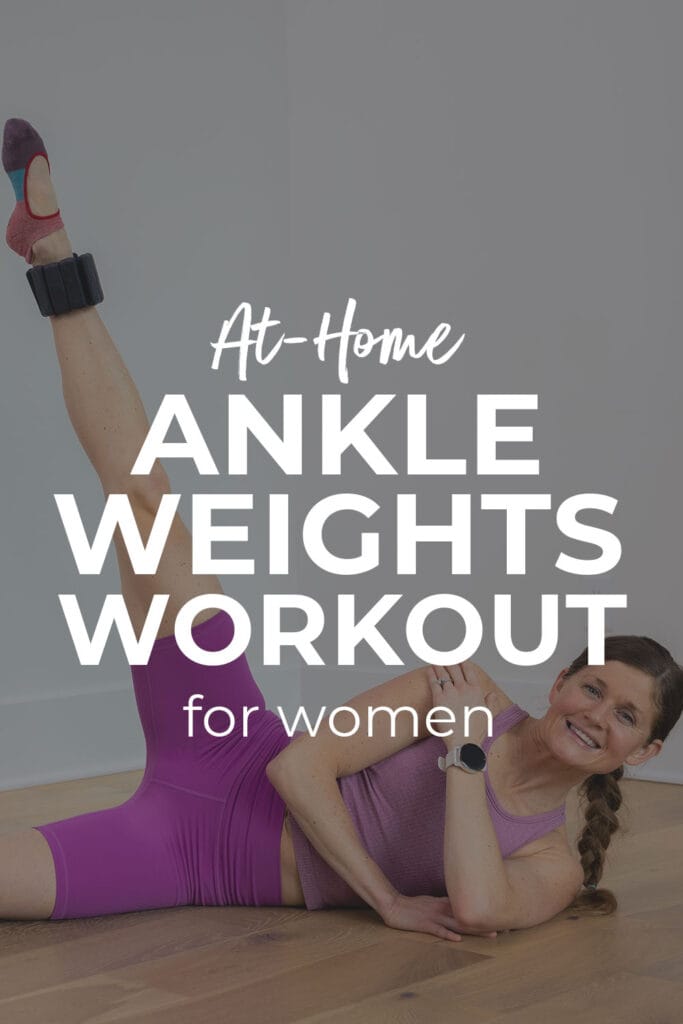
Strengthen, sculpt and tone with this barre-inspired ankle weight workout! This fusion-style workout combines the muscle-building benefits of high-rep strength training with the mobility and core strengthening benefits of barre. Option to perform with just your bodyweight, or add ankle weights for an extra challenge.
Strengthen and sculpt with this guided barre and ankle weights workout.
Barre classes typically involve a series of controlled movements that focus on strengthening the core muscles, improving posture, improving joint stability and increasing flexibility.
Using ankle weights creates extra resistance during each exercise to build strength and definition in the upper body, lower body and core.
Ankle weights are particularly well-suited for barre workouts, which typically include high repetitions of exercises such as leg lifts, lunges and leg curls.
30-Minute Barre Ankle Weight Workout
The best barre-inspired ankle weight exercises to build strength in the entire body and improve mobility.
Modifications are provided throughout this workout, making it accessible for both beginners and more advanced fitness enthusiasts.
The strength and mobility exercises in this full body workout provide an excellent way to increase core strength and control while working other muscle groups, such as the legs, back and arms.
Add full body workouts like this one to yourhome training program1-2 times a week to build muscle mass and increase endurance.
Workout Equipment:
Optional ankle weights. Otherwise you can perform this workout with just your bodyweight.
Flowing from mat to standing and back to the mat for an effective, full body ankle weight workout.
Workout Outline
Mat Sequence
Down Dog Series
Push Up Series
Arabesque Flow
Hamstring Curl Heel Stamps
Planks and Triceps
Standing Sequence
Power Lunge Series
Side Leg Lifts
Knee Tucks and Crunches
Chair Squats
Plié Series
Mat/Core Sequence
Plié Heel Taps
Boat Pose Series
90-Degree Heel Taps
Leg Lowers
5 Best Ankle Weight Exercises
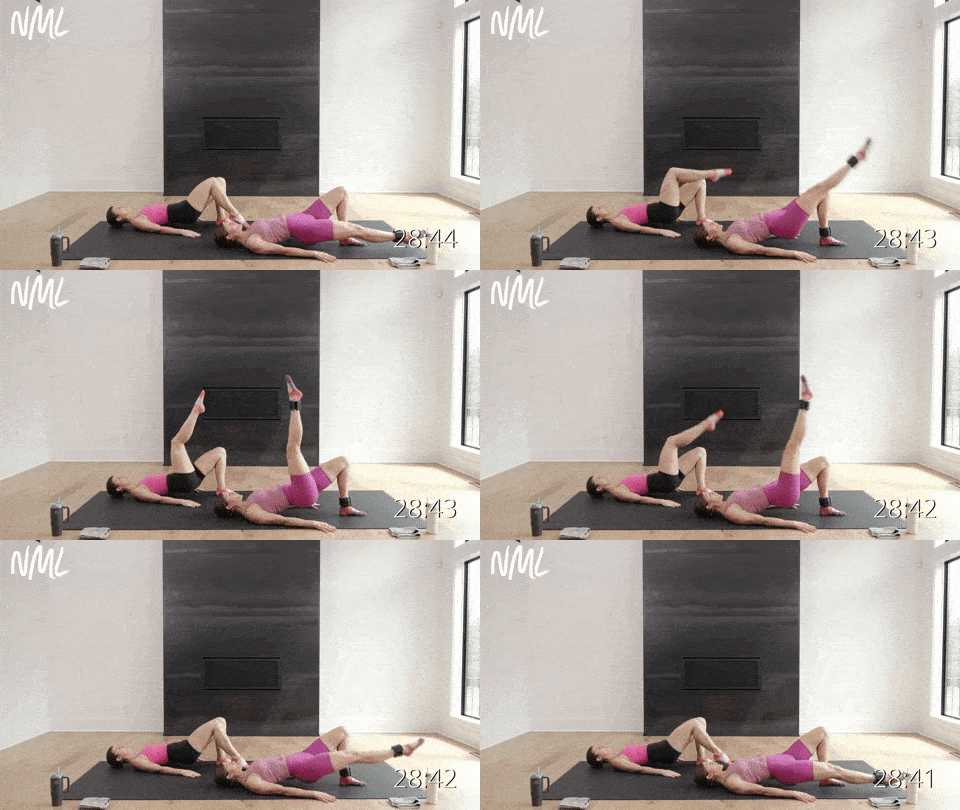
Single Leg Glute Bridge and Leg Lift
Targets: Glutes, hamstrings, hips and pelvic floor muscles.
Unilateral (or single-sided) exercises also increase core engagement.
How To Do Single Leg Glute Bridges and Leg Lifts
Start lying on your back, knees bent and feet flat on the ground.
Keeping your left foot planted on the mat, extend the right foot straight overhead (ankle stacked over knee).
Press through your heels to lift your hips off the mat, squeezing your glutes as you lift. Think about keeping your core engaged and knees in line with your hips.
Hold this bridge position as you slowly lower your right heel towards the floor, keeping your right leg straight through the entire range of motion.
Inhale to float your right leg back up, returning the leg back to starting position.
Modification: Bend the knee of your moving leg, reducing the range of motion.
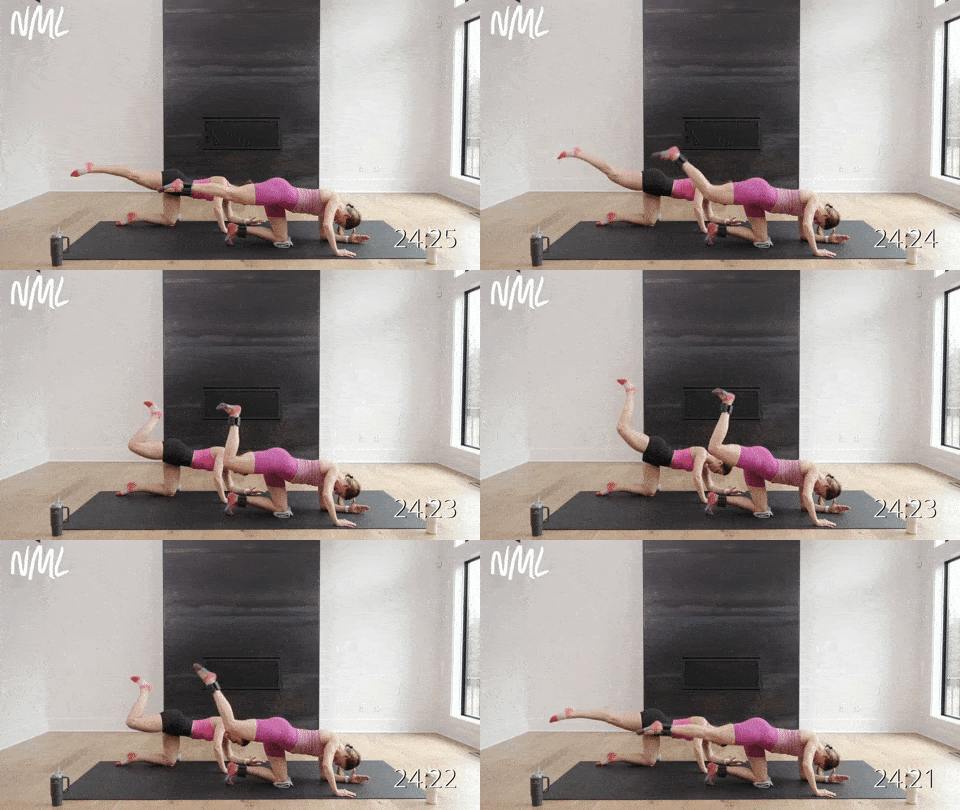
Hamstring Curl Heel Stamps
Targets: Gluteus maximus (the largest of your three glutes muscles) hamstrings, core and shoulder muscles.
How To Do Hamstring Curl Heel Stamps
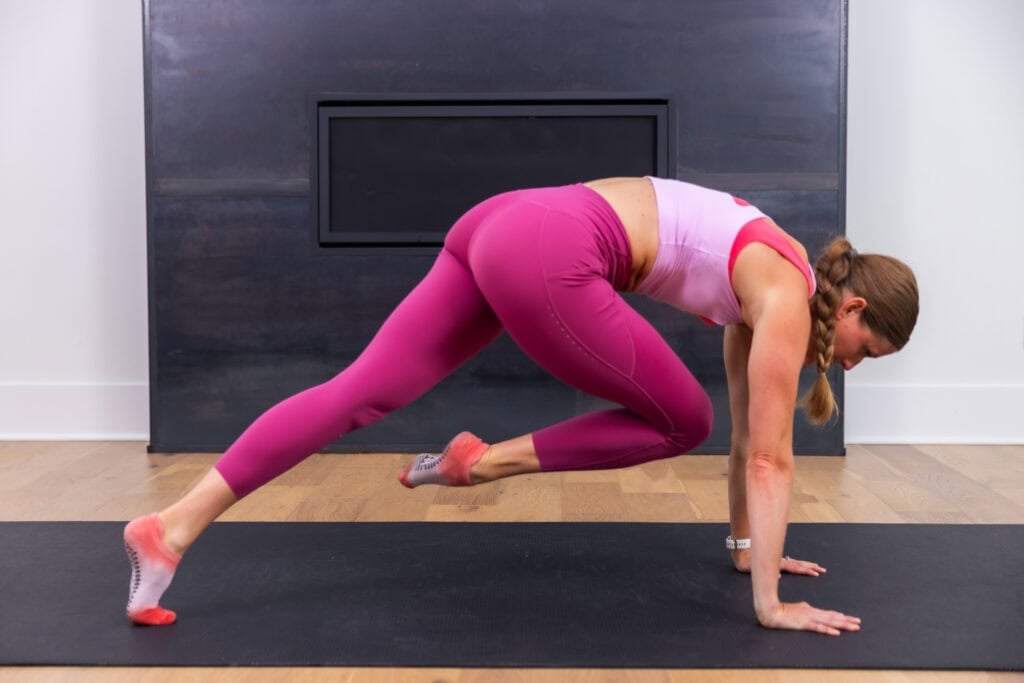
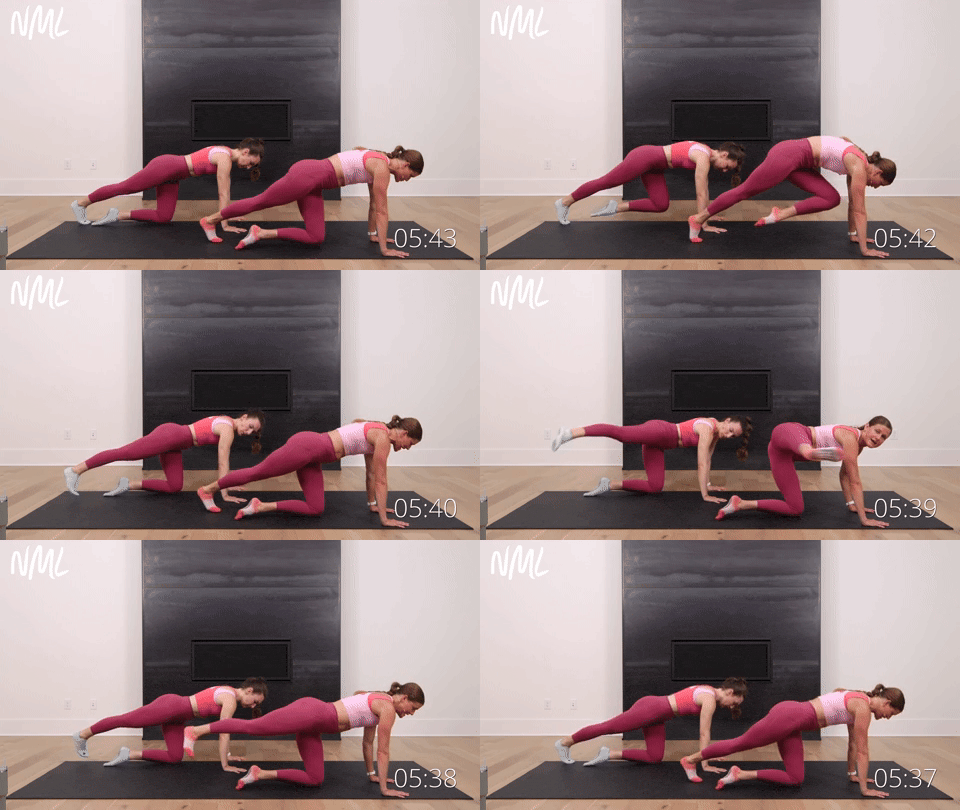
Start in a table top position, quadruped on all fours, shoulders stacked over wrists and hips stacked over knees. Option to drop to your forearms for more stability.
Lift your right leg, straightening it to extend your toes away from your body.
Squeeze through the back of your leg to curl your right heel towards your body, right knee bending to 90 degrees. Right foot is flat, foot flexed and sole of your foot up towards the ceiling.
With the right foot flexed, slightly lift the heel of your right leg up towards the ceiling, performing a “heel stamp”.
With control, slowly lower your right knee down an inch.
Then, straighten through your knee as you kick your right toes out, extending your toes away from the body and returning to starting position.
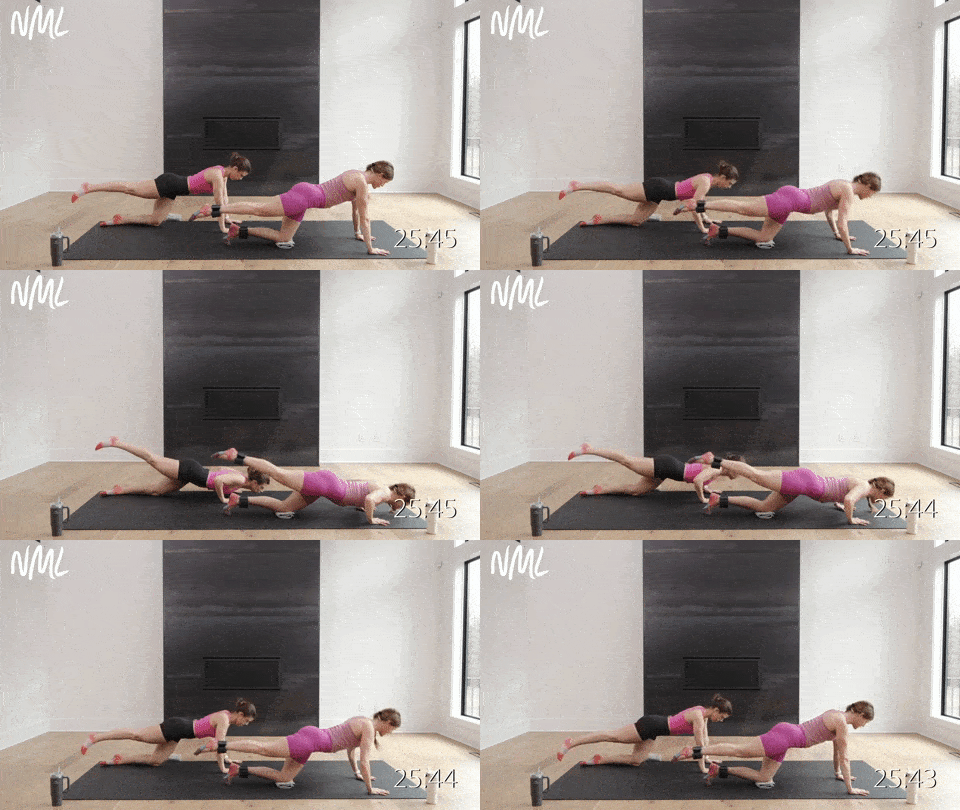
Begin in a kneeling push-up position, both knees on the ground and hands stacked under shoulders, slightly wider than shoulder-width apart.
Then, keep your left knee on the ground as you lift your right leg, extending it backwards. Keep your right leg straight and point your toes to engage your glutes. Your body should form a straight line from your head to your right toes.
Bend your elbows and slowly lower your chest towards the ground, elbows falling back towards your hips. Engage your core to protect your lower back.
Then, press evenly through your fingers to push back up, straightening your elbows and returning to starting position.
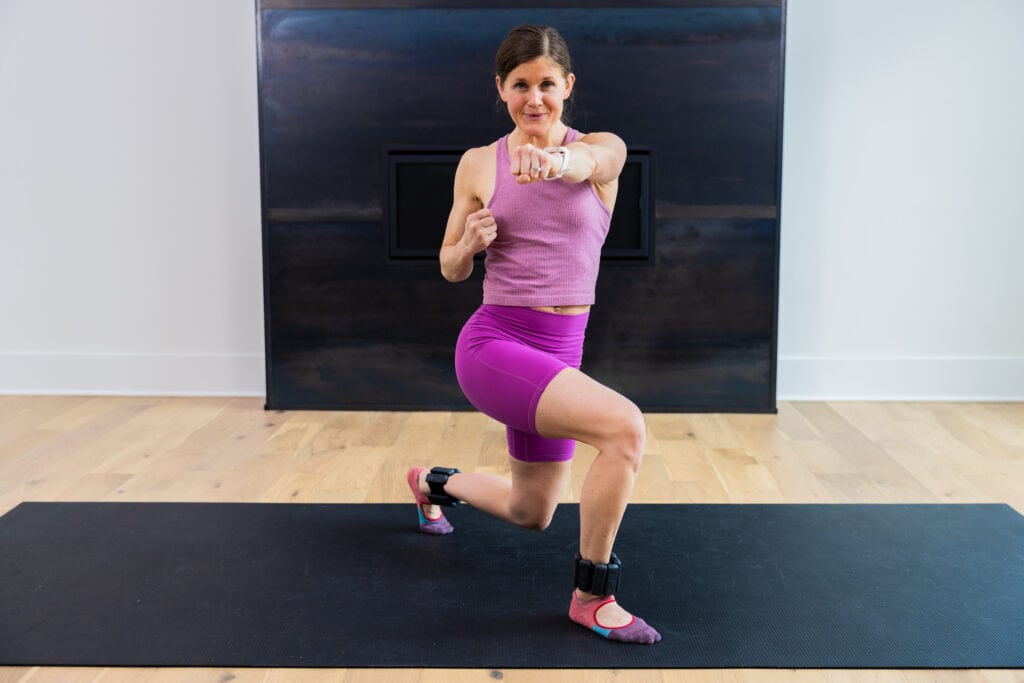
Reverse Lunge, Front Kick and Cross-Body Punch
Targets: Glutes, quads, hamstrings, hip flexors, shoulders, back, abs and core.
The balance challenge created throughout this movement targets the core and many small, stabilizing muscles throughout your body.
How To Do Reverse Lunges and Cross-Body Punches
Start standing, feet hip-width apart and stacked under shoulders.
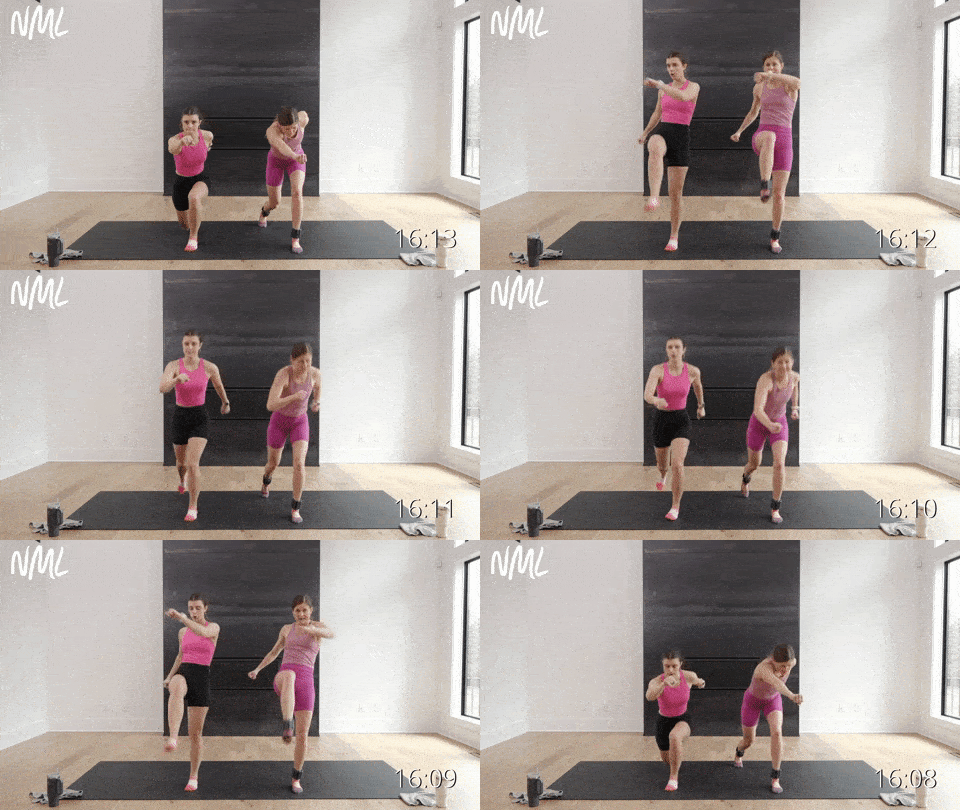
Step back with your left foot, both knees bent at a 90-degree angle to form a reverse lunge. Your front thigh should be parallel to the ground. As you step back, punch your left arm across your body, performing a cross-body punch with your left fist.
Then, press through your front right heel to stand tall, kicking your back left leg forward in front of your body as you stand. Left arm returns to your side.
As you kick, punch your opposite arm (your right arm) across your body, performing a cross-body punch with your right fist.
Then, step your left foot back into a reverse lunge, returning to starting position.
Modification: Reduce range of motion, tapping your moving leg back rather than performing a full reverse lunge.
Standing Side Leg Raise
Targets: Gluteus maximus (the largest glute muscles), gluteus medius (side butt muscles or outer glute muscles), inner thighs, outer thighs, obliques and core.
How To Do Standing Side Leg Raises
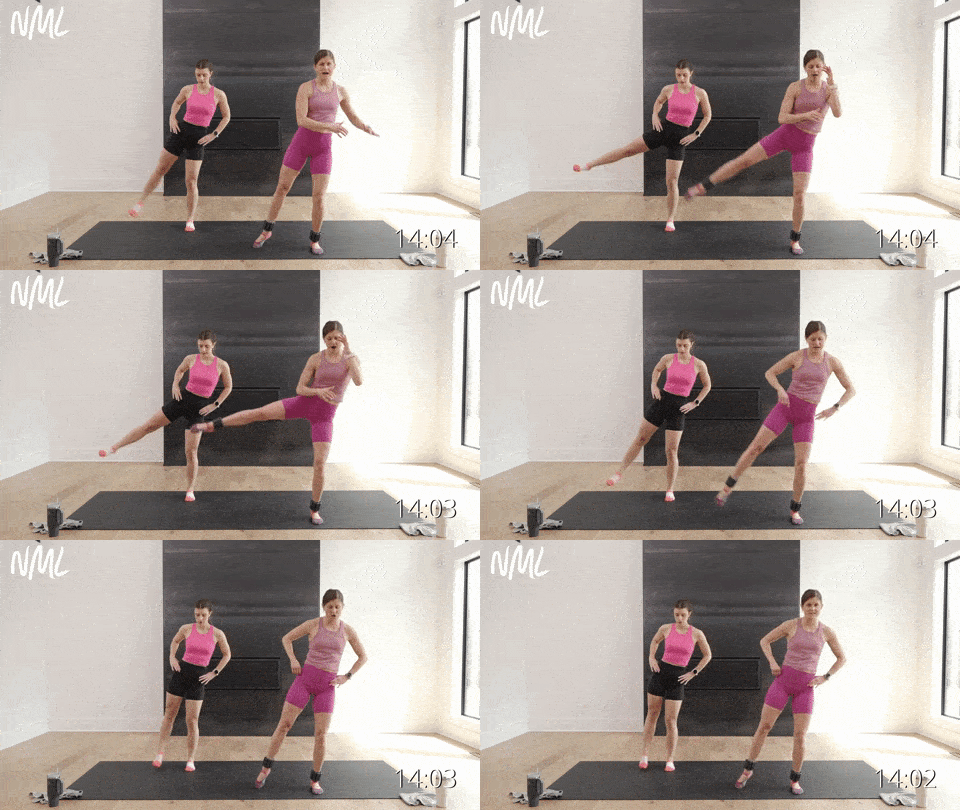
Start standing, feet hip-distance apart. Shift your weight into your right foot, slightly bending your right knee.
Brace your core, then squeeze your outer glute to lift your left leg out towards the left. Left toes are pointed. Range of motion is less important than core stability and muscle engagement.
Then with control, lower back down, tapping your left toes on the mat to return to starting position.
FREE 2-WEEK PROGRAM
Download Your FREE “3-2-8” Workout Plan Here
Barre/pilates, strength training and daily step goals – this well-rounded workout plan is one of our most popular! Download the FREE challenge here.
Adding ankle weights to your workout routine creates additional resistance during each exercise. This increased resistance helps to strengthen and tone your leg muscles, arm muscles and core. Ankle weights can also be beneficial for improving balance and stability and increasing cardiovascular endurance.
Can You Build Muscle With Ankle Weights?
Yes! Ankle weights are one way to build muscle through progressive overload. If you typically perform bodyweight exercises, incorporating ankle weights is a great way to increase the resistance and intensity of the exercise, leading to increased muscle definition. Ankle weights are particularly good for strengthening muscles in the lower body (calves, quads, hamstrings, and glutes).
How Heavy Should Ankle Weights Be?
I recommend choosing ankle weights that weigh between 1 to 5 lbs. Traditionally inbarre workouts, exercises are performed with light weights (or just your body weight) in high repetitions. Choose an ankle weight that will challenge you, but allow you to complete high reps with proper form.
This post includes affiliate links. I do make a small commission for products purchased using these links (at no additional cost to you). Thank you for supporting Nourish Move Love, making the content you see on this blog possible.
Horizontal push exercises are fundamental movements that target mostly the upper body, particularly the chest, front delts, and triceps (although seated leg press is technically a horizontal push).
These exercises are essential for developing upper body strength, putting on muscle, and enhancing overall athletic performance. If you’re a beginner, understanding the mechanics and benefits of horizontal push exercises is going to help you when programming your very won Push/Pull split. Experienced gym hounds, you might learn something, too!
In this article, we’ll dive into the importance of horizontal push exercises, explore different variations, and hopefully inspire you to try some new movements.
What Are Horizontal Push Exercises?
Horizontal push exercises involve moving a weight away from your body in a horizontal plane.
In a horizontal push exercise, such as the bench press, the barbell moves in a direction that is perpendicular to your body’s vertical axis:
As mentioned before, this mostly consists of using the chest, shoulder, and triceps.
It can also be applied to the lower body with leg presses.
The most common example of a horizontal push exercise is the bench press, but there are several other variations that can be incorporated into your workout routine. I will provide the best options below.
Benefits of Horizontal Push Exercises
Besides being able to answer the “How much do you bench?” question that inevitably comes up, there are a few more reasons why you should be doing horizontal push exercises:
Upper Body Strength: Horizontal push exercises are key to building strength in the chest, front delts, and triceps.
Muscle Hypertrophy: Along with strength, size is going to come. A broad chest, rounded shoulders, and thick triceps can be a game-changer when it comes to a strong-looking physique.
Improved Posture: Strengthening the chest and shoulders can help correct posture imbalances, particularly for those who spend long hours sitting, staring at a screen.
Functional Strength: Horizontal push exercises mimic movements performed in many sports and daily activities, making them highly functional for improving overall athletic performance.
Versatility: These exercises can be performed with various equipment, including barbells, dumbbells, resistance bands, and even bodyweight, making them accessible to everyone.
5 Key Horizontal Push Exercises
There are dozens of horizontal push exercises, but most of them can be traced back to the five main movements below:
1. Bench Press
No surprise this one is on here since it’s already been mentioned twice in this article. When it comes to the benchmark (no pun intended) for strength, the bench press reigns supreme.
Standard Bench Press: Focus on the flat bench press, targeting the pectorals, deltoids, and triceps.
Even though you may think of it as a squeezing motion, it’s still considered a horizontal push. The deep stretch and tension put on the pecs during this movement make it one of the best for stimulating muscle growth.
Cable Fly: Offers constant tension throughout the range of motion.
Single-Arm Fly: Helps in focusing on one side at a time for muscle imbalances.
3. Push-Ups
So, bench press might be the MVP when it comes to horizontal push exercises, but push-ups are the OG. You may not build a Mr. Olympia-level chest with push-ups, but they can help establish a solid strength baseline.
Standard Push-Ups: A bodyweight exercise targeting the chest, triceps, and shoulders.
Incline Push-Ups: Easier variation, suitable for beginners.
Decline Push-Ups: More challenging, emphasizes the upper chest.
Diamond Push-Ups: Focuses on triceps.
Wide-Grip Push-Ups: Puts more emphasis on the chest.
Plyometric Push-Ups: Adds an explosive element, enhancing power.
4. Tricep Skull Crushers
Unlike, pushdowns or overhead extensions, Skull Crushers have your arms extend out in front of your body, rather than down or up. The result is all three triceps head getting hit, with the medial head getting hit a little harder.
Standard Skull Crushers: An isolation exercise for the triceps.
Most lists of horizontal pushes aren’t going to have leg press on them, but we think that is a terrible mistake. While you almost always hear, “squats, squats, squats” for leg development, leg press can be a valuable addition to anylower body workout. There’s a reason why they’re popular with bodybuilders, old and new.
Standard Leg Press: Primarily targets the quads, with secondary activation of the glutes and hamstrings.
Wide-Stance Leg Press: Focuses more on the inner thighs and glutes.
Narrow-Stance Leg Press: Places more emphasis on the quadriceps.
High-Foot Position Leg Press: Targets the hamstrings and glutes more.
Common Mistakes to Avoid
Arching the Lower Back: Excessive arching can lead to lower back strain. Keep your core engaged and back flat on the bench. Let’s be real, you’re not entering a powerlifting competition anytime soon, so focus on keeping that low back glued to the bench.
Flaring the Elbows: Keep your elbows at a 45º angle to your body to protect your shoulder joints. Flaring your elbows out to 90º is going to shift strain from your chest to your shoulders, which is just asking for injury.
Inadequate Range of Motion: Ensure you’re lowering the weight fully to engage the muscles properly. Partial reps do have a place in lifting, but when possible, you want to hit the entire range of motion. Full ROM is going to give you better results, strength and size-wise.¹
Lifting Too Heavy: Choose a weight that allows you to perform the exercise with proper form to prevent injury. Don’t sacrifice technique for bragging rights.
Wrap Up
Horizontal push exercises are crucial for building a strong, muscular upper body and improving functional strength. By incorporating a variety of horizontal push movements into your workout routine, you can target different areas of your chest, shoulders, and triceps, leading to balanced muscle development and better functional strength. Remember to focus on form, gradually increase weight, and integrate these exercises into a well-rounded fitness program for optimal results.
References:
Schoenfeld, Brad J, and Jozo Grgic. “Effects of Range of Motion on Muscle Development during Resistance Training Interventions: A Systematic Review.” SAGE Open Medicine, vol. 8, no. 8, Jan. 2020, p. 205031212090155, https://doi.org/10.1177/2050312120901559
Let’s face it: We all want to look great naked. A well-sculpted physique not only boosts your confidence but also shows off the hard work you’ve put into your training. But how do you break through the confusion and get the results you’re after? The key is to train smart, have fun, and push your limits with advanced techniques that really make a difference. Enter the 6-Week Hypertrophy Workout Program.
This 6-Week Hypertrophy Workout Program is your ultimate guide to muscle-building success. This program is designed to pump up your workouts, lean out your physique, and make you stronger in the process. With a structured 4-day split, it can be tailored for all levels, from beginner to advanced. You control the effort, and we provide the roadmap to take you to the next level. Ready to transform and shred? Here’s how we’re going to make it happen.
Each phase of the hypertrophy workout program progressively increases the intensity and complexity, challenging your muscles to adapt and grow. The key techniques utilized in this program include Density Sets, Drop Sets, and Double Rest-Pause Sets, all of which are renowned for their effectiveness in promoting hypertrophy. The Hypertrophy Workout Program is divided into three phases:
Phase 1: Foundation (Weeks 1-2): Lays the groundwork by focusing on mastering the techniques, ensuring consistent form, and building a solid base.
Phase 2: Intensification (Weeks 3-4): Pushes the boundaries by increasing the load, adding more volume, and reducing rest times, which intensifies the training stimulus.
Phase 3: Peak Intensity (Weeks 5-6): Reaches the pinnacle of intensity, pushing your limits with maximal effort and advanced variations of each method, aiming for progressive overload and peak muscle growth.
Training Method Break Down
Drop Sets: Involve performing an exercise to failure, then reducing the weight and continuing without rest. This method increases time under tension, targeting muscle fibers more deeply. Multiple drop sets can be applied.
Density Sets: Challenges you to complete as many reps as possible within a set time, aiming to improve work capacity and muscle endurance by reducing rest periods and increasing overall volume.
Double Rest-Pause Sets: Start with a set to failure of a given exercise, followed by short rest periods and additional couple sets to failure. This method pushes muscles beyond traditional failure points, maximizing muscle activation and growth.
Weekly Structure
Day 1: Upper Body
Day 2: Lower Body
Day 3: Off
Day 4: Upper Body
Day 5: Lower Body
Parilov
The 6 Week Hypertrophy Workout Program
Phase 1: Foundation (Weeks 1-2)
Day 1: Upper Body
Exercise
Sets
Reps
Rest
Method
A. Bench Press
3
6, 6, Drop Set
120 sec
Drop Set (1-2 drops)
B. Pull-Ups
3
5
60-90 sec
Straight Set
C1. Chest Supported DB Row
2
Near Failure
30 sec/ 2 minutes between series
Double Rest-Pause
C2. Incline Pushups
2
Near Failure
30 sec/ 2 minutes between series
Double Rest-Pause
D1. Dumbbell Hammer Curls
1
90 sec
90 sec
Density Set
D2. Banded Triceps Push-downs
1
90 sec
90 sec
Density Set
Day 2: Lower Body
Exercise
Sets
Reps
Rest
Method
A. Back Squat to Box
4
6
120 sec
Straight Set
B. Belt Squat
3
8 (x 1 drops to failure)
0-10 sec
Drop Set to failure on final set
C1. 1.5 Stance Leg Press
2-3
Near Failure
25 sec/ 120 sec between
Double Rest-Pause
C2. Reverse Dumbbell Lunge
3
12
90 sec
Super Set with Leg Press
D1. Inverted Hamstring Curl
1
90 sec
90 sec
Density Set
D2. Standing Calf Raise
1
90 sec
90 sec
Density Set
Day 3: Upper Body
Exercise
Sets
Reps
Rest
Method
A.Barbell Overhead Press
4
6
120 sec
Straight Set
B. Pull-Ups
2
2 minutes
2 minutes
Density Set (Band Assisted)
C1. Dumbbell Rear Delt Fly
3
10-12
90 sec
Super Set
C2. Lateral Shoulder Raise
3
To Failure
10-20 sec
Mechanical Drop Set (Seated to Standing)
D1. Chest Supported Front Raise
3
12
60 sec
Triset Set
D2. TRX Row
3
To Failure
20 sec/ 120 seconds
Double Rest-Pause
D3. Dumbbell Biceps Curl
3
60 sec
120 sec
Density Set
Day 4: Lower Body
Exercise
Sets
Reps
Rest
Method
A. Front Squat
4
6
120 sec
Straight Set
B. Hex Bar Deadlift
3
5 (x 3-5 drops)
15-20 sec/ 120 sec
Drop Set (Reduced Load performing sets of 5, 3-5 times to conclude 1 set)
C1. Lateral Lunge
3
8-10
90 sec
Super Set
C2. Cable Pull-thru
3
Near Failure
15-20 sec/90 sec
Double Rest-Pause
D1. Leg Extension
1
90 sec
120 sec
Density Set
D2. Seated Hamstring Curl
1
90 sec
120 sec
Density Set
Phase 2: Intensification (Weeks 3-4)
Day 1: Upper Body
Exercise
Sets
Reps
Rest
Method
Bench Press
4
6, 6, 6, Drop Set
120 sec
Drop Set (Increase weight slightly, 1 additional set)
Pull-Ups
4
5
90 sec
Straight Set (1 additional set)
Chest Supported DB Row
2
AMRAP
20 sec/ 90 seconds between series
Double Rest-Pause (Reduce rest time)
Incline Pushups
2
AMRAP
20 sec/ 90 seconds between series
Double Rest-Pause (Reduce rest time)
Dumbbell Hammer Curls
1
2 min
90 sec
Super Set (With Banded Triceps Push-downs, Increased Time Block)
Banded Triceps Push-downs
1
2 min
90 sec
Super Set (With Hammer Curls, Increased Time Block)
Day 2: Lower Body
Exercise
Sets
Reps
Rest
Method
Back Squat to Box
5
6
90 sec
Straight Set (Add an extra set, slight increase in load)
Belt Squat
4
6 (x 3 drops)
0-10 sec
Drop Set (Increase drops to 3 drops on last set, increased load)
1.5 Stance Leg Press
2
2-3 RIR
20 sec/ 90sec between series
Double Rest-Pause (Reduce rest time)
Reverse Dumbbell Lunge
3
15
60-90 sec
Super Set with Leg Press (Increased Repetition)
Inverted Hamstring Curl
1
2 min
90 sec
Density Set (Increase set duration)
Standing Calf Raise
1
2 min
90 sec
Density Set (Increase set duration)
Day 3: Upper Body
Exercise
Sets
Reps
Rest
Method
A.Barbell Overhead Press
5
5
90 sec
Straight Set (Increased Load and Volume, Decreased Rest)
B. Pull-Ups
2
3 minutes
2 minutes
Density Set (Body Weight/Assisted, Increased Set Duration)
C1. Dumbbell Rear Delt Fly
3
12-15
75 sec
Super Set (Increased Reps, Reduced Rest)
C2. Lateral Shoulder Raise
3
To Failure
5-15sec
Mechanical Drop Set (Seated to Standing, Reduced Rest)
D1. Chest Supported Front Raise
3
15
45 sec
Triset Set (Increased Reps, Reduced Rest)
D2. TRX Row
3
To Failure
15 sec/ 90 seconds
Double Rest-Pause (Reduced Rest)
D3. Dumbbell Biceps Curl
3
90 sec
120 sec
Density Set (Increased Set Duration)
Day 4: Lower Body
Exercise
Sets
Reps
Rest
Method
A. Front Squat
4
8
120 sec
Straight Set (Increased Reps)
B. Hex Bar Deadlift
3
5 (x 3-5 drops)
15-20 sec/ 120 sec
Drop Set (Increased Load)
C1. Lateral Lunge
3
10-12
75 sec
Super Set (Increased Reps, Reduced Rest)
C2. Cable Pull-thru
3
Near Failure
10-15 sec/75 sec
Double Rest-Pause (Reduced Rest)
D1. Leg Extension
1
90 sec
90 sec
Density Set (Reduced Rest)
D2. Seated Hamstring Curl
1
90 sec
90 sec
Density Set (Reduced Rest)
Phase 3: Peak Intensity (Weeks 5-6)
Day 1: Upper Body
Exercise
Sets
Reps
Rest
Method
Bench Press
5
6, 6, 6, 6, Drop Set
90-120 sec
Drop Set (Maximize drops to 5)
Pull-Ups
5
5
60
Straight Set (Increased Volume)
Chest Supported DB Row
3
AMRAP
15 sec/ 60 seconds between series
Double Rest-Pause (3 rest-pauses, reduced rest)
Incline Pushups
3
AMRAP
15 sec/ 60 seconds between series
Double Rest-Pause (3 rest-pauses, reduced rest)
Dumbbell Hammer Curls
2
2 min
120 sec
Super Set (With Banded Triceps Push-downs, Additional Set Added)
Banded Triceps Push-downs
2
2 min
120 sec
Super Set (With Hammer Curls, Additional Set Added)
Day 2: Lower Body
Exercise
Sets
Reps
Rest
Method
Back Squat to Box
5-7
4-6
120 sec
Straight Set (Add an extra set, slight increase in load)
Belt Squat
4
6 (x 5 drops)
0-10 sec
Drop Set (Increase drops to 3 drops on last set, increased load)
1.5 Stance Leg Press
2
Near Failure
15 sec/ 60sec between series
Double Rest-Pause (Reduce rest time, increased volume)
Reverse Dumbbell Lunge
4
12
60-90 sec
Super Set with Leg Press (Increased load, 1 additional set)
Inverted Hamstring Curl
2
2 min
120 sec
Density Set (Added Set)
Standing Calf Raise
2
2 min
120 sec
Density Set (Added Set)
Day 3: Upper Body
Exercise
Sets
Reps
Rest
Method
A.Barbell Overhead Press
5
3-5
75 sec
Straight Set (Increased Load and Volume, Decreased Rest)
B. Pull-Ups
1
5 minutes
2 minutes
Density Set + Drop Set (Start: Loaded, Body Weight, Finish: Band Assisted Remainder of Time, Increased Set Duration)
C1. Dumbbell Rear Delt Fly
3
15+
60 sec
Super Set (Increased Reps, Reduced Rest)
C2. Lateral Shoulder Raise
3
To Failure
0-10sec
Mechanical Drop Set (Seated to Standing, Reduced Rest)
D1. Chest Supported Front Raise
3
15
30 sec
Triset Set (Reduced Rest)
D2. TRX Row
3
To Failure
15 sec/ 60 seconds
Double Rest-Pause (Reduced Rest)
D3. Dumbbell Biceps Curl
3
90 sec
90 sec
Density Set (Reduced Rest)
Day 4: Lower Body
Exercise
Sets
Reps
Rest
Method
A. Front Squat
6
5
120 sec
Straight Set (Add Another Set, Increased Load)
B. Hex Bar Deadlift
3
5 (x 3-5 drops)
15-20 sec/ 120 sec
Drop Set (Increased Load)
C1. Lateral Lunge
3
12-15
60 sec
Super Set (Increased Reps, Reduced Rest)
C2. Cable Pull-thru
3
Near Failure
10-15 sec/60 sec
Double Rest-Pause (Reduced Rest)
D1. Leg Extension
1
2 min
90 sec
Density Set (Increased Set Duration)
D2. Seated Hamstring Curl
1
2 min
90 sec
Density Set (Increased Set Duration)
Alternative Progression Layout
Phase 1: Foundation (Weeks 1-2)
Focus on achieving perfect form and mastering the basic techniques. Quality and precision are more important than intensity at this stage.
Density Sets: Ensure adequate recovery to support learning and adaptation. Rest as needed to maintain quality movement.
Drop Set: Use weights that are challenging but manageable, allowing you to perfect your form and maintain good technique.
Double Rest-Pause: Focusing on high quality repetitions, focus on mind-muscle-movement-connection. Slow consistency speed.
Phase 2: Intensification (Weeks 3-4)
Increase the intensity by using heavier weights and slightly increasing volume (sets/reps) where appropriate.
Density Sets: Increase set duration by 30 seconds. Slightly reduce rest time between sets.
Drop Sets: Increase the number of drops by 1-2. Slightly increase load.
Double Rest-Pause: Reduced rest time between sets. Slightly increase load.
Phase 3: Peak Intensity (Weeks 5-6)
Push the intensity to the max with the more effort, less rest, and heavier loads in each method.
Density Sets: Further reduce rest time or increase the set duration. You can also increase load.
Drop Sets: Maximize the number of drops, aiming for up to 5 total. Increase load and reduce rest between sets.
Double Rest-Pause: Extend the duration of rest-pause intervals to push for maximum volume.
Tone your core at home with 15 pilates ab exercises. These are my favorite pilates-inspired core exercises to strengthen the upper abs, lower abs, obliques, deep transverse abdominal muscles and pelvic floor.
Pilates classes have become very popular in the last year, particularly because they’re great for core strength.
Pilates workouts focus on precise movement and breath control, so I’ve found that they’re really effective in building functional strength in your core muscles.
Pilates core exercises are especially good for strengthening the transversus abdominis muscles or deep core muscles that criss-cross around the trunk of your body.
Today’s mat pilates ab workout is great for all fitness levels. These exercises are performed with just your bodyweight, making it a great way to mix up traditional reformer pilates.
15 Pilates Ab Exercises
15 at-home pilates exercises to build a strong core and sculpt your midsection.
Add this pilates core workout to yourweekly workout routine1-2 times a week to build muscle and improve definition in the abdominal muscles.
Timed Intervals (40 seconds of work, 20 seconds of rest. Perform as many reps as possible with good form within the timed interval.)
Perform Each Pilates Move x1 (no repeats)
Workout Outline
Bent Knee Stretch
Straight Leg Scissor Kicks
Straight Leg Circles
Teaser Roll Up
Criss Cross Obliques
Full Body Roll Up and Saw
Reverse Plank Alternating Single Leg Bend and Extend
Pilates 100s
Forearm Plank Body Saw and Alternating Leg Lift
3-Point Scoop and Side Leg Kick (Right)
Side Lying Leg Lift and Oblique Crunch (Right)
Rolling Plank
3-Point Scoop and Side Leg Kick (Left)
Side Lying Leg Lift and Oblique Crunch (Left)
Pilates Roller Boats
5 Mat Pilates Ab Exercises
Straight Leg Circles
Targets:Rectus abdominis, transverse abs and lower abs.
How To Do Straight Leg Circles
Lie on your back. Press your low back firmly into the mat and think about “wrapping” your abdominal wall around your core.
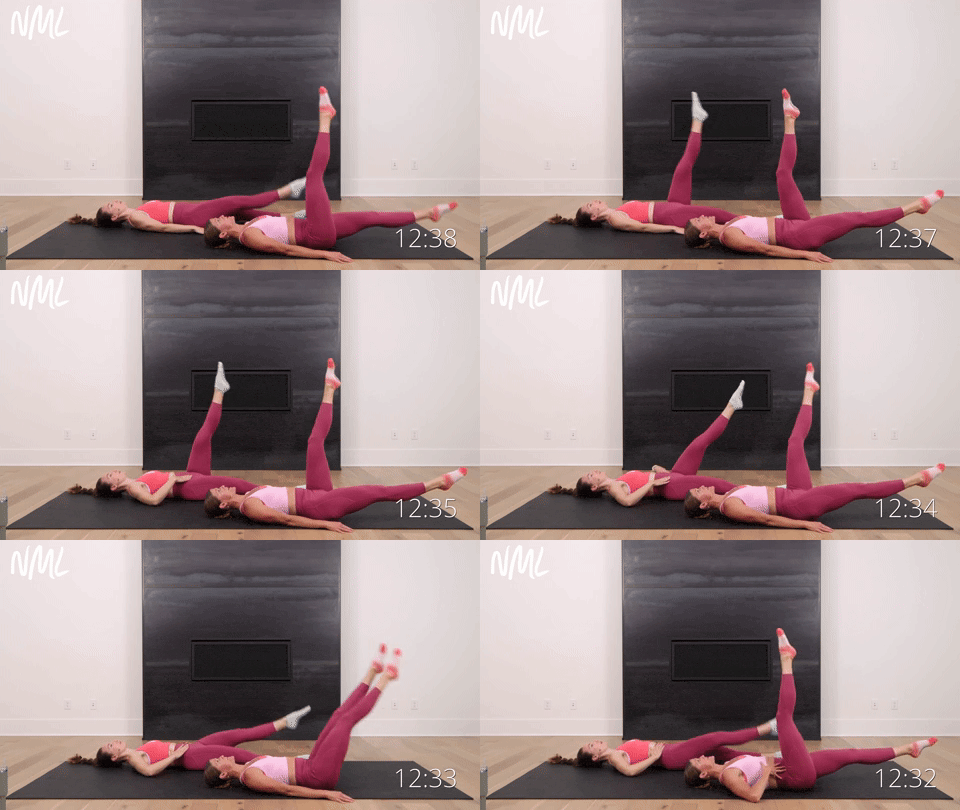
Straighten your legs and extend them over your hips, toes pointed and facing the ceiling.
Slowly lower the right leg towards the ground, hovering the heel above the mat and keeping both legs as straight as possible. Focus on keeping your lower back pressed into the mat.
Draw two small, donut-sized circles with the big toe of the left foot.
After drawing two small circles, switch legs, slowly lowering the left leg towards the ground as you pull the right leg up.
Then repeat, this time drawing two small circles with the big toe of the right foot as the left heel hovers above the ground. Keep the hips as stable as possible throughout the movement.
Modification:Lower the leg all the way down to the ground, resting it on the mat as you draw two leg circles with the opposite leg. This allows for more stability.
Pilates 100s
Targets:Rectus abdominis and transverse abs.
How To Do Pilates Hundreds
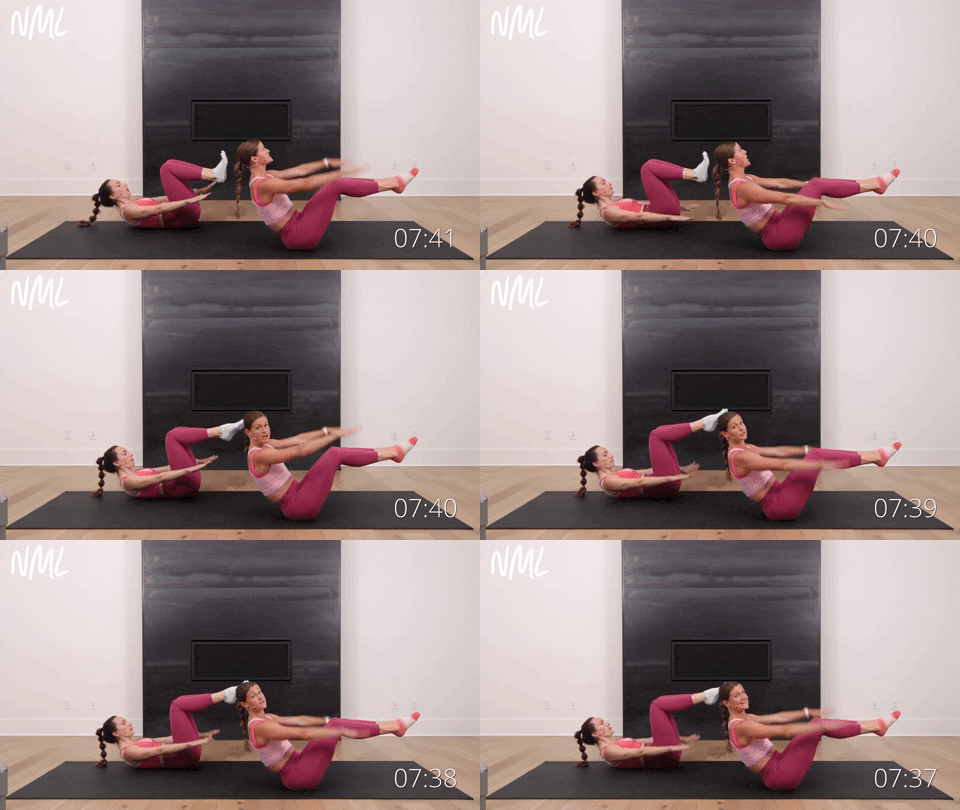
Start sitting on the floor with your legs bent at 90 degrees. Lean back slightly sitting on your sit bones (two sitting bones and tailbone), keeping a nice long spine, shoulders down and back.
Place your hands behind your knees and lift your feet off the ground. Bent legs are extended out in front of you.
If possible, slowly straighten your legs out in front of you. Raise the tips of your toes to eye-level or just higher.
Then straighten your arms, extending them out at shoulder height, palms facing down. Pulse your arms up and down 2-3 inches, while holding this position (pilates hundreds or boat pose).
Modification:Option to keep your back resting on the floor, lifting only your head and shoulders off the mat.
Forearm Plank Body Saw and Alternating Leg Lift
Targets:Upper abs, lower abs, obliques, shoulders, glutes and thighs.
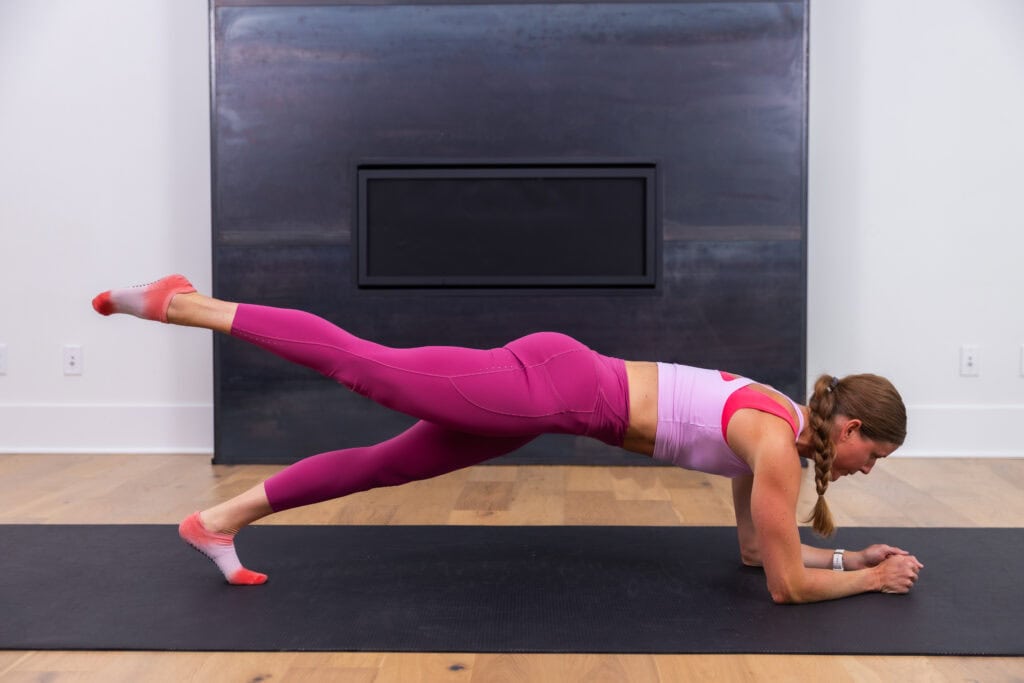
How To Do A Forearm Plank Body Saw and Alternating Leg Lift
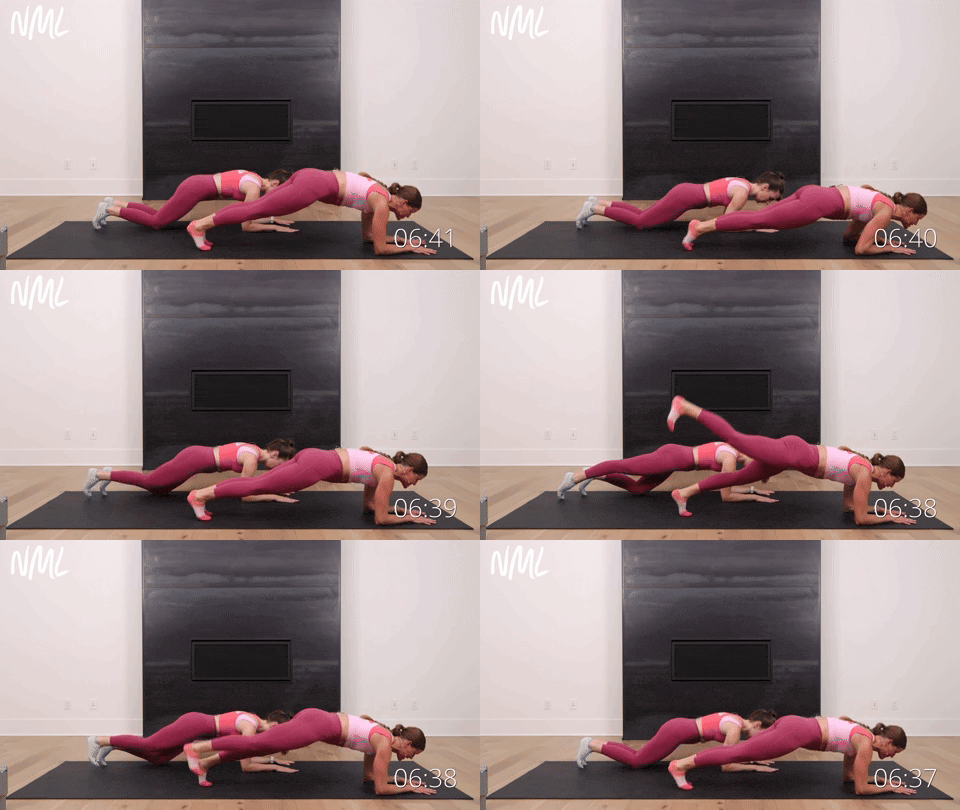
Start in a forearm plank position, arms stacked horizontally beneath your shoulders, core engaged, one long line from your head through your heels.
Slightly rock forward to perform a body saw, pushing your nose towards your fingertips. With control, push back, returning to a forearm plank position.
Then engage the glutes as you lift your right leg up towards the ceiling. Keep the foot flexed and keep the leg straight as you lift.
With control, lower the right leg back down, finding a forearm plank position again.
Then repeat the body saw and leg lift, this time lifting the left leg.
Modification:Perform a modified forearm plank and body saw by keeping the knees on the ground. On the leg lift, straighten the right leg and lift while keeping the left knee on the ground in modified plank.
3-Point Scoop and Side Leg Kick
Targets:Transverse abdominals, upper abs, lower abs, glutes, hip flexors and shoulders.
How To Do A 3-Point Scoop and Side Leg Kick
Begin in a tabletop position, kneeling on all fours with shoulders stacked over wrists. Straighten the left leg behind you, placing the toes on the ground, to the left of the bent right leg.
Round through the spine as you pull the right knee up and off the ground, pulling it in as close to your chin as possible.
Hold for a moment, then lower the right knee back towards the mat with control.
Then, keeping the left foot flexed and left leg straight, raise the left leg so it’s in line with your hips as you kick up and around, creating a 90 degree bend between your torso and left leg. Think of creating a semicircle as you kick the leg up and around from behind the right foot to in line with the hip.
Reverse the movement of the left leg, pulling it back to the starting position and repeat.
Modification:Reduce the range of motion on the side leg kick.
Side Lying Leg Lift and Oblique Crunch
Targets:Internal and external oblique muscles (the muscles that run along the side of your core) and transverse abdominus.
How To Do A Side Lying Leg Lift and Oblique Crunch
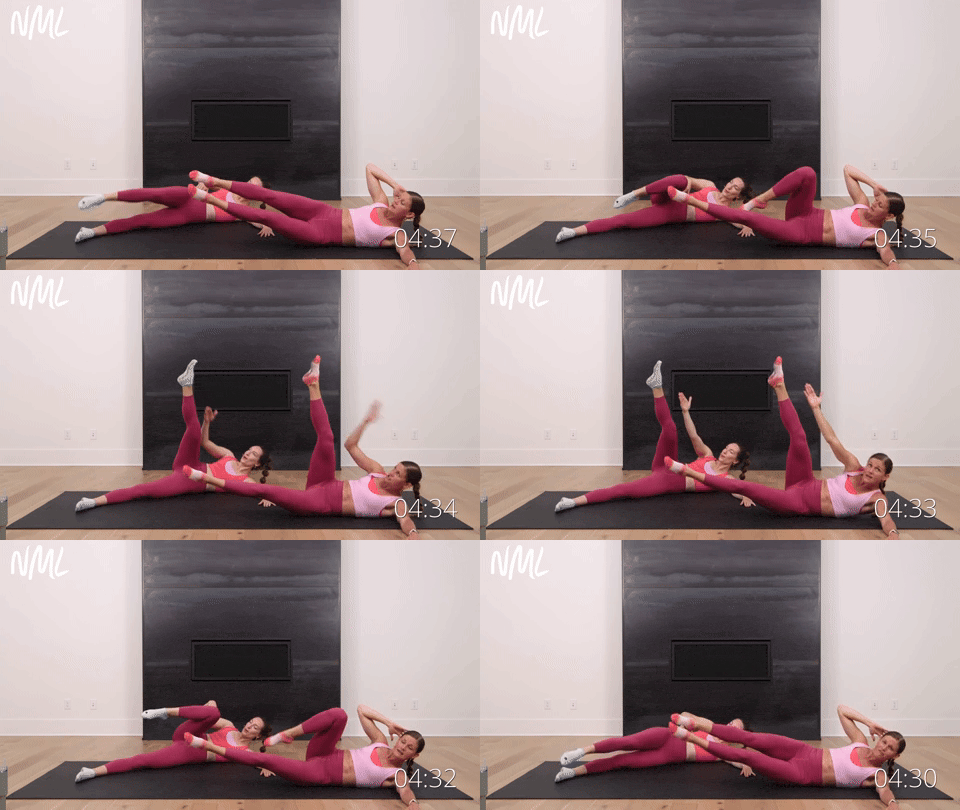
Start lying on your side, right arm on the mat, left hand behind your head. Extend both legs long, feet stacked on top of one another. Brace your core.
Lift your head and neck off the ground while also lifting your legs up off the mat.
Pull the top (left) knee in towards your face. Then extend the left leg long, left toes pointing towards the ceiling.
Then, lift the shoulders off the mat as you aim to touch the left fingertips to the left toes. Think of performing an oblique crunch while the leg is raised.
With control lower the shoulders back down, then bend the left leg to lower it, sending it long. Left foot to meet right foot.
Modification:Option to keep the bottom (right) leg on the mat throughout the movement, creating more stability and support.
Pilates Ab Exercises FAQs
Can I Get Abs With Pilates?
Pilates classes are known for their focus on small, targeted movements and breath control. This helps you isolate and engage your core muscles more effectively, making pilates an effective workout for strengthening the abs.
How Do I Get Abs Through Pilates?
Variations of pilates hundreds, toe taps, leg circles, planks, and leg extensions or lifts are some of the most popular and effective pilates ab exercises. These exercises target all parts of the core and train the abs to stabilize the trunk of the body, making them extremely functional.
Pin This Workout: 15 Pilates Ab Exercises
This post includes affiliate links. I do earn a commission for products purchased using these links (at no additional cost to you). Thank you for supporting Nourish Move Love, making the content you see on this blog possible.
We live in an amazing time to be in the fitness game. “Back in our day,” the only information we got about fitness was from bodybuilding magazines and our friends. Now, lifters can access unlimited information, such as all the fitness podcasts and YouTube channels – any answer can be found online. Well, if you know where to look.
We have so much information now that we have crossed the spectrum where there’s information overload, not to mention misinformation. Therefore, we will help you and wade through the nonsense to give you the top fitness podcasts and YouTube channels.
In no particular order, we’re just gonna get right into it.
1. Mind Pump
Mind Pump is one of the top fitness podcasts, if not the top. However, it didn’t become so by providing dumbed-down info to please listeners. Rather, the premise is to break down all the myths and lies spread by all the “fitness charlatans.” They deliver cold, hard facts; every episode is packed with truths, even if they are not what you want to hear.
The primary team at Mind Pump, consisting of Sal Di Stefano, Adam Schafer, Justin Andrews, and Douge Egge, is a powerhouse of knowledge. They use a round-table discussion format that allows for a natural flow of conversation. Each episode is a blend of science, study breakdown, anecdotal evidence, education, stories, and experience, all delivered with the perfect amount of humor.
Listening to a podcast is terribly easy. It feels like you’re just listening to a bunch of friends if your friends were leading experts in the fitness industry.
2. Stronger By Science
If you’re looking for a science-backed fitness podcast, the Stronger By Science podcast and YouTube channel is for you. The term “science-backed” has been hijacked in the fitness industry, and just about anyone who heard from a friend that heard from a friend that read an article will use it.
Well, Stronger By Science really is.
Stronger By Science, founded by Greg Nuckols, is a beacon of knowledge in the fitness world. Despite not having a PhD, Nuckols’ wealth of information and ability to break down scientific research in a way the general public can understand is commendable. His Master’s in Exercise Science, multiple all-time powerlifting world records, and years of experience as a fitness writer make him a trusted source of information.
He does have his Master’s in Exercise Science, multiple all-time powerlifting world records in the 220lb and 242lb classes, and years of experience as a fitness writer. He has publications in T-Nation and Men’s Health and serves as Chief Content Director for Juggernaut Training Systems.
The entire brand includes a website, YouTube channel, and podcast. With this much going on, a team runs Stronger By Science with Knuckols on lead. On the podcast, he’s joined by Dr. Eric Trexler, Dr. Milo Wolf, and Dr. Pak Androulakis—a lot of doctors and world-class lifters.
Now, some people may find it too sciency with too much information. If you’re looking for a fitness podcast that mainly tells you “what to do” rather than “why you should do it,” Stronger By Science might not be for you.
3. Barbell Medicine
Barbell Medicine is an awesome podcast; we want more people to know about it! Its entire premise is to push the Exercise Is Medicine movement, an area of fitness that emphasizes using fitness to treat and prevent various conditions.
For example, it speaks on topics such as:
Preventing cancer
Improve bone growth
Treat sleep apnea
Lower blood pressure
Treat diabetes
It is extremely interesting and informative and an absolute must for anyone looking for a different way to stay healthy from modern medicine. This makes it stand out from other fitness podcasts, so it’s unique – you won’t find most of their information anywhere else.
To be clear, they do not criticize modern medicine or provide sketchy information, so no worries there. Instead, everything is research-based and meant to educate the public on how essential fitness is for our health.
3. BioLayne/Dr. Layne Norton
Dr. Layne Norton has been on social media in the fitness world forever. He has a YouTube channel and a podcast, Biolayne. Dr. Layne Norton was a world-class powerlifter and pre-natural bodybuilder who is now one of the most sought-after physique coaches. In addition, he’s a prominent researcher and holds a PhD in Nutritional Science, completing his thesis on the role of leucine in muscle protein synthesis.
His content tends to focus more on nutritional topics and biohacks, specifically busting myths – things like whether seed oils are harmful to you, whether eating at night causes you to get fat, and whether ice baths work. However, he does touch on bodybuilding and powerlifting topics as well.
Dr. Norton has climbed the ranks in the world of fitness social media thanks to his high levels of knowledge and practical knowledge. At the same time, he has a very charismatic personality, making this content very easy to listen to and learn useful stuff!!
4. Renaissance Periodization (RP Strength) W/ Dr. Mike Israetel
Renaissance Periodization was founded by Dr. Mike Isratel, known as Dr. Mike for short. Dr. Mike Israetel is a true fitness expert and holds a PhD in Sport Physiology. Previously, he was a professor in the School of Public Health at Temple University in Philadelphia, where he taught courses such as Nutrition for Public Health, Advanced Sports Nutrition and Exercise, and Nutrition and Behavior.
Renaissance Periodization, founded by Dr. Mike Israetel, is a comprehensive resource for fitness enthusiasts. Dr. Mike, a true fitness expert with a PhD in Sport Physiology, leads the team. Their YouTube channel and podcast, featuring Dr. Mike and Nick Shaw, cover a wide range of topics, with a focus on bodybuilding and muscle hypertrophy training. However, their content spans the entire spectrum, and their team consists of various experts.
Now, what people like about RP is Dr. Mike himself. The YouTube channel is very simplistic and contains Dr. Mike sitting at a table with a little informational window. That’s it. However, Dr. Mike perfectly blends his expertise with humor and breaks down concepts so they’re easily digestible. This makes content from RP Strength highly binge-worthy and a community favorite.
5. More Plates, More Dates
More Plates, More Dates (MPMD) is a unique channel that provides in-depth information on all things anabolic steroids, SARMS, TRT, and more. While we do not advocate the use of these substances, we believe it’s essential to be educated properly if you have ever thought about it. MPMD is the channel to follow if you are interested or have questions about these topics.
MPMD is a bit unique as it’s run by the founder, who is simply known as Derek. As far as we can tell, Derek seems to have a degree in business, with all of his fitness and steroids education being self-researched. But don’t worry, he lists every piece of evidence and study in his videos. He has found himself on numerous other podcasts speaking about this stuff, including the king of podcasts, Joe Rogan!
If you are interested in or have questions about this, More Plates, More Dates is the channel to follow.
6. Buff Dudes
Buff Dudes is an OG fitness channel that dates back 12 years or so. This means they have a ton of content and currently have 757 videos. Buff Dudes is a set of brothers, Hudson and Brandon White. Similar to More Plates, More Dates, it seems like the Buff Dudes just have a ton of knowledge from all their years of training, which is sometimes the best as they know what people need.
Now, with 757 videos, you can imagine they have a ton of content. However, they tend to focus their information on bodybuilding and nutrition.
Buff Dudes is known for their light-hearted, comedic personalities as they cover various topics in their videos. The topics can include:
They cover everything. Just because it’s done a bit light-hearted doesn’t mean it’s not bad information. Buff Dudes provides solid content in a style that suits viewers who find “fitness talk” a bit boring. Excellent content that’s easily digestible, simple to understand, and highly applicable to your training makes Buff Dudes an excellent choice for those new to fitness.
7. Jeff Nippard
Jeff Nippard has one of the most popular fitness and bodybuilding YouTube channels, with 5.4 million subscribers. He’s a highly successful natural bodybuilder and powerlifter with a bachelor’s in biochemistry. Jeff has coached numerous elite bodybuilding competitors and presented at numerous summits and conferences.
With that said, his channel is known for being based on using science-backed research. Every video has plenty of studies to back up the information presented, so you know the information is legit. At the same time, Jeff uses his own experience to merge science with practical applications so that you can optimize your training.
We also like that he’s not dogmatic about anything he presents, which is how a true science-backed fitness channel should be. If there is a negative point, some people may find some information dry, but this will not be the case if you’re genuinely interested in learning and understanding deeper concepts in bodybuilding.
8. Scott Herman Fitness
We’d need to check some records, but Scott Herman might be the first fitness YouTube channel to take off. He’s largely considered the original YouTube fitness OG, and you can still find his oldest videos, which go back 15 years! In addition, Scott Herman is a highly sought-after trainer, BSN athlete, influencer, and founder of MuscularStrength.com.
His library currently contains 1,800 videos, and while his output has slowed down, he still releases a couple of videos every month or so. His channel is built on the concept of;No Bro-Science, No Drama, No Click-Bait!
And this is what he delivers, for the most part. He does have some drama with Athlean-X, which he has several videos about, and is always a bit fun to get into. However, this can even educate you on some of the issues in the industry.
Anyways, Scott is an OG and paved the way for all others who came behind him, giving them a template. For that, Scott will always be one of the best fitness YouTube channels, and you should check him out.
9. Barbell Shrugged
The Barbell Shrugged podcast is your go-to source for achieving physical and mental health goals. With new episodes every week, it covers everything from gut health and macros to building resilience and optimizing sleep. The podcast explores the Science behind trending health and fitness topics and those you might not have heard about yet.
It’s run by a highly qualified team and hosted by Anders Varner. Varner is a four-time CrossFit regional competitor and member of John Cena’s “One Ton Club.” Anders has trained with and coached high-level NFL, WWE, and CrossFit athletes.
It seems they are currently inactive, but all 1,600 videos dating back 12 years are still available on their YouTube channel or Podcast catalog.
10. Iron Culture (Omar Isuf & Eric Helms)
“Iron Culture was started by Eric Helms and Omar Isuf as a means of exploring the world of physical culture and attempting to distill a unified philosophy of lifting and to help listeners find greater meaning from the iron.”
Iron Culture is a simple setup with Omar Isuf and Eric Helms chatting on various topics with various guests from time to time. Each session usually revolves around a single question or topic, such as “Do Advanced Lifters Need More Volume?“ or “A Scientific Examination Of The Carnivore Diet?“This setup makes it extremely easy to scroll through the episodes to find what you want.
The primary purpose of the podcast is to talk about various topics in the fitness community that have caused division or confusion. Combining personal experience with high levels of education, each podcast attempts to explore the topic and arrive at a concussion based on Science.
If this sounds interesting, go and browse their library to see if a topic meets your needs!
11. Revive Stronger
Revive Stronger is a YouTube channel and Podcast hosted by Steve Hall and his crew. The podcast evolved after Steve’s near-death experience and his subsequent recovery, hence the name. Of all things, bodybuilding motivated and pushed Steve to improve his body and health—this podcast is a conglomerate of everything he’s learned along the way.
The podcast covers everything, but many cover topics such as life growth and lifestyle. For example, topics include “Finding A Hobby Outside Bodybuilding” and “The Skill Of Dieting,” as well as handling a range of myths and misconceptions.
12. Mark Bell (Power Project & Super Training Gym)
Mark Bell is a bit of a legend in the strength and powerlifting world. During his 20s and 30s, Mark became a world-ranked powerlifter. He is currently ranked in the top 10 all-time powerlifters with an all-time total of 2,628 lb. His best lifts are a 1,080 lb squat, 854 lb bench press, and 766 lb deadlift.
He was also a professional wrestler and inventor of several pieces of powerlifting equipment, such as the Sling Shot, which aids in the bench press. At the same time, he owns Super Training Gym in California, where he hosts numerous guests to produce content for his YouTube channel. At the same time, he also hosts his podcast Mark Bell’s Power Project with his two co-hosts, bodybuilder & grappler Nsima Inyang and producer Andrew Zaragoza.
Both channels cover various topics, but his YouTube channel focuses more on lifting and programming. On the other hand, the podcast covers a range of social and conversational topics in sports and fitness, such as;
Genetics vs. Hard Work
PED Side Effects
Effect Of Blue Light
There’s also plenty of myth-busting and breakdowns of various controversies in the industry.
Keep On Learning!
All of these Youtube channels and podcasts are awesome and contain a ton of legitimate information that you can apply to your fitness journey. You can choose to check them all out or just one; the most important thing is that you always keep learning. Your fitness journey is long, and constantly replenishing your brain with the newest information will ensure you can optimize your training and time in the gym!
There is a misconception that if you are a singer in a concert, all you have to do is stand onstage in front of a microphone to do your thing. That is far from the case at a hard rock or heavy metal show. Performers such as I Prevail vocalist Brian Burkheiser commits a lot of energy because he uses a powerful voice and moves around the stage a lot in order to connect with the fans rocking out to hits such as “Gasoline” and “Bad Things.”
“I have a lot of respect for artists in other genres, but it is just different with my genre. We have to provide that energy so the crowd has the best experience possible,” the vocalist said. “That is why I am a huge cardio guy. If my cardio is on point, I can be 30 minutes in a show and still have my first wind.”
Fortunately for Brian Burkheiser, he can provide the energy he needs thanks to his previous experience playing sports when he was younger. His love for singing began after high school after he was told he had a good voice.
“I always thought I was going to go into sports broadcasting,” he said. While he may have been good at doing play-by-play, his pivot to music has paid off.
“Before I knew it, we had managers, we were on a label and on tour. I was able to quit my job at Domino’s.”
Brian Burkheiser
Since I Prevail began in 2014, they have released three albums, had their version of Taylor Swift’s hit “Blank Space” go platinum, and have become quite comfortable with the Billboard charts. They have also been nominated for Grammys. They were on a rocket that appeared to just keep going up. No journey is completely smooth, though, and Burkheiser found that out for himself when he had to have a polyp removed in 2017.
“That was the first thing that hit me and made me realize how much I needed to take care of my voice.”
After that brief bump on the road, he applied that lesson going forward. However, a much bigger pothole was awaiting him when he noticed something was off within himself. He was checked out and cleared, but he still didn’t feel right.
“I was in pain constantly,” he recalled. “So, I put my own finger and dig around my mouth to feel around. All of a sudden, I hooked myself in the back of my mouth and felt something like a bone sticking out.”
Following his own self-exam, doctors determined he was dealing with Eagles Syndrome. According to the National Institute of Health, Eagles Syndrome is a condition associated with the elongation of the styloid process or calcification of the stylohyoid ligament, clinically characterized by throat and neck pain, radiating into the ear.
“It wreaked so much havoc on my voice and even my everyday life,” he recalled. “Talking at times was so painful, and there was so much mental taxation.”
Brian Burkheiser had to go under the knife to repair the damage that was done. He expressed gratitude to Dr. Ryan Osborne in Los Angeles for the care, but the surgery meant he had to go off the road for a while. Once I Prevail wrapped up a tour, Burkheiser had his surgery.
“(Dr. Osborne) said that it was one of the worst cases of Eagles Syndrome he saw in quite a while. He saw it on the right side but discovered it on the left as well. The left side was very close to my carotid artery, and who know what would’ve happened if I waited.”
As of the summer of 2024, Burkheiser is back on the road, and I Prevail is in the final leg of their 2024 tour. He is doing well enough to perform but still must take extra care of himself so he can completely recover.
“He did tell me this won’t fix itself in a day. Even though I am overall feeling better, I still have my days that I have pain and swelling. I just do my best to stay positive every day.”
Brian Burkheiser
Brian Burkheiser Shares His Four Tips To Save Your Voice
The voice is as important to a singer as any muscle for a bodybuilder. That is why singers are encouraged to work on recovery and protect their voices. Brian Burkheiser shares three tips that help him make sure he is ready to perform onstage or in the studio.
Be Very Regimented with the Voice
Just as athletes train for their sport consistently and with a high level of commitment, Burkheiser feels artists should do the same. Making sure you have a routine for your voice that you can stick to will serve you very well.
“If you take a couple of days from it, you will feel the negative effects from it. I stay hydrated and steam my voice as much as possible.”
Brian Burkheiser Is all About Warmup and Cooldown
You wouldn’t jump on a 500-pound squat without stretching and doing lighter sets first. Nor would you go sit somewhere for an hour and do nothing after. Burkheiser advises that singers warm-up and cool down their voices so they can stay healthy and ready to perform.
“I have made the mistake of singing for a long time, then talking for a while without cooling down, then I feel like garbage the next morning. It is very important to do both. If you don’t you may get sick, then you might have to postpone a show.”
Bubbling with Doctor Vox
Burkheiser learned about Semi-Occluted Vocal Tract (SOVT) therapy during his 2017 recovery from polyp removal and started using a tool called DoctorVox. He vocalizes into the long tube of the bottle and if it generates bubbles, then he is doing it correctly. He found this to be so helpful that he invested in the company as a part-owner.
“I recommend this to any singer.”
Brian Burkheiser Now Relies on Sleep More than Ever
Everyone needs sleep regardless of what they do for a living, but it is especially true for musicians because they are touring, flying, and are often in different time zones. Yes, there are perks to fame, but Berkheiser hopes other artists make sleeping at night a priority.
“It’s fun to party and go drink, but sometimes I go in my bunk, put on my ear buds, and try to relax. It’s so important for me to go into shows. A lot of musicians that get into this world don’t realize that until it is too late.”
You can learn more about I Prevail and see their remaining 2024 tour dates by going to www.iprevailband.com and following them on Instagram @iprevailband.