Fitness news Archives - Page 2 of 13 - cablebuzznewsmeta name="google-site-verification" content="6a1diVfBBjrtLHOs0wceITdcAeKPOV6tx6NhXqyRKPs" /

cablebuzznews

Category: Fitness news

Fitness can be depicted as a condition that helps us with looking, feel and set forth some courageous energy. Real Fitness incorporates the presentation of the heart and lungs, and the muscles of the body.

  • Russell Dickerson Is Ripping Up the Country Charts and the Weightroom

    Russell Dickerson is a country music artist whose star appears to just keep rising. He has had three albums make the U.S. Country charts and has had four No. 1 songs, including “Yours,” “Blue Tacoma,” “Every Little Thing,” and Love You Like I Used To. Another hit “God Gave Me a Girl,” reached No. 2.

    Dickerson now has a newly released EP, “Bones,” and the title track already has over two million streams on Spotify.

    He’s enjoying success now. His YouTube This is Russ series, which chronicled his life on the road and at home, is a must-watch. However, sometimes he wishes he documented the early days of long miles and low pay all in the pursuit of his country music dream.

    “I definitely wish I would have started earlier. It’s just like, man, back in the day was so exhausting. We’re driving a van, we’re going here, we’re going there, we’re making 200 to 500 bucks, like, just enough to get gas to the next one.”

    Now Russell Dickerson, along with his family and bandmates, ride in style, thanks to custom tour bus created by a WWE Superstar.  “Triple H designed it,” he says. “As soon as we got on it, this bus was fire! It’s as big as my living room. And when you’re on a tour bus, that extra space is so precious. It even had a washer and dryer!”

    Now the Union City, TN, native’s name is on the marquis now, as he’s currently wrapping up his North American tour. But before headlining shows, Dickerson got started working as a member of the stage crew for christian artist Chris Tomlin.

    “I was the first up, last out,” he says. “I had to help hang lighting, and then once I got the stage, I had to set up a full drum kit, an organ, three other keyboards, four guitar amps, plus change strings on eight guitars. All of this before the show started. it was grueling.”

    It’s worth noting that Dickerson isn’t griping about learning the music ropes from the ground up. He enjoyed every minute of it because that time was fueling his own goals and aspirations. Sometimes, however, the country superstar feels the urge to  his inner roadie and take on some of the packing responsibilities. Especially when the complaints start flying from the crew.

    “I’m like, ‘Boys, y’all got it too plush—I don’t want to hear this crap,’” he says, laughing. “I used to have to triple stack a trailer, and y’all are just pushing cases. I don’t want to hear it.”


    Staying Fit on the Road

    With huge success comes a certain bit of sacrifice. For this fitness fanatic, it meant having to part with most of your traveling gym equipment—which included a rack, bench, bars, and plates that went with him at each stop on a separate bus—in order to store extra hoodies and hats and T shirts that his fans now demand.

    “We lost our space to more merch, which is a great problem to have,” Dickerson says.  They’re like, ‘You got your workout equipment and everything, but we need it for merch.’ I was like, we got to pay the bills.  We got to make that money. So I will sacrifice my beautiful workout setup for more merch. Now we just got dumbbells.”

    Now that he is on the bus and living his dream, he wants to make the most out of it. Part of that means being in shape to put on the best show possible for the fans that paid their hard-earned money to see him. There are gyms all over the country, but that may not always be an option. That is why he has fitness equipment with him on that bus.

    “I got my clothes, I got my workout stuff. I got, you know, I got the dumbbells.”

    Russell Dickerson will put in work with the equipment he does have, but he isn’t trying to set world records. The goal is to stay in shape for the main reason he is on the road. He uses MAPS Fitness Programs for his workouts, and he enjoys doing them because they serve him very well.

    “I’m not trying to gas myself because if you see my live show, I get some good cardio. And we’re jumping, we’re running. We don’t just stand there and sing.”

    Dickerson has been active ever since he was a kid but acknowledged that he wasn’t a star athlete in school. Besides having already discovered his love for music, he didn’t reach his current height of six foot, four inches until he was already in college. Fortunately for him, he already knew what he wanted and was investing the time to pursue it.

    “I just was way more passionate about music and drums and playing guitar and learning songs on guitar.”

    Dickerson also doesn’t allow touring to be an excuse for not eating healthy. He may not have a perfect kitchen setup on the road, but he makes the most out of what he does have—a microwave and a Traeger grill.

    “I always keep Mega Fit Meals, and it is so good I always keep it on deck,” he says.  “And I got cottage cheese and Celsius in there, and individual Costco chicken packs. Those are amazing.”

    When it comes to nutrition, Dickerson is not one for counting calories or macros. By following the guidance of experts like Paul Saladino, Dickerson has found what works best for him and sticks with it. As long as his protein is where he wants it to be, he is good.

    “I just really make sure that I have 170 to 190 or more grams of protein per day.”

    Russell Dickerson album cover art
    Russell Dickerson

    Structure Equals Consistency

    There is a lot of uncertainty that comes with touring and recording, but finding ways to have structure in a schedule can help make everything work so Dickerson can stay on track with everything both with his physical shape and recording. Having to balance touring, training, and business along with writing songs is not easy, but he has a team around him that makes the process less daunting.

    “I have a great, a great team that schedules it very intentionally to make sure I get time off the road and time with the family,” he explained. “It kind of comes and goes in seasons. This is a very heavy touring season, then starting in October, it’ll be more writing and more recording.”

    As the tours continue and Dickerson’s success continues to grow, he is still learning more about the business and himself. New artists are breaking into his business regularly, and he remembers what it was like for him on that journey. He acknowledged being blessed to receive a lot of great advice, including from the great Tim McGraw, who told him to focus on why he is where he is to begin with, the music.

    “He’s like, ‘it is all about the songs.’ You can look like Tim McGraw, but like, you gotta have the songs. And he’s stayed true to that.”

    Follow Russell Dickerson on Instagram @russelldickerson .

    For tickets to the remaining shows on his tour, Click here!

    #Russell #Dickerson #Ripping #Country #Charts #Weightroom

  • 7 Knee-Dominant Exercises Your Workout Routine Can’t Miss

    When it comes to building lower body strength and size, it’s important to be able to target specific muscle groups effectively. Knee-dominant/quad-dominant exercises focus on the quadriceps, the four (where the “quad” in quadriceps comes from) large muscles on the front of your thighs (trust us, there are four, whether you can see them or not), and are essential for sculpting an impressive pair of legs.

    Understanding these exercises and how to integrate them into your workout routine can significantly improve your overall strength, mobility, and athletic performance. This article will cover what knee/quad-dominant exercises are, highlight the best exercises, and provide tips on how to include them in your fitness program.

    What Are Knee-Dominant Exercises?

    Knee-dominant exercises are movements that primarily involve bending and extending the knee joint, placing a significant emphasis on the quadriceps. These exercises are called “quad-dominant” because they primarily target the quads, though they also engage other lower body muscles, including the glutes and hamstrings to a lesser extent, depending on the exercise.

    knee dominant exercise

    Key Characteristics of Knee-Dominant Exercises:

    • Primary Movement: Flexion and extension at the knee joint.
    • Primary Muscles Worked: Quadriceps, with secondary involvement of glutes, hamstrings, and calves.

    Benefits of Knee-Dominant Exercises:

    1. Builds Quad Strength: Essential for leg development and balanced muscle growth. This becomes even more critical to keep mobility as we get older.
    2. Improves Functional Fitness: Helps make everyday activities such as standing up from a seated position, climbing stairs, and walking easier.
    3. Supports Athletic Performance: Key for athletes in sports requiring explosive leg movements, like basketball, soccer, and cycling. Want to increase that vertical jump? Start hitting those quads.
    4. Aids in Injury Prevention: Strengthens the muscles around the knee joint, providing better stability and reducing the risk of knee injuries.

    Top Knee-Dominant/Quad-Dominant Exercises

    This is in no way a complete list of these exercises, just our favorites.

    1. Squats

    The fundamental movement for lower body strength, targeting the quads, glutes, and hamstrings. Unless you have a medical reason why you can’t, you should be trying to incorporate some sort of squat into your routine. Squats have been proven multiple times to increase testosterone levels in the body¹, meaning they can actually help you see gains in other muscle groups.

    Variations include: back squats, front squats, goblet squats, and split squats. Learn more.

    2. Lunges

    If you were to look up a description of lunges, you’d probably get something along the lines of, “Lunges are a versatile exercise that challenges balance and coordination while targeting the quads.” The real description should be, “Lunges will make you second-guess every decision you’ve made in your life, and make you question why you’re doing them almost every step of the way.” They are that hard. But, I find myself doing them every week, because they work. Your quads, hamstrings, and glutes will all be burning so good by the end of your set.

    Variations include: forward, reverse, lateral, and walking lunges. Learn More.

    3. Step-Ups

    I know, I know. You see step-ups and think of exercise videos with Spandex in neon colors and rolled down slouch socks. But step-ups can actually be an outstanding addition to any lower-body workout, no matter the fitness level. Starting with a simple fitness step and working up to a weight bench or plyo box, step-ups will give your quads a beastly workout, with more hamstrings and glutes getting involved with a higher surface.

    Variations include: goblet step-ups, lateral step-ups, crossover step-ups

    4. Leg Press

    You’ve seen people in the gym do these all sorts of interesting ways. The guy that loads every single plate in the gym on it, then has a friend sit on top, just to move to the weight about a half inch. The person that rolls up like a cinnamon bun at the bottom of the movement. Both great ways to get hurt doing this exercise. If you want to see results, you’ll follow the advice from Jay Cutler above. Move your feet to different positions on the footplate to target different areas of your legs.

    Variations include: narrow stance, wide stance, feet high on the footplate, feet low on the footplate

    5. Leg Extensions

    This exercise certainly isn’t for everyone. If you have had knee surgery, or recurring knee problems, you’re probably going to want to consult your doctor before making these a mainstay in your workouts. This is truly a knee-dominant exercise, with that being the only point of movement. Leg extensions are a great way to get volume into a leg workout, my favorite thing to do is use them for burn-out sets at the end of my workout to really finish off my quads.

    Variations include: toes in, toes out, negatives, partials

    Related: 5 Best Substitutes for Leg Extensions

    6. Wall Sits

    This exercise is a little different from the others on this list, since it’s an isometric hold. I was first introduced to wall sits at a soccer camp when I was 12 years old, and based on that you can see how much of an impact they had on me. 60 seconds felt more like 60 years. Once you slide down into position, it won’t be long until you start feeling the burn deep in your quads. But fight through it! You’ll be rewarded with a strong base for squatting.

    Variations include: narrow stance, heels raised, single-leg, with forward plate hold

    7. Bulgarian Split Squats

    Imagine doing a really deep lunge. Ok, now imagine doing a deeper one, and not getting any relief at the top of the movement. Bulgarian split squats take the brutality of lunges and take it up a level by elevating your back foot. A word of caution, make sure you’re within arm’s reach of a railing when going up or down stairs after these bad boys.

    Variations include: Zercher BSS, negatives, isometric holds, landmine BSS

    How to Incorporate Knee-Dominant Exercises Into Your Workout Routine

    1. Balance With Hip-Dominant Exercises: To avoid muscle imbalances, combine knee-dominant exercises with hip-dominant ones (deadlifts, glute bridges), like deadlifts and glute bridges. This ensures that both the anterior (front) and posterior (back) muscle groups of your lower body are equally strengthened.
    2. Program Frequency and Volume: Include knee-dominant exercises in your routine 2-3 times per week. For beginners, start with 2-3 sets of 8-12 reps per exercise. Advanced trainees can increase the sets, reps, or resistance based on their strength and fitness goals.
    3. Warm-Up and Mobility: Properly warming up with dynamic stretches and mobility drills, focusing on the hips, knees, and ankles, can improve your range of motion and reduce injury risk.
    4. Progression and Variation: Progressively increase resistance or complexity, such as adding weights or trying unilateral (single-leg) variations. Introducing changes like tempo adjustments (slower descents or explosive rises) can also challenge your muscles differently.
    5. Mind Your Form: Always focus on maintaining proper form to protect your knees and lower back. Use mirrors or seek guidance from a fitness professional if needed.

    Wrap-Up

    Knee-dominant exercises are a key component of a balanced and effective lower body workout routine. By incorporating a mix of these movements into your program, you’ll not only build stronger quads but also enhance your overall functional fitness and athletic performance.

    Remember to balance these exercises with hip-dominant movements, listen to your body, and progress gradually to achieve optimal results. Start including these exercises today, and experience the benefits of stronger, more powerful legs!

    Related: Key Exercise Movement Patterns You Need To Train

    References:

    1. Wilk, Michal, et al. “Endocrine Response to High Intensity Barbell Squats Performed with Constant Movement Tempo and Variable Training Volume.” Neuro Endocrinology Letters, vol. 39, no. 4, 1 Oct. 2018, pp. 342–348, pubmed.ncbi.nlm.nih.gov/30531700/.
    #KneeDominant #Exercises #Workout #Routine
  • The Ultimate Guide To Progressive Overload and Muscle Growth

    “Progressive overload” has been one of the core principles on resistance training to build muscle. I remember being taught about it in college 25 years ago and reading about it in the late, great Dr. Fred Hatfield’s must-read training bible, Hardcore Bodybuilding: A Scientific Approach.

    The term refers to gradually adding weight (or reps at the same weight) on an exercise as you are getting stronger.

    Progressive overload is nothing new. But despite the fact that it’s almost as old as lifting itself (we all know the story of Milo of Croton who would carry a calf every day, until it reached its adult size, growing stronger as the bull grew larger) and that it is the secret for long-term progress, it’s very often misapplied, misunderstood or not used at all.

    It is also, oddly, responsible for a lot of injuries and stagnation!

    But how can that be, if it’s the secret for muscle growth?

    It’s because people continue to focus on the wrong training elements: They make adding weight (or reps) the life or death goal of their training. To quote the DC training guys: “You must beat the logbook.”

    By focusing on the “adding weight/reps at all cost” mantra, you’re opening the door to poor form, cheating, momentum, and adding weight faster than your actual rate of strength gains, which can lead to, at best, stagnation or at worse, an injury.

    See, adding weight (or reps) is not the goal.

    It’s simply a tool you’re using to keep the exercises you are doing effective.

    As you get stronger from your training, recovery, and nutrition, if you keep doing the same reps and weight over and over it just becomes less and less effective, until it is too easy to have any effect on constant muscle growth.

    Muscular-Man-Deadlifting-Heavy-Weights-Struggling-workout-Partner motivating partner to get over his fitness plateau using the progressive overload method

    EFFECTIVE REPS, EFFORT LEVEL & PROGRESSIVE OVERLOAD

    The modern theory of hypertrophy is that to stimulate muscle growth you must accumulate enough effective reps.

    What is an effective rep? It could also be called a “hard rep” or more precisely a repetition that require a high level of effort to complete.

    Let’s say that you do a set of 10 repetitions with the max weight you can lift for 10 (your 10RM). The first 5 reps are very easy, they don’t require you to strain against the load. As fatigue accumulates during the set, the reps get gradually harder, requiring a higher level of effort. If those first 5 reps are easy, the next two get moderately hard while the last 2-3 require a high level of effort.

    The harder a rep is, the more stimulating it is.

    That’s because as the reps get harder, and you have to strain against a load that make the reps slow, even if you are pushing hard, your muscle are under a higher level of mechanical tension. And that mechanical tension is the main driver of muscle growth.

    In simple terms: No hard reps, no growth!

    And that’s where progressive overload comes in.

    If you train properly, eat for growth and have sufficient recovery, you should get a little bit stronger with every workout.

    Over time, as you get stronger, the same weight done for the same reps becomes progressively easier. This means that your sets get a bit less effective and eventually lead to a loss of effective/hard reps. Until a set can stop providing any stimulus for growth.

    That’s why you need to gradually add weight or reps: to keep the sets hard.

    ADDING REPS OR WEIGHT?

    Both have their pros and cons.

    Adding weight

    Pros:

    • May be more motivating for many. lifters
    • Gives better neurological improvements and greater strength gains,
    • Can add less central fatigue than adding reps (especially as reps get high).

    Cons:

    • The smallest possible weight increase often exceeds the true possible weekly strength gain.
    • Can more easily lead to using bad form/momentum/reduced ROM just to “get more weight.”
    • It may possibly lead to more injuries more easily.

    Adding reps

    Pros:

    • It’s easier to add one rep than the smallest possible load increase (5 pounds most of the time) so you can progress more smoothly.
    • Less likely to lead to compensations and form breakdown, less psychologically intimidating.

    Cons:

    • More reps cause more central fatigue. This can negatively impact the quality of the whole workout.
    • It can be harder to maintain focus for longer sets. During long sets, we often stop the set because it “hurts” (lactate accumulation) than because the reps get truly harder.
    • On big lifts, higher reps can lead to failure because of being out of breath rather than the muscles being truly challenged (sets of 20 reps squats anyone?).
    Muscular bodybuilder doing biceps workout with a bicep curl exercise
    Jasminko Ibrakovic

    THE FOOL-PROOF METHOD

    Considering these pros and cons, I feel that the best way to use progressive overload is the double progression model.

    Simply put, you first increase weight, up to a point, then you add weight.

    It looks like this:

    I personally recommend keeping your reps from 4 to 12 when training for hypertrophy. You can build muscle with lower or higher reps per set, but to me they have too much drawbacks either from a potential danger standpoint or an excessive fatigue one.

    1. For the purpose of the double progression model I like to create training zones of, typically 3 reps: 4 to 6, 6 to 8, 8 to 10 or 10 to 12.
    2. Select your zone (e.g. 6 to 8 reps)
    3. Select the number of work sets you’ll do (e.g. 3 work sets of 6 to 8 reps)
    4. The goal is to use the same weight for all work sets, after warming-up (e.g. 3 work sets of 6 to 8 reps at 100 pounds)
    5. When you can use the same weight (100 pounds in our example) for all your work sets (3 in our example) at the top of the selected range (8 in our example) you add weight at your next session. Which will likely bring the reps down, so you build your way back up.

    For example:

    • Week 1: you get 8, 7, 6 reps at 100 pounds, so you have to keep using the same weight.
    • Week 2: you get 8, 8, 7 reps at 100 pounds, you progressed but not enough to add weight.
    • Week 3: you get 8, 8, 8 reps at 100 pounds, now you can add five to 10 pounds.
    • Week 4: you get 7, 7, 6 reps at 100 pounds, so you keep using the same weight.
    • Week 5:  you get 8, 7, 7 reps at 110 pounds, you progressed, but not enough to add weight.

    You get the idea.

    This ensures that load progression is not too fast for your strength gains. Now you can progress for longer and with less risk of stagnation and injuries.

    Pecs-Barbbell-Bench-Press
    Per Bernal / M+F Magazine

    WHAT TO DO WHEN YOU CAN’T PROGRESS ON A LIFT?

    Even if you are using the double progression model, you are bound to hit a wall at one point or another. What do you do then?

    Well, first make sure that the lack of progress is due to being adapted to the training not because of inadequate rest or nutrition.

    If it’s truly the training there are two main options:

    The impatient lifter/variety seeker option: if you hit a wall on a exercise (not being able to progress in weight or reps for 3 similar workouts) you can simply rotate to another exercise for that muscle and apply the double progression on that new exercise.

    The patient/routine-based option: you can use the triple progression model. In the triple progression model, once you cannot progress in a zone, you switch to a new zone, ideally an heavier one.

    For example:

    • Start with the 10-12 reps zone and progress as long as possible. When you stagnate you…
    • Switch to the 8-10 reps zone and progress in that new zone for as long as possible. Then…
    • Switch to the 6-8 reps zone and milk that zone for as long as possible. Then…
    • Either switch to the 4-6 reps zone or restart the progression with a new exercise.

    REMEMBER

    To get maximum muscle growth, the three most important things are:

    1. Training at a high enough level of effort (your sets must be taken close to failure to maximize the number of effective reps).
    2. Use progressive overload, not to lift more weight for its own sake, but to keep the training effective.
    3. Use proper form to impose tension on the target muscle(s)

    Everything else is essentially just debate material for social media and doesn’t matter if you don’t get 1, 2 and 3 right.

    #Ultimate #Guide #Progressive #Overload #Muscle #Growth

  • Franco Columbu Workout Routine: How To Train Like A Legend

    Franco Columbu is one of the greatest athletes of all time in terms of all-around strength. Sometimes overshadowed by Arnold Schwarzenegger, Franco Columbu was a force to be reckoned with no matter what sport he did. Boxing, powerlifting, Strongman, and, of course, bodybuilding.

    Franco Columbu seems to be one of the original hybrid athletes who followed what you might call “powerbuilding.” This article will review Franco Columbu’s history and training philosophy and dig into his unique training. Read to the end for a sample Franco Columbu workout routine.

    Who Is Franco Columbu?

    Franco Columbu was a professional bodybuilder who competed in the 1970s, during the Golden Era of bodybuilding. In fact, he and Arnold Schwarzenegger went head-to-head in Mr. Olympia during this time, fighting for the win. Franco Columbu would prove to be one of the greatest ever, but he was much more than that.

    Franco’s Non-Bodybuilding Sports Career

    Before we get to his bodybuilding career, we want to review Franco’s other sporting endeavors. He was much more than just having an awesome physique!

    Boxing & Olympic Lifting

    Franco Columbu started his athletic life as an amateur boxer in his hometown of Sardinia, Italy. It’s hard to get specific details, but it appears he was accomplished “with over 30 wins.”

    However, Franco Columbu would end up deciding to quit boxing as he believed it resulted in too much damage to the head. Now that we know a lot more about the devastating effect of concussions in boxing, it appears Franco was right.

    Franco first began his strength training career in Olympic weightlifting as a natural athlete who needed to compete. According to his website, his best lifts were:

    • Olympic Press 325 lbs
    • Snatch 270 lbs
    • Clean and Jerk 400 lbs

    Finding any more specific information about this was challenging, so we can’t say exactly where or even when it occurred.

    Related: The Best Beginner Olympic Weightlifting Program

    Powerlifting

    He would venture into the powerlifting world after this sting (however long it lasted). Interestingly enough, Arnold Schwarzenegger spent time powerlifting before his bodybuilding career took off. Either way, according to his website, his records were:

    • Bench Press 525 lbs
    • Squat 655 lbs
    • Deadlift 750 lbs

    Not only were these his best lifts, but they’re listed as “Powerlifting Records” on his website. These numbers are awesome for anyone, but consider that he only weighed around 200 pounds. That’s a 3.75x bodyweight deadlift and a 2.625x bodyweight bench press. We tried to find some more proof of this and found it. In one video, he’s deadlifting 700 lbs for 3 reps (no straps) and another of various lifts, including a 400lb bench press for 5 reps.

    Related: The Best Powerlifting Program For Strength

    Strongman

    One other Amazon achievement occurred late into his bodybuilding career. 1977 Franco Columbu competed in the first inaugural World’s Strongest Man competition. He would go on to place 5th, but several notable occurrences exist.

    First, Franco Columbu is relatively small, especially compared to other bodybuilders and Strongmen. Standing at just 5’5″, his competition weight was just 185 lbs, while his off-season weight was just 10 lbs greater. All four competitors above Franco had him by around 100 lbs. It’s insane that he kept up with guys more than 50% of his body weight.

    Second, part of this loss is due to a horrific knee injury during the last event, a refrigerator carry. You can actually see footage here. (Warning! It’s not too graphic, but you may not want to watch if you’re squeamish with snapping legs.) With that said, compare his size to his competitor, and it’s obvious! Also, it’s worth pointing out that he was easily beaten before the unfortunate event happened.

    Third, the guy who finished fourth was fellow competitor Lou Ferrigno! This just goes to further show how bodybuilders during the Golden Era incorporated strength training. Compare that to today’s bodybuilders, who will concentrate on using light weights for more reps and a mind-muscle connection.

    Related: The Best Strongman Workout Plan

    Franco Columbu Bodybuilding Career

    Now, let’s get into Franco Columbu’s bodybuilding career. One thing to note before we get started is that, as mentioned above, Franco Columbu was small. He was only 5’5″ and weighed 185 pounds. As such, this led to him competing in various divisions at the time. For example, the IFBB Mr. World competition had a “short” division. In contrast, Mr. Olympia had a “lightweight” division.

    Franco Columbu first ran into Arnold in the mid-1960s at a show in Germany. This would lead to this unique relationship that lasted until his death. In fact, many people are aware of how Arnold came to California in the 1960s to work with Joe Weider. Well, it just so happens that Franco went, too, alongside Arnold. This relationship between Arnold Schwarzenegger and Franco Columbu would last until Franco’s death in 2019, and Arnold is adamant about Franco being the best lifting partner he ever had.

    With that in mind, Weider helped Franco get set up in the US and provided a minimal weekly stipend as he trained him to compete in the evolving world of bodybuilding. In addition to training with Joe Weider’s help, Vince Gironda would be another key figure in Franco’s training and would shape his lifting style.

    Columbu started competing in bodybuilding contests in 1966, and over the following years, he frequently participated in various NABBA and IFBB events. He made his Olympia debut in 1972, securing a fifth-place finish, and was the runner-up in 1973. In 1974 and 1975, he won the under-200-pound division at the Olympia but was defeated by Arnold Schwarzenegger, who claimed the overall Olympia title both years.

    To make sense of this, at the time, Mr. Olympia split the competitors into “lightweight” (under 200 lbs) and “heavyweight” (over 200 lbs) divisions. The winners of these two divisions would then compete against each other to win the overall title. Franco Columbu won the lightweight division of Mr. Olympia twice, but his best friend Arnold kept him from winning overall.

    This would all change as Arnold retired after the 1975 win, which gave Franco the chance he needed to grab the overall title, and that he did. In 1976, Franco won his first Mr. Olympia title and became the first winner ever to weigh less than 200 lbs!

    Primed to build upon this win, Franco’s reign would unfortunately get cut short as he would suffer his Strongman accident the following year, forcing him to take time off. Since Franco didn’t just sit around while he recovered, he got his chiropractic license spurred by his fascination with the body and recovery.

    In 1981, Franco Columbu would go on and make his return to bodybuilding and enter his last Mr. Olympia retook his crown. That said, there’s quite a bit of controversy surrounding this win. It’s important to point out that Arnold Scwarneagger promoted Mr. Olympia, and many people believe both Danny Padilla and Tom Platz had a better physique. Either way, this was his last competition.

    Franco Columbu’s Bodybuilding Titles

    Here’s a recap of Franco Columbu’s wins at major competitions.

    • 1970 IFBB Mr. World (short)
    • 1970 IFBB Mr. Universe (short & overall)
    • 1971 IFBB Mr. World (short & overall)
    • 1974 Mr. Olympia (lightweight)
    • 1975 Mr. Olympia (lightweight)
    • 1976 Mr. Olympia (lightweight & overall)
    • 1981 Mr. Olympia

    Related: Complete List Of Every Mr. Olympia Winner

    Franco Columbu’s Workout Routine

    So now, let’s get into Franco Columbu’s workout routine and how he was prepared to be such a major player in the world of bodybuilding. We’ll tell you that his training program is a bit more complicated than others, as he didn’t use a general 4-day split.

    Therefore, we’ll divide his program into two parts: the training split and the actual training sessions.

    Franco Columbu broke down his body parts into the following muscle groups.

    • Chest & Shoulders
    • Back
    • Legs
    • Arms
    • Abs

    Sometimes, he would pair a training session with two body parts, such as arms and abs, but Franco divided his training into 14-day (2 weeks) blocks, where he trained for 6 days and rested for the 7th. He would usually train twice a day, with an AM and a PM session, but some days, he’d just train once. This schedule allowed him to add much volume, but it was a brutal set-up.

    We’re going to lay out the two-week schedule and then his training sessions. The following days include either one or two divided sessions (AM and PM).

    Week 1

    • Day 1- Chest, Shoulders, Abs // Arms
    • Day 2- Back // Legs
    • Day 3- Chest, Shoulders, Abs // Arms
    • Day 4- Arms
    • Day 5- Legs, Abs // Back
    • Day 6- Chest, Shoulders, Abs
    • Day 7- REST

    Week 2

    • Day 1- Arms // Legs
    • Day 2- Back, Abs
    • Day 3- Chest, Shoulders // Arms
    • Day 4- Back, Abs // Legs
    • Day 5- Chest, Shoulders, Abs
    • Day 6- Arms
    • Day 7- REST
    franco columbu workout routine

    Franco Columbu’s Workout Sessions

    Now that you see how the training split is set up, we’ll go over the actual sessions. You’ll notice the days have different muscle groups. Therefore, you will plug the following training sessions wherever you see them in the above template.

    We need to mention that Franco liked to use supersets, so we have those listed as such.

    Another important variable is that Franco would like to ramp up the load and decrease reps during the sets for some exercises, such as the bench press. Therefore, we will list the corresponding reps.

    For example, when you see Barbell Bench Press (15, 10, 4), you’ll use weight and perform 15 reps in the first set. Then, you’ll up the load and perform 10 sets in the second set, and then repeat this for the third set, where you’ll use 4 reps.

    Chest

    EXERCISE SETSREPS
    Barbell Bench Press x Cable Crossovers315/10/4
    Dumbbell Flys x Cable Crossovers320/15/6
    Incline Bench Press x Barbell Pullovers325
    Dips1To Failure
    Cable Crossovers125 

    Shoulders

    EXERCISESETSREPS
    Standing DB Lateral Raise410
    Bent Lateral Raise610
    Behind the Neck Presses410
    Alternating DB Front Raises38
    Cable Lateral Raise310

    Arms

    EXERCISESETSREPS
    Cable Pushdowns x Standing DB Curls48
    Lying Barbell Triceps Extension x Barbell Preacher Curl48
    Seated Barbell Extension x DB Incline Curl48

    Legs

    EXERCISESETSREPS
    Barbell Squat720/15/10/8/6/4/2
    Leg Press450/25/15/8
    Leg Extensions6-720
    Barbell Lunges2-312-15
    Deadlifts65/5/5/3/1/1

    Back

    EXERCISESETS REPS
    Pull-ups (wide grip)610-15
    T-Bar Row410
    Seated Cable Row410
    One-Arm DB Row x Hammer Grip Pull-ups310

    Abs

    We could not find his specific ab training, so we are using movements Arnold was known to use. As they trained together often, it would likely be similar.

    Note: We don’t have a specific rep scheme, so depending on your needs and time, you can use 3-5 sets of 6-15 reps for each exercise.

    EXERCISESETSREPS
    Incline Sit-up3-56-15
    Hanging Knee Raise3-56-15
    Side Twists3-56-15
    Leg Raises3-56-15
    Cable Crunch3-56-15

    Franco Columbu’s Cardio

    When it comes to cardio, Franco Columbu is known to be against the notion that “you need cardio.” He believed that their bodybuilding training style during the Golden Era was their cardio. Now, you need to realize that their sessions could last 2-3 hours with a ton of volume, which is very different from how most people train today. You can see him talk about this in this short clip.

    However, there are other videos in which Arnold states the opposite. He claims they did a lot of cardio, and even Franco pushed him to run. Further, remember that Franco was a boxer and would still hit the bags and jump rope. So what’s the deal?

    Well, we can’t say for sure why Franco seemed so opposed to the idea of doing cardio. Perhaps it looked different when they did it, and it was just something that happened naturally rather than planned. However, planned or not, cardio is still cardio, and you still get the same benefits.

    Keeping that in mind, Franco probably meant they didn’t plan a 60-minute session on an incline treadmill. Their cardio was sporadic, shorter in duration, and of higher intensity. In the video above, Arnold talks about “running 10 blocks,” which could be around 0.5 to 0.75 miles, which likely took 5-6 minutes of running.

    Franco Columbu’s Diet

    Franco Columbu, like all bodybuilders in the Golden Era of bodybuilding, ate your basic clean, whole-food diet. Like his ab training, we will say that finding his specific diet was somewhat tricky. With that said, we can come up with a few variables.

    There’s good evidence that Franco prompted using 3 main meals with 2 smaller snacks throughout the day. The snacks were between lunch and dinner, followed by a nighttime snack.

    Concerning specific foods, Franco promoted getting protein from quality sources such as chicken, fish, beef, and pork. One food that really stands out here is Franco’s heavy emphasis on eggs. Franco loved eggs, and they were one of his favorite protein sources.

    When it came to carbohydrates, he preached that they were important for providing energy but needed to come from clean sources. He would promote steamed vegetables, rice, fruit, and beans.

    In terms of fat, it seems his fat intake was like an afterthought. He preached that you should eat these whole foods, and your fat intake would be met if you did. Again, he often ate eggs, fish, and beans, just to name a few fat sources.

    Unfortunately, getting information on exact calories or macro ratios is tough to do.

    Other Accolades Of Franco Columbu

    Due to Franco’s extensive athletic career, he has a litany of various achievements.

    Another big part of his life was film! Many people know of the bodybuilding documentaries he appeared in. However, he also appeared in several Hollywood films; as you could likely guess, many of these films were alongside Arnold. These include:

    • Stay Hungry (1976)
    • Pumping Iron (1977)
    • Conan The Barbarian (1982)
    • The Terminator (1984)
    • The Running Man (1987)

    He also started his own production company, Franco Columbu Productions, which produced several films such as “Beretta’s Island,” and “Doublecross”.

    Perhaps the most random achievement was his ability to pop balloons with his breath. In April 1979, Franco could blow up a hot water bottle until it burst in just 55 seconds using only sheer lung power (that is 28.5 lbs/square inch)!  This put him in the Guinness Book of World Records for the highest lung power. To be honest, we’re not sure what “hot water bottle” means. We tried to look but couldn’t find any definitive answer, but here’s a video of him popping some kind of balloon at 0:23!

    As we mentioned above, Franco Columbu also became a chiropractor. He would then go on to author several books covering bodybuilding, nutrition, and fitness. Some of his more notable titles include;

    • Winning Bodybuilding (1977)
    • Coming On Strong (1978)
    • Winning Weight Lifting and Powerlifting (1979)
    • Weight Training and Bodybuilding: A Complete Guide for Young Athletes. Wanderer Books (1979)
    • Franco Columbu’s Complete Book of Bodybuilding. Contemporary Books (1982)
    • The Bodybuilder’s Nutrition Book (1985)

    Achievement Awards

    Here’s a look at the various other achievement awards Frank Columbu collected during his life, as shown on his website.

    • 1983- Induction into the Italian American Sports Hall of Fame
    • 1985- Received a Certificate of Merit from the IFBB
    • 1988- Awarded the highest civilian honor of merit – the merit of Ufficiale – by Francesco Cossiga, the President of Italy
    • 2004- Received the FBB Achievement Medal Award
    • 2006- Inducted into the Worlds Gym Hall of Fame
    • 2007- Received the Muscle Beach Hall of Fame Award
    • 2009- Received an award from the ICA for “Special service to the chiropractic profession and the world of fitness.”
    • 2009- Awarded Arnold’s Classic Lifetime Achievement Award

    Franco Columbu

    Looking at this article, it’s easy to see Franco Columbu’s insane life and massive impact on sports, fitness, and health. He’s one of the strongest strength athletes pound for pound, which is further exaggerated by the fact that he was also a Mr. Olympia champ. Pair this with his career in film and becoming a chiropractor, and it’s clear that Franco Columbu is truly one of the greatest figures in bodybuilding and sports as a whole.

    Check out our full collection of celebrity & pro athlete workouts!

    #Franco #Columbu #Workout #Routine #Train #Legend

  • Forged in Fire: SEALs to CEOs – Building Grit, Resilience, and Peak Performance

    Navy SEALs have long been revered for the commitment to excellence that they bring to their craft. These elite warriors push themselves to the absolute limit, both physically and mentally, operating in some of the world’s most demanding environments. But what happens when they transition from the battlefield to the boardroom? We sat down with DJ Shipley and Cole Fackler, co-founders of GBRS Group, a leading tactical training company, to learn how their experiences in the SEAL Teams have shaped them as successful entrepreneurs and how those lessons can be applied to building mental and physical resilience in anyone’s life.

    From Battlefield to Boardroom: Grit and Adaptability

    The foundation of any successful organization is a strong work ethic and the ability to adapt to ever-changing circumstances. “There’s a 100% similarity between the grit needed in the military and the grit needed to build a company,” says Fackler. The military is a dynamic environment where failure is not an option. You learn to think on your feet, overcome adversity, and constantly push your limits. This translates perfectly to the entrepreneurial world. Just like in combat, Shipley adds that “you need to put your head down and keep pushing forward, even when things get tough.”

    Building a Winning Mindset

    Starting a business is a marathon, not a sprint. Maintaining a positive and focused mindset is crucial. While routines can vary, both Cole and DJ prioritize self-care. “My day starts with a cold plunge,” says Shipley, “It allows me to start the day feeling focused and energized.” Cole, on the other hand, is a surfer who likes catching a wave before diving into emails. Both men prioritize time with their families.

    Mental Toughness: Forged Through Experience

    Mental resilience doesn’t appear overnight. “It’s built through experience,” says DJ. He notes that stacking up ‘micro-wins’ in everyday life builds confidence and teaches you to overcome challenges. Cole agrees, adding that “failing and learning from those failures is a key to growth”. You have to trust yourself and your ability to bounce back.

    Leadership Lessons Learned

    The SEAL Teams are renowned for their strong leadership culture. Both Cole and DJ highlight the importance of shared experiences and fostering a sense of accountability within their teams. Shared pain creates a powerful bond, says Shipley. It creates the sense among a team that everybody is in it together. Shipley pointed out, “Pain doesn’t recognize rank.” This translates perfectly to the business world. “Coming down to eye level demonstrates empathy and builds trust,” says Fackler. “It shows your team that you’re willing to do whatever it takes to succeed.”

    Maintaining Peak Physical Condition

    Life after the SEAL Teams requires a different approach to fitness. You get smarter about prioritizing mobility and injury prevention. Both emphasize the importance of listening to your body and finding an exercise routine that works for you in the long haul.

    The GBRS Group Performance Program: Fitness for Everyone

    DJ utilizes the GBRS Group Performance Program, designed by renowned strength and conditioning coach Vernon Griffith it is available on the TrainHeroic app. This program focuses on developing a well-rounded foundation. It incorporates mobility, strength, and agility, all designed to minimize injuries and improve overall performance. The program provides a framework for anyone looking for a structured yet adaptable program, regardless of fitness level.

    The Takeaway: Lessons for Life

    The road to success, whether in business, the military, or everyday life, is paved with challenges. By learning from the experiences of these former SEALs, we can cultivate the grit, resilience, and mental fortitude needed to overcome adversity and achieve our goals. Start your day with a positive routine, prioritize self-care, learn from your mistakes, and find a fitness program that works for you. Remember, success is a journey, not a destination. It takes dedication, hard work, and a willingness to learn and adapt. As Cole Fackler puts it, “Talk is cheap. Actions are telling, and trust is everything.” So take action, build trust, and watch your own personal battlefield transform into a path toward success.

    M&F and editorial staff were not involved in the creation of this content.

    #Forged #Fire #SEALs #CEOs #Building #Grit #Resilience #Peak #Performance

  • LMNT Electrolyte Review + Health Benefits


    As an athlete, I prioritize hydration and clean ingredients. This honest, not sponsored LMNT review includes what’s in these drink mix packets, when to use them, a taste test review, and why I’ve added LMNT to my daily routine. Bonus: you can get a free sample pack (with any purchase) so you can easily find your favorite flavor.

    As a busy mom of three, I get it! Some days you need extra energy to manage everything. Here’s my tip for sustained energy throughout the day (and better workouts)… LMNT.

    Hydration is key to supporting mood and energy levels. And an electrolyte-rich drink mix like LMNT supports optimal hydration.

    Electrolytes are essential minerals (like sodium, calcium and potassium) that your body needs to function. We lose electrolytes when we sweat during a tough HIIT workout (or when we try to wrangle a bunch of kids through the airport).

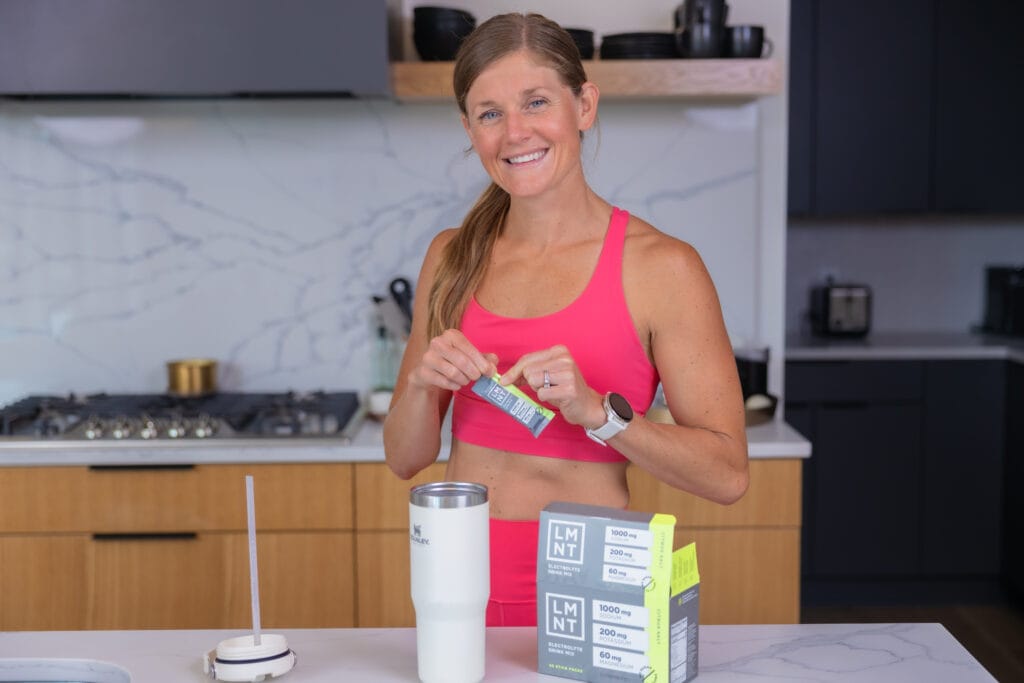
    Women opening a packet of lmnt electrolyte flavor citrus salt in her kitchen.

    What Is LMNT?

    LMNT is a tasty electrolyte drink mix that’s simple to add into your water for extra hydration. This drink mix is full of clean ingredients — no sugar, coloring, artificial ingredients, gluten or fillers.

    You lose both water and sodium when you sweat, no matter your activity level. Both need to be replaced to prevent muscle cramps, headaches and energy dips.

    The electrolytes in LMNT are minerals that conduct electrical charges in your body, maintain fluid balance, aid in blood flow, regulate blood pressure, and influence a wide range of hormones. As with most other nutrients, electrolyte needs increase during pregnancy, postpartum and injury recovery.

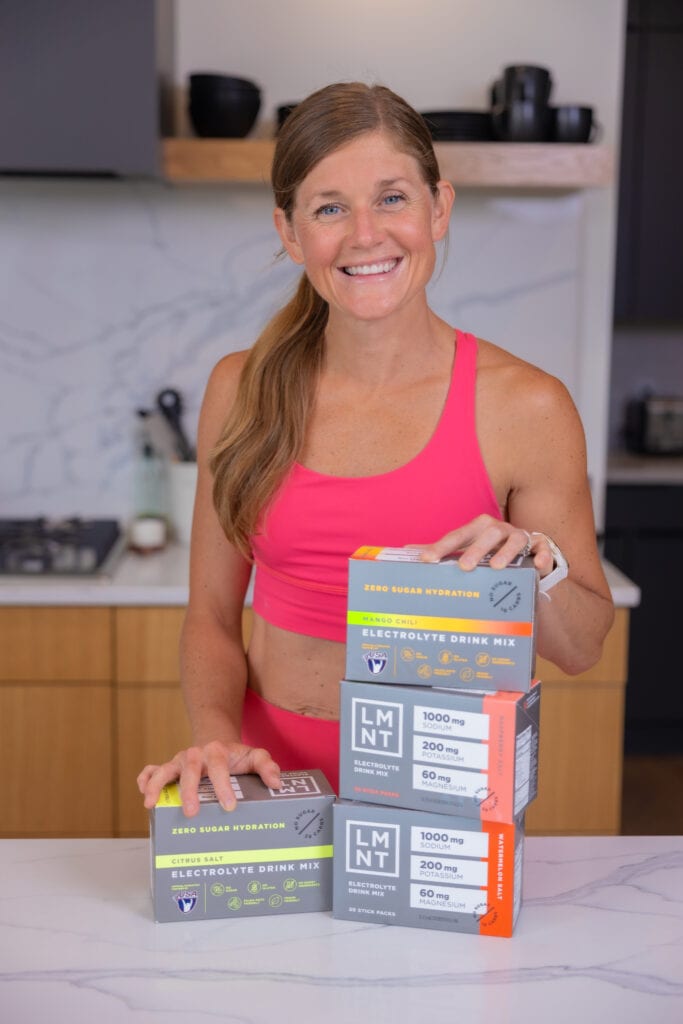
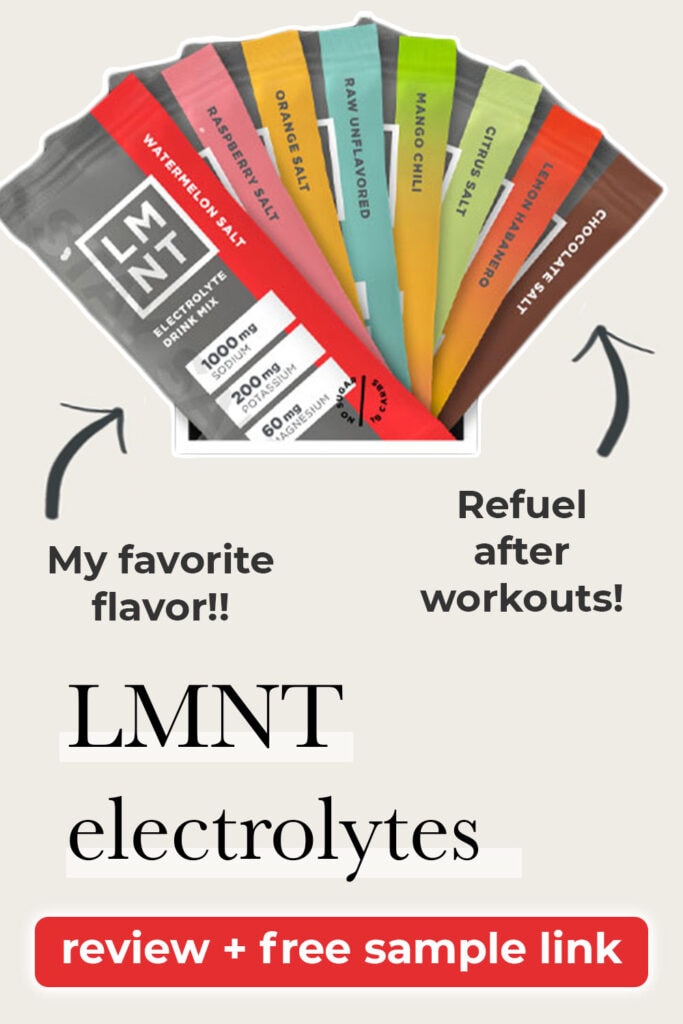
    Women with the LMNT electrolyte flavors: watermelon, mango chili, citrus salt, and raspberry salt.

    Try LMNT

    A high-quality electrolyte-rich drink mix – delivered directly to your doorstep. Click the link below to receive a free LMNT sample pack of all flavors with any order!

    Claim Offer

    LMNT Ingredients: What’s Inside the Mix?

    LMNT electrolyte powders contain essential electrolytes like sodium, potassium, and magnesium for fluid balance, nerve function, muscle contraction and cellular health. 

    • Sodium: helps regulate fluids, nerve function, muscle contractions and nutrient absorption. Each stick pack of LMNT contains 1,000 mg of sodium. 
    • Potassium: helps muscles contract, supports healthy blood pressure and supports cell hydration. Each stick pack of LMNT contains 200 mg of potassium. 
    • Magnesium: aids in muscle relaxation, energy production, blood sugar levels and heart function. Each stick pack of LMNT contains 60 mg of magnesium. 
    • Other Trace Minerals: minerals like zinc, iron and selenium are also found in LMNT.
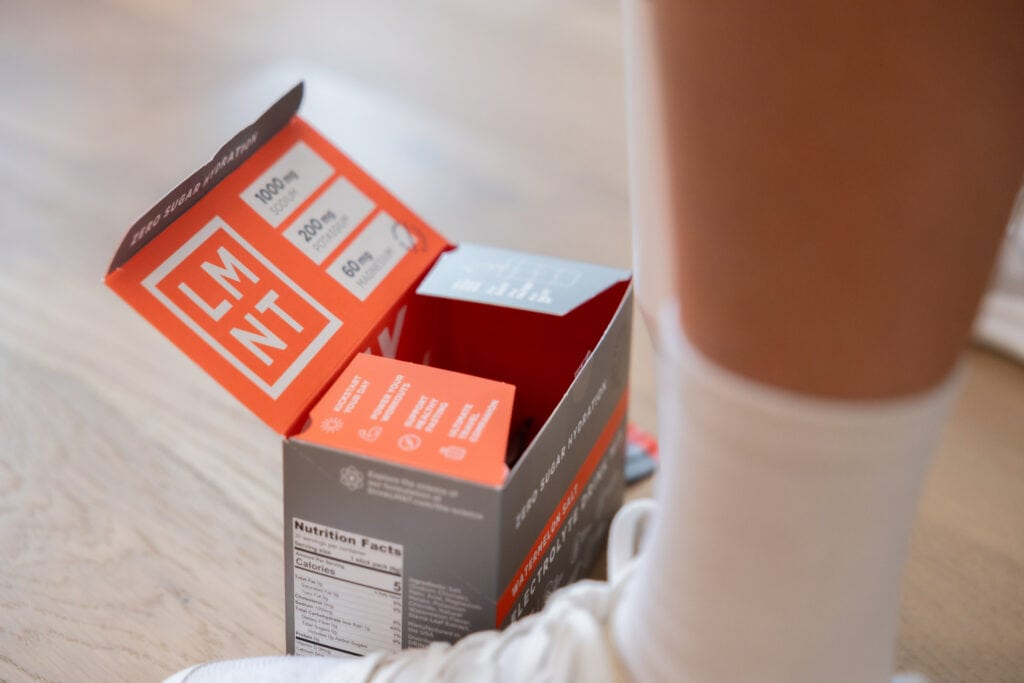
    A box of the electrolyte drink mix LMNT of the flavor raspberry salt. With the ingredients of sodium chloride, potassium chloride and magnesium. ,

    LMNT Taste Test Review

    • Grapefruit: This delicious flavor is great on its own or when added to sparking water.💜 NML Team Favorite
    • Citrus Salt: A perfect mix of a salty, sweet and sour. 💜 NML Team Favorite
    • Orange Salt: Refreshing summer flavor and tastes even better in sparkling water.
    • Watermelon Salt: Tastes just like a watermelon jolly rancher (no joke). 💜 NML Team Favorite
    • Raspberry Salt: Tart, sweet and the perfect mix of salt. 💜 NML Team Favorite
    • Mango Chili: Right amount of spicy to make a cocktail or mocktail.
    • Raw Unflavored: Contains no added sweeteners. Can be enjoyed plain or added to other drinks.
    • Chocolate Salt: Winter favorite because it mixes well with warm beverages (add to coffee for a salty mocha or to hot water for a salty hot chocolate).
    • Chocolate Caramel: Another winter favorite to add to your coffee or hot chocolate!

    Is LMNT Worth It?

    Yes! Adding electrolytes to my routine has helped with nausea and fatigue during pregnancy, supported hydration postpartum, and improved my energy and athletic performance. LMNT has also been great for my family—my husband drinks it before volleyball to prevent muscle cramps and boost performance, and it helps ensure my kids get the vitamins and minerals they need.

    Pros of LMNT

    1. LMNT has no artificial ingredients.
    2. These drink sticks are low-calorie and have no sugar, making them suitable for many types of diets (LMNT is keto-friendly and paleo-friendly).
    3. They include a balance of sodium, potassium and magnesium.
    4. This company offers free shipping in the US and a no-questions-asked return policy. 
    5. The powdered mix can be added to a wide range of liquids, including flat water, sparkling water and coffee.

    Cons of LMNT

    1. LMNT contains 1,000 mg of sodium — some customers believe the electrolyte mix tastes too salty.
    2. This drink mix may not be appropriate for those with high blood pressure or those who are salt-sensitive and on a low-sodium diet.
    3. LMNT is more expensive than other electrolyte brands, including LiquidIV.
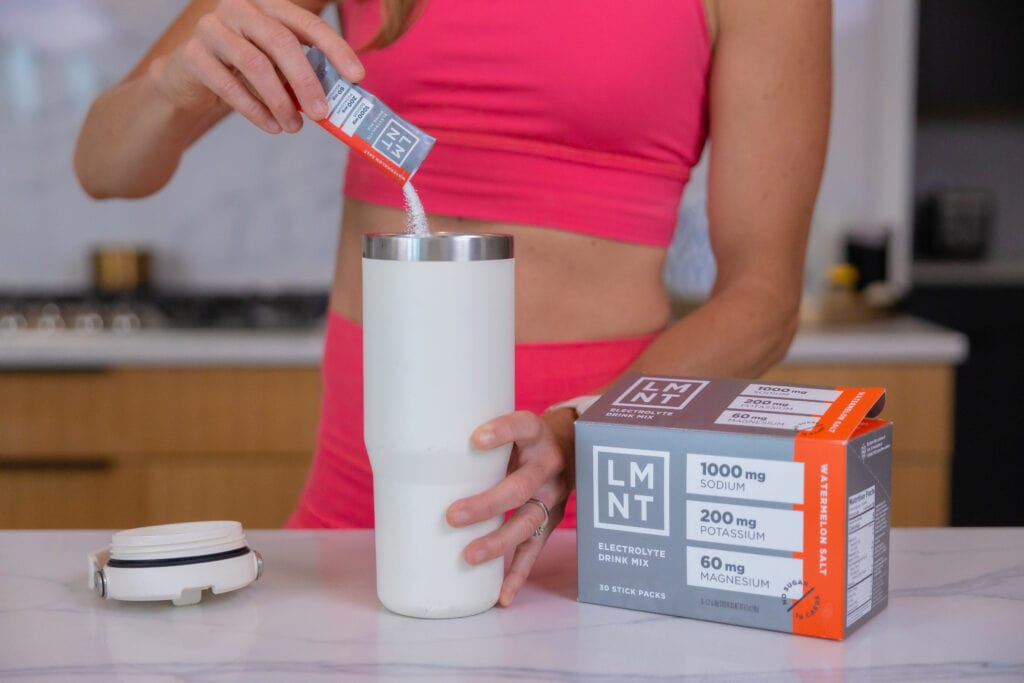
    Women opening a packet of the best electrolyte drink mix lmnt electrolyte flavor watermelon salt into a water bottle in her kitchen.

    How Much Does LMNT Cost?

    LMNT electrolytes are sold as either a one-time purchase or as a monthly subscription. You can select the monthly subscription to receive a discounted price. One box of LMNT costs $45 for 30 stick pack servings. 

    If you have never tried LMNT and are not sure which flavor you would enjoy, I suggest buying the LMNT Variety Pack for a one-time purchase of $20. You’ll receive citrus salt, raspberry salt, orange salt and watermelon salt (3 sticks of each flavor). You’ll also receive a free sample pack of every flavor when you use the link in this blog post.

    If you know which flavors you want, I recommend the insider bundle pack. This value pack includes 120 stick packs (four boxes — choose your four flavors) and you’ll receive a free LMNT sample pack of every flavor when you purchase through my link. Subscribe and save for $117 ($0.98/stick) or make a one-time purchase for $138 ($1.13/stick). 

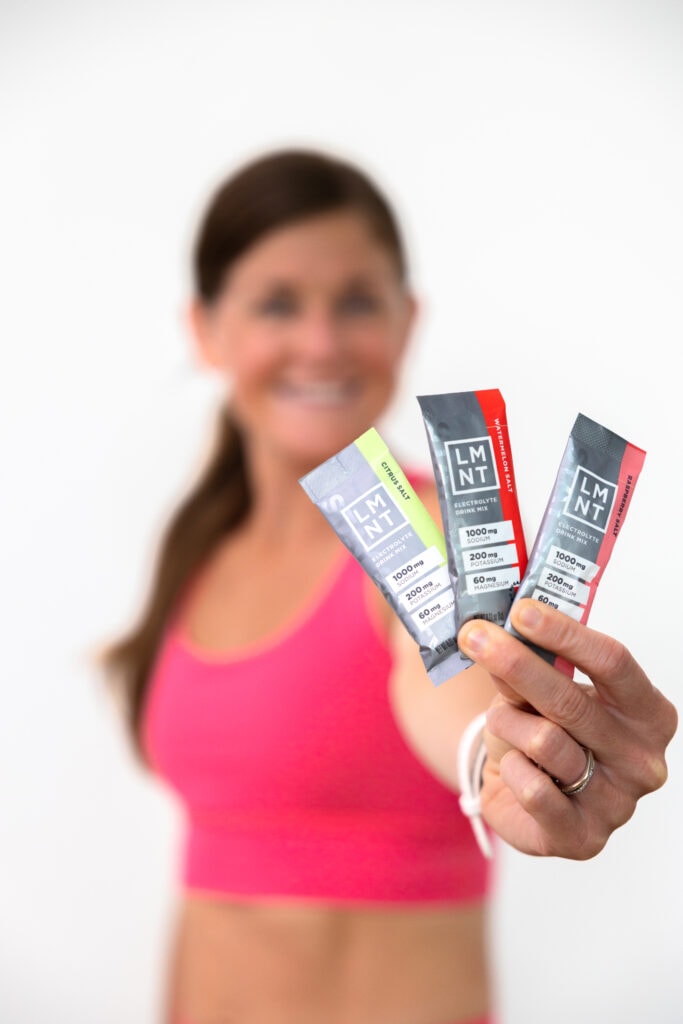
    women holding out three flavors of the LMNT electrolyte packets. Flavors: watermelon salt, raspberry salt and citrus salt.

    Try LMNT

    A high-quality electrolyte-rich drink mix – delivered directly to your doorstep. Click the link below to receive a free LMNT sample pack of all flavors with any order!

    Claim Offer

    LMNT Electrolyte FAQs

    What Are The Benefits Of Drinking LMNT?

    LMNT electrolyte drink mix is designed to replenish essential electrolytes including sodium, potassium and magnesium. LMNT can support hydration, increase energy, reduce headaches, and improve mental focus.

    Can I Drink LMNT Everyday?

    LMNT is safe to drink every day. LMNT suggests mixing one packet of electrolytes into 16 or 32 ounces of water, depending on how salty you want the drink to taste. I personally drink electrolytes daily during my workout. I add half a packet of LMNT and 5g of creatine to 30 ounces of water.

    Who Should Use LMNT?

    You are most likely to benefit from using LMNT if you are an athlete or are highly active, are living in hot and humid climates, or if you are breastfeeding.

    Who Should Not Use LMNT?

    LMNT does contain 1,000 mg of sodium per packet, which may not be suitable for some individuals. I recommend talking to your doctor about using LMNT if you have been diagnosed with hypertension, are sodium-sensitive, aren’t physically active, or eat a diet high in processed foods.

    What Is The Difference Between LMNT And LiquidIV?

    LMNT doesn’t have any added sugars or carbohydrates like LiquidIV does. LMNT contains magnesium while LiquidIV does not. LMNT has 1,000 mg of sodium per packet while LiquidIV has 500 mg of sodium per packet. I personally prefer the flavors and ingredients in LMNT compared to other electrolyte brands. 

    Pin This Post: LMNT Electrolyte Review

    LMNT Electrolytes Review Post - pin for pinterest

    This post includes affiliate links. I do make a small commission for products purchased using these links (at no additional cost to you). Thank you for supporting Nourish Move Love, making the content you see on this blog possible.

    #LMNT #Electrolyte #Review #Health #Benefits

  • Larry Scott Workout Routine: Train Like the First Mr. Olympia

    Larry Scott is bodybuilding. Yes, that’s a complete sentence. He’s arguably the most prolific bodybuilder ever and was the first to bring the obscure sport to the mainstream. Not only was he the winner of the very first Mr. Olympia in 1965, he came back in 1966 and became the first back-to-back Mr. Olympia champion! Sure, many others came after Larry Scott, but he was the first bodybuilder and a trailblazer who made having mass look amazing! We’re going to lay out now not just one Larry Scott workout routine but 2! If you want to train like the “Legend,” keep reading.

    Who is Larry Scott?

    Larry Scott was born in 1938, and this is where his story starts. Growing up, Larry Scott was not this genetic monster destined to be the top bodybuilder she would later become. Rather, Larry is very open about how he was just a skinny, scrawny little kid. That was until he stumbled upon a bodybuilding magazine in a dumpster at the age of 16. This discovery was his first experience with bodybuilding, and he became hooked.

    His transformation from a skinny teenager to a bodybuilding legend is truly inspiring and a testament to the power of dedication and hard work; you could even say he was the first “motivational transformation.” If he were alive today, he’d for sure have a short video with edited progression shots in it.

    At the time, he reportedly weighed less than 130 lbs at 5’8″. He was also said to have narrow shoulders, which is generally an automatic disqualifier from being a professional bodybuilder with any type of meaningful presence. As he won Mr. Olympia later on in his life, it’s obvious he learned to deal with it.

    From 16 to 20, Larry Scott trained hard. He learned a lot and altered his training until he had put on a significant amount of muscle and started his career in 1959. He made waves immediately, winning contest after contest. He won IFBB Mr. America in 1962, IFBB Mr. Universe in 1964, and then the first two Mr. Olympia contests in 1965 and 1966. He would then retire, leaving a legacy as a trailblazer of the sport.

    Larry Scott Workout Routine

    As mentioned above, we will review two different workout routines for Larry Scott. Since Larry Scott had trained for many years, he utilized numerous workout routines and methods throughout his time.

    It’s hard to 100% verify this information, but multiple sources have said Larry Scott’s workout routine varied greatly from when he first began working out to later on in his career. The determining factor is reportedly his use of steroids. Now, we can’t 100% verify what caused his training to change, so take that with a grain of salt.

    The reasoning would make sense as the total volume increased dramatically.

    Larry Scott 3-Day Full Body Split

    Larry Scott’s “before” workout had him training 3 days a week using a full-body split. He only used one exercise per body part and would then use high volume, generally 6 sets. This makes this program insanely easy.

    Further, he primarily used moderate reps, on the lower end. Most exercises were performed with 6-8 reps and just one with 8-10 reps. Besides, he performed 15-20 reps for his calves and then a crazy 100-150 bent knee leg raises.

    He got this workout routine from Vince Gironda, who uses this training style and other methods, such as an 8×8 routine. To refresh your memory, Vince Gironda is well known to be one of the primary mentors of Arnold Schwarzenegger and his bodybuilding success.

    To be clear, even though we suggested this would be “low-volume” to his workout routine later in his career, this is still high-volume as he’s using about 18 working sets per muscle group.

    EXERCISE SETSREPS
    Barbell Squats68
    Bench Press to the Neck66-8
    Calf Raises615-20
    Behind the Neck Shoulder Press66-8
    Lat Pulldowns68-10
    Barbell Tricep Extension66-8
    Preacher Curls 66-8
    Bent Knee Leg Raises1100-150

    Larry Scott’s 6-Day Body Part Split

    In comparison, his “after” program had him training five days a week using a typical body-part split, or “bro-split,” similar to the Arnold split This type of workout was used during the peak of his career,  and the added volume probably contributed to his becoming the first Mr. Olympia.

    It’s also believed that he built this training program under the guidance of the same god-like figure in bodybuilding, Vince Gironda! Again, Vince was responsible for mentoring many of the top early bodybuilders; he was a pivotal figure in his own right and a fountain of knowledge!

    While Larry Scott does use slightly higher reps, 8-12, he still uses a relatively high number of sets per exercise, averaging 5. The sheer amount of volume per muscle group in a single training session is also a point of interest. For example, he used 28 sets to train his chest in one day!

    larry scott workout

    Chest

    EXERCISESETS REPS
    Wide Grip Barbell Bench Press55-8
    Incline Dumbbell Press55-8
    Parallel Bar Dips510-12
    Incline Dumbbell Flys58-12
    Decline Dumbbell Flys58-12
    Push-ups3AMRAP

    Back

    EXERCISESETS REPS
    Wide Grip Chin-ups55-10
    Hanging Scapular Rotation From Bar510-12
    Straddled Single Arm Lat Pulldowns58-12
    Close Grip Seated Cable Rows510-12
    Crossbench Dumbbell Pullovers510-12

    Shoulders

    EXERCISE SETSREPS
    Standing Barbell Overhead Press55-8
    Dumbbell Scott Press55-8
    Barbell Front Raises510-12
    Dumbbell Lateral Raises510-12
    Rear Delt Raises510-12

    Arms

    EXERCISESETS REPS
    Barbell/Dumbbell Scott Curls510-12
    Single Arm Biceps Curls510-12
    Barbell Overhead Triceps Extensions510-12
    Single Arm Triceps Extensions510-12
    Reverse Barbell Curls510-12

    Legs

    EXERCISE SETSREPS
    Narrow Stance Barbell Squats55-8
    Hack Squats55-8
    Barbell Stiff Leg Deadlifts55-8
    Leg Extensions510-12
    Standing Calf Raises515-20

    Abs

    EXERCISE SETSREPS
    Sit-ups315
    Bent Knee Raises315
    Leg Raises315

    Scott Curls And Scott Presses

    You don’t become Mr. Olympia without leaving a mark in the gym; Larry Scott created two exercises: the Scott curl and the Scott press. We wanted to give these two special attention to further elaborate on how to perform these exercises and the ingenuity of Larry Scott and Vince Gironda. It’s interesting to look at how these trailblazers trained, as they literally invented some exercises as they went on to meet their needs.

    Scott Curl

    Larry Scott was known for having massive arms, especially his biceps. Part of this growth was his use of what’s become known as “Scott curls.”  Scott’s curls are basically preacher curls, and the terms tend to be used interchangeably.

    If there’s any major difference, it’s that a Scott curl would be performed with free weights and a preacher curl with a machine, but that’s really splitting hairs. Either way, Larry Scott first performed them using the back of a bench. As such, this caused his elbows to be close together with his arms spread out slightly with external rotation. If you watch a lot of guys do preacher curls, their elbows will be out wide, and their arms will be slightly internally rotated. Don’t do that!

    What’s interesting is that one of the reasons Larry did this is that he believed the exercise stretched the bicep at the very bottom of the movement. He emphasized the need to go all the way down and get that full stretch. In fact, he was known to promote little mini reps at the bottom of the movement as a finisher.

    With what we now know about stretch-mediated hypertrophy, it seems he was right! In fact, here’s a study in which trainees performing preacher curls with just the lower half of the rep saw 2.25% greater growth than those who trained using just the top portion!¹

    Scott Press

    The Scott press is another exercise made famous by Larry Scott. Vince Gironda designed it specifically for Larry so he could grow his shoulders. Larry believed his triceps were too strong for regular overhead presses and always overpowered his delts. To get around this, Vince created this unique exercise for him.

    The Scott press is a dumbbell shoulder press, but the elbows don’t extend; they stay at a 90-degree angle. You begin the movement as you would any dumbbell overhead press. You then drive your arms up, but your elbows stay bent. This will drive your elbows up, and the dumbbells will move towards your head. It looks simple, but it’s pretty complicated to master due to our natural inclinations. Here’s a video of the Legend himself performing it!

    Larry Scott Diet

    Larry Scott was one of the first bodybuilders to put a major emphasis on nutrition in bodybuilding. Well, maybe the second bodybuilder, as he got most of his education from, again, the legendary Vince Gironda.

    Either way, Larry Scott generally stuck to a high-protein, high-fat, low-carb diet. For example, he was known to follow the “steak and egg diet” advocated by Vince. The steak and egg diet is exactly what it sounds like, as that’s all you would eat. It was believed to support muscle growth, increase testosterone, and burn fat.

    Even when not on this diet, he maintained similar macros. He ate a lot of meat, eggs, cheese, and milk. Larry Scott also ate a few carbs, including a minimum amount of vegetables.

    Desiccated Liver Tablets

    Larry Scott also consumed a ton of liver tablets daily, something that was common among early bodybuilders. This was one of his primary supplements.

    Liver tablets packed a ton of minerals, vitamins, and BCAAs, which helped nourish his body, support muscle growth, and maintain a healthy body.

    Protein Powder & Amino Acids

    Larry Scott was well known for being a fan of protein powder. He did advocate whole foods but was realistic about the need to support an elite bodybuilder.

    With that said, he was known to take at least one serving every day, and many days, he’d take two. Further, Larry was known to make protein shakes using up to ⅔ quarts of cream and milk to increase total calories and further increase his protein intake in addition to healthy fats and nutrients.

    Digestive Enzymes and Hydrochloric Acid Tablets

    During Larry Scott’s bodybuilding period, taking digestive enzymes and hydrochloric acid tablets was another common practice. These are meant to aid in the digestion of food and the absorption of its nutrients.

    It just so happens that enzymes and the importance of gut health have recently made a massive comeback. If you were to look at numbers, we’d bet “gut health” is one of the top rising topics of interest. So basically, Larry Scott and his fellow lifters were once again following solid nutritional principles decades ago.

    Training Like Larry “The Legend” Scott

    Larry Scott is a monumental figure in the sport of bodybuilding and fitness as a whole. He was a trailblazer and created a pathway for all future bodybuilders. What’s interesting is just how accessible his training was. Yes, Larry Scott used a lot of volume, but his workout routines were terribly simple compared to today’s. We love that; it shows effectiveness doesn’t need to be complicated. Even though Larry Scott used various workout routines, his training methodology always shared a common theme: do what works and then do it a lot.

    Check out our full collection of celebrity and pro athlete workout routines!

    References

    1. Sato Shigeru, Yoshida Riku, Kiyono Ryosuke, Yahata Kaoru, Yasaka Koki, Nunes João Pedro, Nosaka Kazunori, Nakamura Masatoshi. Elbow Joint Angles in Elbow Flexor Unilateral Resistance Exercise Training Determine Its Effects on Muscle Strength and Thickness of Trained and Non-trained Arms. Frontiers in Physiology, volume 12, 2021. 10.3389/fphys.2021.734509. 1664-042X

    #Larry #Scott #Workout #Routine #Train #Olympia

  • James Hall Record-Breaking Tips For Smashing the SkiErg

    James Hall is a former professional rugby player, brother to strongman Eddie Hall, and a strength coach who is smashing it on the Concept2 SkiErg. Having broken the record for the fastest SkiErg times to reach both 1,000 and 2,000 meters, this Brit knows how to get the most bang for his buck when it comes to efficiency, as he recently shared via social media.

    Hall set a record of 2 minutes and 40.6 seconds in the 1000m SkiErg and 5 minutes and 57.3 seconds in the 2000m distance. He did so by studying the machine and learning the best way to train in order to get the maximum output. His resulting advice will be of great value for gym goers, CrossFitters, and HYROX athletes alike. “You don’t want to stay down with the cord and burn your quads out,” shared Hall in an IG post on August 23, 2024. “Punch the cords down and get yourself back upright asap. The less time you’re on the resistance (part of the move) and back up tall, the more efficient you can be.”

    James Hall SkiErg Tips for Greater Sustainability

    The SkiErg has become popular with all types of athletes, from endurance specialists to WWE wrestlers like “Stone Cold Steve Austin”, but while the exercise is great for cardio, and working the whole body, the focus shouldn’t be on your legs says Hall. “So, make that punch count,” he explains. “Use your hips and bodyweight, make the fan spin fast, stand up early ready for your next stroke.”

    Hall is adamant that the pulling action should not travel down towards a squat. “I’m very hinge based (at the hips),” he explained in another post back in July. The former competitive swimmer notes that those who are successful on the SkiErg take the same approach as him, and only use around 25% of the movement, choosing not to squat down when they pull the cord, but rather bend at the body. This method is far more sustainable, especially over long periods of time, rather than tiring out the quadriceps. “In HYROX, do you want to pull the SkiErg to your knees and gas your quads out for the next 1K run? Would the marathon world record holder Andrea Nygaard be able to hold 1:45.3 (average pace) for 2 hours 28 minutes pulling it to his knees!? No way!”

    So, there you have it, aim for higher ground the next time you hit the SkiErg and don’t be tempted to slope too far at the knees.

    Improve your Posture and Your Cardiovascular With The SkiErg

    For more information on James Hall’s online coaching follow him on Instagram!

    #James #Hall #RecordBreaking #Tips #Smashing #SkiErg