meta name="google-site-verification" content="6a1diVfBBjrtLHOs0wceITdcAeKPOV6tx6NhXqyRKPs" /

AACCC counselling for NEET UG 2024 begins today, check details here

[ad_1]

Aug 28, 2024 10:04 AM IST

AYUSH NEET UG Counselling 2024: NEET-UG qualified candidates can apply for it on the official website, aaccc.gov.in.

AACCC NEET UG Counselling 2024: The Ayush Admissions Central Counselling Committee (AACCC) will begin the online counselling process for undergraduate courses today, August 28. NEET-UG qualified candidates can apply for it on the official website, aaccc.gov.in.

AACCC counselling for NEET UG 2024 begins today (Representational image)(Unsplash)

Ayush Admissions Central Counseling Committee (AACCC) conducts online counseling for allotment of all India quota (AIQ) seats of undergraduate (BAMS/BSMS/BUMS/BHMS/B.Pharm-ITRA) courses.

As per the counselling schedule, registrations for the first round will remain open up to September 2 (2 pm). The fee payment window will close at 5 pm on September 2.

The choice filling window will open on August 29 and close on September 2 (11:55 pm). The window to lock choices will open at 2 pm and close at 11:55 pm on September 2.

Round 1 seat allotment result will be announced on September 5.

Selected candidates must report at the allotted institutions between September 6 and 11.

The second round of AYUSH NEET UG counselling will begin on September 18 and the third round will begin on October 9. After the regular rounds are over, the AACCC will hold three stray vacancy rounds for various institutions. Check the schedule here.

How to apply for AACCC AYUSH NEET UG counselling 2024?

  1. Go to aaccc.gov.in.
  2. Open the registration link for the first round of UG counselling.
  3. Provide the required details and login.
  4. Fill the registration form, upload the required documents.
  5. Pay the application fee.
  6. Submit the form and save the confirmation page.

AYUSH NEET UG Counselling 2024: Application fee (non-refundable)

For AIQ government, government-aided colleges, central universities/national institutes

1,000 for unreserved, EWS and OBC-NCL candidates

500 for SC, ST and PwBD candidates

For Deemed universities: 5,000 for all candidates

In addition, candidates have to also deposit refundable security money of 20,000 for AIQ government colleges, aided colleges, central universities/national institutes and 50,000 for Deemed universities.

Check the information bulletin for more details.

Elevate your career with VIT’s MBA programme that has been designed by its acclaimed faculty & stands out as a beacon for working professionals. Explore now!

Discover the complete story of India’s general elections on our exclusive Elections Product! Access all the content absolutely free on the HT App. Download now!
Get latest news on Education along with Board Exam, Competitive Exam and Exam Result at Hindustan Times. Also get latest Job updates on Employment News

[ad_2]

Source link

Assam: NIT Silchar to reconsider awarding degree to Bangladeshi students posting anti-India remarks | Education

[ad_1]

The authorities of National Institute of Technology (NIT) are reconsidering if the students from Bangladesh, who allegedly posted anti-India remarks on social media, should be awarded their degrees.

ASSAM: NIT Silchar to reconsider awarding degree to Bangladeshi students posting anti-India remarks

Some students from the neighbouring country, who have completed studies here, were found posting anti-India remarks during the student movements in their country recently.

Educational institutions reopened in Tripura after a week closure due to flood

At least 77 students from Bangladesh are studying here on scholarships under Indian Council for Cultural Relations (ICCR) of Ministry of External Affairs, India.

Director of NIT, Silchar, professor Dilip Kumar Baidya on Tuesday told HT that as per their knowledge, one student named Sadat Hossain Alphi, who has completed the academic activities recently, was allegedly seen posting anti-India slogans. However, he is yet to be awarded the final degree.

Check This: What is adaptive learning? How it helps in preparing for NEET, JEE exams which have vast syllabus & intense competition

“All the controversies are surrounding his alleged social media posts and we are also examining his posts. Since he is not in our campus anymore and the protests occurred outside our campus, we cannot take any decision instantly,” he said.

It can be mentioned that several complaints were lodged before the police in Cachar district by different organisations like Vishwa Hindu Parishad against Bangladeshi students of NIT Silchar for their alleged anti-India remarks on social media.

Superintendent of police (SP), Cachar district, Numal Mahatta on Saturday night visited the NIT Silchar campus and ordered the cyber monitoring cell to investigate the matter.

Read More: ‘Is God real? Is Satan real?’: US high school assignment sparks outrage, furious mother shares questions

Additionally, the return of the final year student from Bangladesh’s Dhaka, who was sent back home on Monday after she liked an anti-India post, is also uncertain because she will only be allowed here only if the Ministry of External Affairs permits it.

A former student of Assam University Silchar on Saturday alleged that a Bangladeshi student residing in NIT Silchar campus has reacted to one of the anti-India posts.

After her name surfaced on social media, she applied to the authorities to let her leave the campus and police on Sunday escorted her to the India-Bangladesh international border in Karimganj.

Professor Baidya on Tuesday said that the female student will not be able to return unless the Bangladesh government sends her after discussing the matter with the government of India.

“Since they are studying under ICCR, the female student needs permission from the concerned authorities to return here. Alphi has completed the academic studies but his degree is yet to be awarded. After investigation, we’ll reconsider if it’ll be awarded to him at all,” he said.

According to the protesters, some other former students of NIT Silchar, who are presently in Bangladesh, were seen posting anti-India remarks and complaints would be lodged against them too.

Subhasish Choudhary from Hindu Rakkhi Dal said that they are protesting against the anti-India posts by the Bangladeshi students but they are not against everyone.

“Nearly 500 students from our area are studying in various parts of Bangladesh and we should think about their safety before posting anything on social media,” he said.

Professor Baidya said that they have instructed their students to refrain from posting anything on social media on this controversy.

He also said that Sadat Hossain Alphi reached out to the authorities after the controversy and claimed that his facebook account was hacked and he didn’t post anything against India.

“We’ll investigate if his claims are true before taking the final decision,” professor Baidya said.

[ad_2]

Source link

A Better Measure of Teacher Shortages

[ad_1]

New Insights and Opportunities

Web scraping is relatively inexpensive, disaggregates job postings by subject area, and can capture data twice a week. Because job postings are available at this frequency, they provide a clear, nuanced, and timely signal of school staffing needs.

The importance of timeliness cannot be overstated, especially when considering traditional data reporting and state legislative calendars. In Washington State, legislators conclude their work by late April, or sooner, each year. In spring 2023, for example, any state funding or policy decisions aimed at addressing teacher staffing challenges in the 2023–24 school year would have been based on data from 2021 (a May 2021 report on teacher shortages and the state education department’s 2021 report card) and early 2022 (the national teacher shortage survey from 2021–22). Data from job postings would have provided a detailed snapshot from the fall of 2022—more current by almost a full year.

The timebound nature of scraped job postings data also sheds light on school and district hiring processes as they relate to teacher quality. Research has shown that late hires, which happen in late summer or early fall, can be detrimental to student learning. Observing when districts post open jobs can signal whether they are engaged in early hiring, late hiring, or something in between, where the difference can mean new teachers have months to prepare or are scrambling to get their footing after the school year has already begun. Such information could inform policy and targeted supports for more effective management practices.

Job postings data can also serve as a ready measure of policy impact. State personnel data tell us when new people are hired, but those data are generally not available until the following school year. This lag is limiting when policymakers are facing immediate issues, such as the imminent expiration of federal Covid-era relief funding. For example, in a separate analysis, we looked at scraped job postings data in Washington State to determine the impact of federal ESSER (Elementary and Secondary School Emergency Relief Fund) dollars on school staffing. That analysis found that 12,000 school staff and roughly 5,100 teachers were hired statewide with ESSER funds—suggesting that district budgets will likely face cuts when the funds are gone.

Scraped job postings data do not capture everything education leaders and policymakers need to know. Job postings data don’t show the share of teachers working out-of-field or with emergency credentials, or illuminate trends in teacher retention, diversity, or quality. However, the data can serve as an important accompaniment to traditional data collection.

Many states are currently investing millions of dollars to support new pathways into the teaching profession; scraped data could steer investment toward subject area and school types most in need of new teachers. Incentives such as loan forgiveness, bonuses, housing stipends, and salary boosts could also be directed toward districts that struggle to hire sufficient staff. Such policies have helped address shortages in the past; for example, in Hawaii, a $10,000 bonus program for new special education teachers reduced vacancies by 32 percent, research by one of us (Roddy Theobald) has found. States could also use scraped data to coordinate with undergraduate institutions to recruit students in shortage areas like STEM to pursue a teaching credential. Additionally, typical counts of unfilled classroom jobs tend to overemphasize the shortage of elementary teachers, which are the largest share of the workforce, and understate the immediate needs for special education and STEM teachers, who are employed in smaller numbers overall.

Common sense and job postings data tell us that teacher shortages are multifaceted and complex. There are multiple, distinct challenges to bring credentialed educators into the classroom based on subject area and school type, and hiring enough qualified candidates will require a variety of inputs and incentives. Web scraped job postings data highlight inequities in teacher demand and supply that go beyond what is captured in administrative data, and they appear to be a valid signal of district and school hiring needs. This low-cost, timely method of data collection can provide vital information to policymakers and educators who hope to address systemic inequities in public schools.

[ad_2]

Source link

Australia’s 2025 enrolment cap unveiled, but uncertainty lingers

[ad_1]

On August 27, the Australian government announced that, subject to the passage of legislation before the parliament, a National Planning Level for new international student commencements will be set at 270,000 for calendar year 2025.

In a joint media release, ministers said that independent providers will be allocated 30,000 new student commencements, while public universities will receive an allocation of around 145,000.

Education minister Jason Clare suggested providers in the vocational education sector will see the largest reductions. Under the new “managed approach”, there will be around 95,000 new VET international student commencements in 2025.

It is understood that institutions will each be subject to individual caps for the duration of the academic year – although these have not yet been made public.

However, Clare said that as of August 27 universities would have begun receiving communications containing their individual caps for 2025, with the government intending to making this information public “in due course”.

One stakeholder “disappointed” with the allocation for independent providers is Peter Hendy, CEO of Independent Higher Education Association, pointing out that some institutions will only be able to recruit international students numbers at approximately 21% of the level allowed for public providers.

“Given the important role of independent higher education providers to the international education market, we have initial concerns that the 2025 allocation is only slightly better than the 27,000 international student commencements at independent providers during a Covid-ravaged 2021,” he said.

From the outset, IHEA has been opposed to capping of international students, especially the impact it could have on a sector that has already suffered from a “brutal visa processing regime”, said the peak body representing Australia’s independent higher education providers.

One change mostly welcomed by the sector is the proposed end to the controversial ministerial direction 107 from January 1 2025.

“While the end of ministerial direction 107 is important, it will be even more important that for the remainder of 2024, it is not used as blunt instrument to further damage the international education sector,” said Hendy.

Meanwhile, Neil Fitzroy, managing director, Australasia, Oxford International Education Group, said that “conflation of the planned rescinding of ministerial direction 107… does little to redress the concern that this Bill is a migration Bill masquerading as education policy”.

Group of Eight CEO Vicki Thomson said that in defending the caps, Clare “has engaged in a clumsy sleight of hand by conflating ministerial direction 107 – a visa processing capacity issue of the government’s own making – with caps”.

“Caps will not undo the damage of ministerial direction 107 as international students simply will not study where the Australian government tells them to,” pointed out Thomson.

For Fitzroy, sector fears have came true, in that the proposed enrolment caps have been “derived by a crude spreadsheet formula with little consideration of the individual contexts of providers or states”.

The legislation required to impose these enrolment caps has not yet been passed, or yet completed senate review, he reminded the sector, and yet global headlines “again reflect the confusion, chaos and contradictions reigning in Australian policy”.

Student confidence in Australia as a welcoming destination is today at serious risk

Neil Fitzroy, OIEG

“With four months until the end of calendar year, prospective students for 2025 intakes – including those with visas already issued, others already in Australia on a pre-sessional course, and those still deciding their study destination – have no further clarity on their future study plans. Student confidence in Australia as a welcoming destination is today at serious risk.”

“Prospective students, their parents, education agents and Australian education providers have a multitude of questions regarding the intended implementation of the proposed legislation – the information shared from department has raised more questions than it has answered,” said Fitzroy.

Just a day before the announcement, stakeholders gathered for the second day of Senate hearings on the ESOS bill. Significant concerns were raised – worries that still linger – about the economic impact of the enrolment caps, now known as the National Planning Level.

Thomson has since blasted government for its lack of economic modelling on the impact of caps on Australia’s economic outlook, raising concerns that the impact of caps had not been incorporated into economic forecasts.

Treasury officials said their work could not be characterised as modelling but instead described it as as “analysis” and “broad economic advice”. It was also revealed that economic modelling will be undertaken after caps are set, in what Thomson is calling a “startling admission”.

[ad_2]

Source link

Why students leave and how to prevent it: Survey reveals higher ed data practices impacting retention

[ad_1]

Higher ed retention rates are on the upswing, say researchers, coinciding with institutions’ growing use of data capture and analysis to identify risk factors and intervene before students jump ship. Student retention remains a leading priority — and source of headaches — for higher ed leaders amidst a shrinking pool of students, rising competition and skepticism over the value of higher education. Knowing which behaviors or experiences make withdrawal more likely can help institutions reverse detractions before students are lost.

To shed light on the opportunities to drive engagement and counter the factors that often precede students’ decision to leave, TouchNet partnered with Higher Ed Dive’s studioID to survey higher ed leaders across the U.S. and Canada about which experience levers they prioritize or deem effective in student retention.

Identifying early indicators of imminent student dropout

What factors tend to sway students’ decision to leave before completing their degree? Surveyed higher ed leaders ranked challenges based on their impact on students’ choice to drop out. Top challenges indicated as having a “significant” or “moderate” impact included:

  • Financial hardship (86%)
  • Emotional or mental stress (80%)
  • Job of family responsibilities (73%)
  • Health challenges (66%)
  • Courses are not a good fit for career goals (65%)
  • Lacking sense of belonging or participation in non-academic campus activities (65%)
  • Technology obstacles to navigating the higher ed experience (59%)
  • Inconsistent experiences with campus services, resources or staff (57%)

Given the broad range of influential factors, institutions may find it challenging to know which area(s) to focus their improvement efforts first. Fortunately, students often leave many clues indicating they’re disengaged and at risk of imminent withdrawal before they actually drop out, such as the following signals indicated by the survey respondents:

  • Student has frequent class absences (63%)
  • Student’s grades are slipping (61%)
  • Student is behind on tuition payments (42%)
  • Student isn’t using resources or services at their disposal (41%)
  • Student has difficulty coming to campus for activities that require their physical presence (27%)
  • Student is late to return or access dorms (25%)
  • Student isn’t attending campus events or club meetings (23%)
  • On-campus resident isn’t using the meal plan (18%)

These trackable behaviors present opportunities for early intervention.

Tracking trending behaviors enables early identification of threats, opportunities

The higher education sector still trails behind other industries in its use of data to inform business, financial or operational decisions. Even so, data use in higher ed has grown steadily in the last couple of years, with twice as many leaders reporting that they use data to guide decisions in 2024 compared to TouchNet and Higher Ed Dive’s 2022 survey.

When asked what student data they compile and review in 2024 that wasn’t compiled or reviewed a year ago, survey respondents pointed to trending student behaviors, health services usage and financial data, among others.

Where are leaders finding that data? At many institutions, the solution lies in leveraging a tool that’s already deeply integrated into campus life: the campus ID. From dining hall swipes to building access, the campus ID is a common thread tying together different student experiences. For many leaders, that rich pool of data presents a prime opportunity to impact retention and revenue.

California College of the Arts (CCA) is an excellent example of how school leaders can leverage student activity data to inform decision making. CCA staff can easily access comprehensive student data — e.g., class registrations, payments, activity participation, meal plan usage, etc. — within a centralized dashboard. According to Michelle Ziegmann, CCA’s associate vice president of technology services, this great student data integration and access helps them “understand where students are from application to graduation so we can offer the right services at the right time that would help them stay on the path toward graduation.”

“Having access to that data is critical for spotting hidden risks and opportunities,” says Heather Richmond, vice president of marketing for TouchNet, which is CCA’s provider of integrated commerce and credentials solutions. It is also key in helping school leaders make sound decisions after they identify the risks and opportunities. “[Campus ID data] helps higher ed leaders vet their hunches as to why students are leaving, so they don’t sink effort and dollars into areas that won’t yield desired results,” Richmond explains.

Preventing a domino effect of disengagement and dissatisfaction

Students live interconnected lives, and no single metric can gauge student success (or their intent to leave) in isolation. Whether on campus or remote, student experiences are cumulative and interwoven: Grades, event attendance, a sense of belonging and more all come together to shape student sentiment toward the institution.

As one survey respondent explained, if you can’t pay your tuition on time, your grades might slip, you might skip campus events, and stress might taint all other campus experiences. Without proactive intervention, that one point of failure can trigger a domino effect, collapsing onto other experiences and perceptions.

It’s why having a unified source of campuswide data is such a game-changer, Richmond notes. “Put simply, it’s an evidence-based roadmap to help leaders spot pockets of waste and opportunity, as well as early risk signals that would’ve remained hidden otherwise.”

She concludes: “If you’re looking to impact retention with a high degree of certainty, your campus ID data is a trusty compass, illuminating your best next steps.”

Download the full survey report for more insights that can help strengthen student retention at your institution. Explore what’s possible for your institution when you schedule a complimentary consultation with TouchNet.

[ad_2]

Source link

Love My Library Partners With Mackin to Bring Easy and Equitable Book Fundraising to Schools

[ad_1]

Burnsville, MN – Love My Library is thrilled to announce its partnership with Mackin Educational Resources, a leading distributor of PK-12 library resources and educational materials. This strategic collaboration will significantly enhance the availability of books through Love My Library’s cutting-edge, fundraising platform to schools, libraries, and educational institutions across the country.

Renowned for its innovative approaches in supporting school libraries and fostering a love for reading, Love My Library will now offer over 5,000 titles through the Mackin platform. This inclusion marks a significant milestone for both organizations, combining Love My Library’s easy to employ fundraising site with Mackin’s robust catalog and distribution network to better serve the educational community.

“We are excited to join forces with Mackin Educational Resources,” said Stephanie Davern, VP of Sales and Marketing at Love My Library. “Their vast reach and commitment to educational excellence align perfectly with our mission to support libraries and encourage a lifelong love of reading. This partnership will enable us to bring our convenient and innovative fundraising platform to a broader audience and make a meaningful impact in these schools.”

Mackin’s Director of Bids, Contracts, & Digital Services, Mesa Heise, expressed enthusiasm about the collaboration, stating, “We are delighted to partner with Love My Library. Their dedication to making fundraising for books effortless, and their forward-thinking solutions make them a perfect fit and align with our literacy goals, to get books in the hands of students.”

For more information about Love My Library’s products and their availability through Mackin Educational Resources, please visit https://home.mackin.com/library/love-my-library/

About Mackin:
For over 40 years, Mackin has provided PK-12 grade libraries and classrooms with access to over 3.5 million printed and digital titles. The 24-time, multi-award-winning digital content management system, MackinVIA, along with divisions Mackin Classroom, MackinMaker, Mackin Learning, and the brand-new, whole school resource management system, MackinVision, help to create a truly unique and robust educational resource company that schools and educators have relied on, year after year. For more information, visit Mackin.com.

About Love My Library:
Love My Library is a unique fundraising platform designed to make books accessible to every child, everywhere. Additionally, they are dedicated to enhancing the role of libraries in educational and community settings. Through innovative programs, tools, and resources, Love My Library supports libraries with the tools needed to get books into the hands of students, effortlessly to foster a love for reading and learning.


[ad_2]
Source link

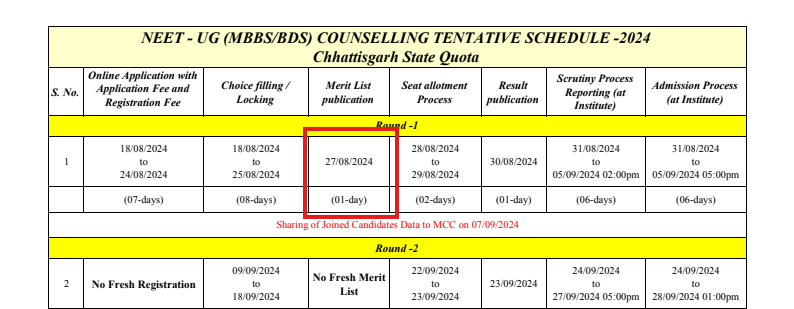
Chhattisgarh NEET UG Counselling 2024: Round 1 Seat Allotment Results to be Released on August 27

[ad_1]

The Directorate of Medical Education (DME) Chhattisgarh is set to announce the Round 1 Seat Allotment result for Chhattisgarh NEET UG Counselling 2024 tomorrow on August 27, 2024.
Candidates who applied for state quota seats in the Bachelor of Medicine and Bachelor of Surgery (MBBS) and Bachelor of Dental Surgery (BDS) programs can view their allotment results on the official website: cgdme.in.

Chhattisgarh NEET UG Counselling 2024: What after results are declared?

For those who receive a seat in the first round of NEET UG counselling in Chhattisgarh, it is mandatory to accept the offer from government medical colleges. However, acceptance of offers from private medical colleges, government dental colleges, or private dental colleges is not compulsory. All allotted candidates must undergo a verification process. Candidates who do not accept a seat at a government medical college will be removed from the counseling process.
Candidates allocated a seat in a government medical college must report in person to the assigned institution and complete the document verification process with the scrutiny committee.
Following successful scrutiny, candidates will be required to accept their admission offer to the assigned government medical college seat.

Chhattisgarh NEET UG Counselling 2024: Upgradation of seats

Candidates who wish to upgrade their seat from Round 1 to Round 2 must log in to their candidate portal and indicate their willingness to upgrade using an OTP.
By choosing this option, the previously selected choices will be canceled, and candidates must make new choices, lock them in, and submit them afresh. It is important to note that if a candidate opts for an upgrade, their admission to the government medical college allocated in Round 1 will be automatically canceled.


[ad_2]

Source link

FVC Invests in South Korean AI EdTech Startup Catius – EdTechReview

[ad_1]

Singapore venture capital fund Farquhar VC (FVC) has announced its investment in South Korean EdTech artificial intelligence (AI) startup Catius Inc. Smilegate Investments and STIC Ventures were among the lead investors in the pre-A round.

FVC said in a statement that Catius is the second Korean startup to join the FVC stable of high-growth companies that include Sicpama (food and beverage retail-tech), of which FVC invested alongside Infobank IAccel and the Daegu Center for Creative Economy & Innovation in February 2024.

Catius Inc. is a revolutionary interactive conversational AI companion for children. The platform engages the kid in constant back-and-forth conversation, exploring many enjoyable and exciting themes to instil a lifetime interest in learning and the world around us. It stimulates conversations and maintains children’s interest by asking questions and giving interesting quizzes. Cati uses discussion to assist the child in developing their conversational, social, and real-world abilities.

FVC has recently inked two partnership deals, namely with the Goyang Investment Authority to support the mutual advancement of startups between South Korea (Goyang Special City) and Singapore and South East Asia and Twin Ventures to enable and support cross-border startup collaborations between the two countries and geographical regions. In addition, the firm is currently in discussions with various Korean government and industry stakeholders on potential fund collaborations, while its innovation-advisory subsidiary will be embarking on a joint accelerator programme to enable startups in southern South Korea to explore global expansion opportunities.

Commenting on the latest development, Jason Su, Managing Partner and Chief Investment Officer of FVC, said:

FVC is grateful to be entrusted with enabling startups to scale beyond domestic borders through investment and acceleration. This is possible by having strong partners in academia, the commercialization industry, and government, such as Hanyang University Holdings, Irislab, Infobank, Twin Ventures, and Goyang Special City.

Jason added:

More importantly, several of our portfolio companies (such as Tictag, MyFirst, and Spark Systems) are having ongoing commercial activities in South Korea, proving our ability to catalyze and sustain ties between the two countries and geographical regions.

Established in 2020, FVC has invested in more than 40 global startups to enable their growth through targeted market access with its network of mid-sized and large corporates. The company’s latest investments include EMERGE Group and Aevice Health. In 2024 and 2025, FVC will invest in high-growth Korean startups via its Green Future Fund.

[ad_2]

Source link