To celebrate warrior women everywhere, Under Armour have created a fresh new range of activewear in purple; the official color of the women’s movement. Now you can support equality while getting your sweat on as M&F takes a look at this powerful new gear — perfect for repping this International Women’s Day on March 8.
The Velociti 3 certainly looks pretty in purple and makes for a cool looking iteration of these lightweight, rubberless sneakers. UA says that this shoe features cushioning that gives a close-to-the-ground-feel, making them “grippy” so that you can go all out and aim for those running PRs while a winged tongue adds midfoot hold and containment with added foam to eliminate pressure on top of the foot.
Great socks can make for the foundation of many epic workouts, and these purple no show socks might just give you that hidden edge. They are ultra-thin, so you will hardly notice that they are on, leaving you to focus on the challenge at hand. These socks also offer sweat wicking and an embedded arch support that Under Armour says will “reduce foot fatigue.”
Under Amour uses specially engineered fabric for softness while wicking sweat “like a champ,” says the brand. The material also offers 4-way stretch so that you won’t be hindered no matter what type of training you are into. There’s a built-in shelf bra for added support too.
UA’s tired and tested HeatGear fabric comes into play with these luxurious leggings, also welcomely available in short and taller sizes. The high-rise, no-slip waistband provides support and confidence and these leggings are also made with flatlock seams so that your workout will be chafe-free. There’s even a side drop-in pocked for your phone, earbuds, or other small accessories.
Now you can celebrate powerful women everywhere with the color purple, no matter your gender. This sling is designed to be hands-free, making it ideal for travelling or on hikes where you don’t want cumbersome baggage along for the journey. There are plenty of compartments, however, including pockets for your phone, ID, tablets, earbuds and other must-haves. There’s even a side water bottle pocket so that you can stay out for longer.
Gold and real estate are two of the most popular physical assets used for portfolio diversification. When investors are looking for protection from inflation, volatility, and economic uncertainty, these tangible investments commonly spring to mind. Here are some distinctions between gold and real estate that investors could consider before they invest in these assets.
When it comes to ease of access, gold is the clear winner. The average home costs over $430,000 and commercial property is orders of magnitude more expensive. These historically high prices, which are ever-increasing, keep the overwhelming majority of investors from considering real estate as part of their portfolio. Conversely, gold’s ease of divisibility results in a broad spectrum of assets representing various price points. Whether you’re purchasing your first piece of gold or topping up your retirement account, you’ll have no trouble finding a gold asset that matches your pricing needs.
Maintenance
Real estate doesn’t just require a bigger buy-in than gold. It also demands considerable ongoing investments. Generally, owners should expect to spend up to 2% of the property’s value every year on general upkeep including maintenance and repairs. That means real estate investors should expect to put over $8,000 annually into this asset, based on the average price of a home. On the other hand, investing in physical gold doesn’t incur any routine costs. In proper storage conditions, gold assets don’t face any risks of deterioration. The only exception would be for investors who open a precious metals IRA which only costs a few hundred dollars annually.
Ideally, a physical investment offers wealth protection while being easily convertible into cash when necessary. Unfortunately, this isn’t the case for real estate which has a strong reputation as an illiquid asset. The average timeline for selling a home stands at nearly two months, while historically a short period of time, severely restricts an investor’s flexibility when they are ready to sell. The liquidation process is even longer for commercial properties. Alternatively, gold is considered a highly liquid asset because of its incredibly high demand and worldwide recognition. Selling gold is a much more straightforward process that often only takes a few days. This allows investors to convert their investments at will to take advantage of market trends or to address financial needs.
Inflation Hedge
One of the defining characteristics of a worthwhile physical asset is its ability to hedge against inflation. Investors purposefully seek out these investments to preserve their wealth as inflation ravages paper markets. Gold has always demonstrated a strong inverse relationship to the rest of the economy. In other words, gold prices tend to rise as inflationary pressures sink the value of traditional assets. For example, when the US economy was being decimated by stagflation throughout the 1970s, gold prices surged over 1,700% from around $36 to well over $650 within the decade. In the same period, the average home prices climbed only 9.9%. It’s also important to note that all the costs involved with maintaining real estate increase with inflation, eating into any potential gains.
Risk
Physical assets are typically perceived as carrying less risk than their paper counterparts. However, the complexity of real estate transactions and the sheer number of people involved opens up investors to considerable counterparty risk. Just recently, the National Association of Realtors – the largest consortium of brokers in the country – was found guilty of artificially inflating brokerage fees by fixing industry-wide rates. This robbed investors of several percentages of their property’s value. Institutional investors have been found guilty of manipulating gold prices too, but the impact is much less severe than in the real estate market. Plus, these schemes impact paper gold much more than physical gold which maintains its inherent value regardless of market manipulation.
Debt
Real estate’s higher barrier of entry inevitably forces people into debt. A staggering 78% of home purchases in the United States require financing which is reflected in the national mortgage debt of $19 trillion. This debt accumulation puts investors at risk of overleveraging and defaulting. Although some precious metals investors take out loans to increase their gold holdings, debt is not a prerequisite for investing in gold like it is for real estate. There’s a rich variety of gold assets spanning a range of price points, making it easy for investors to find products that suit their needs. Gold’s lower price point also lends itself to the investment strategy of dollar-cost averaging.
Volatility
The real estate market is heavily influenced by the rest of the economy which makes it a more volatile asset than gold. Everything from interest rate hikes and currency devaluation to inventory changes and market sentiment can throw real estate prices out of whack. Plus, there’s the constant issue of debt. The relatively recent 2008 Global Financial Crisis was sparked by a massive housing bubble resulting from bad loaning practices, and the foundation of the real estate market is still based on debt. Centuries of recognition and worldwide use as a hedge against economic pressures have made gold an incredibly stable asset. Its inherent value isn’t impacted by flare-ups in the economy which keeps prices relatively calm.
Gold vs Real Estate: Shifts in Perception
Common investing wisdom might suggest that real estate is the ideal physical asset for protection against economic uncertainty and instability. However, recent numbers demonstrate gold’s strength in virtually all categories. A recent Gallup survey revealed that the number of Americans choosing real estate as the best long-term investment dropped by 11%. Conversely, gold’s selection as the leading investment nearly doubled from 15% to 26%.
If you’re interested in learning more about investing in gold, grab a FREE copy of our Precious Metals Investment Guide. It’ll equip you with everything you need to know to get started investing in precious metals to diversify your portfolio, protect your wealth, and hedge against inflation.
Gold and real estate are two of the most popular physical assets used for portfolio diversification. When investors are looking for protection from inflation, volatility, and economic uncertainty, these tangible investments commonly spring to mind. Here are some distinctions between gold and real estate that investors could consider before they invest in these assets.
Accessibility
When it comes to ease of access, gold is the clear winner. The average home costs over $430,000 and commercial property is orders of magnitude more expensive. These historically high prices, which are ever-increasing, keep the overwhelming majority of investors from considering real estate as part of their portfolio. Conversely, gold’s ease of divisibility results in a broad spectrum of assets representing various price points. Whether you’re purchasing your first piece of gold or topping up your retirement account, you’ll have no trouble finding a gold asset that matches your pricing needs.
Maintenance
Real estate doesn’t just require a bigger buy-in than gold. It also demands considerable ongoing investments. Generally, owners should expect to spend up to 2% of the property’s value every year on general upkeep including maintenance and repairs. That means real estate investors should expect to put over $8,000 annually into this asset, based on the average price of a home. On the other hand, investing in physical gold doesn’t incur any routine costs. In proper storage conditions, gold assets don’t face any risks of deterioration. The only exception would be for investors who open a precious metals IRA which only costs a few hundred dollars annually.
Ideally, a physical investment offers wealth protection while being easily convertible into cash when necessary. Unfortunately, this isn’t the case for real estate which has a strong reputation as an illiquid asset. The average timeline for selling a home stands at nearly two months, while historically a short period of time, severely restricts an investor’s flexibility when they are ready to sell. The liquidation process is even longer for commercial properties. Alternatively, gold is considered a highly liquid asset because of its incredibly high demand and worldwide recognition. Selling gold is a much more straightforward process that often only takes a few days. This allows investors to convert their investments at will to take advantage of market trends or to address financial needs.
Inflation Hedge
One of the defining characteristics of a worthwhile physical asset is its ability to hedge against inflation. Investors purposefully seek out these investments to preserve their wealth as inflation ravages paper markets. Gold has always demonstrated a strong inverse relationship to the rest of the economy. In other words, gold prices tend to rise as inflationary pressures sink the value of traditional assets. For example, when the US economy was being decimated by stagflation throughout the 1970s, gold prices surged over 1,700% from around $36 to well over $650 within the decade. In the same period, the average home prices climbed only 9.9%. It’s also important to note that all the costs involved with maintaining real estate increase with inflation, eating into any potential gains.
Risk
Physical assets are typically perceived as carrying less risk than their paper counterparts. However, the complexity of real estate transactions and the sheer number of people involved opens up investors to considerable counterparty risk. Just recently, the National Association of Realtors – the largest consortium of brokers in the country – was found guilty of artificially inflating brokerage fees by fixing industry-wide rates. This robbed investors of several percentages of their property’s value. Institutional investors have been found guilty of manipulating gold prices too, but the impact is much less severe than in the real estate market. Plus, these schemes impact paper gold much more than physical gold which maintains its inherent value regardless of market manipulation.
Debt
Real estate’s higher barrier of entry inevitably forces people into debt. A staggering 78% of home purchases in the United States require financing which is reflected in the national mortgage debt of $19 trillion. This debt accumulation puts investors at risk of overleveraging and defaulting. Although some precious metals investors take out loans to increase their gold holdings, debt is not a prerequisite for investing in gold like it is for real estate. There’s a rich variety of gold assets spanning a range of price points, making it easy for investors to find products that suit their needs. Gold’s lower price point also lends itself to the investment strategy of dollar-cost averaging.
Volatility
The real estate market is heavily influenced by the rest of the economy which makes it a more volatile asset than gold. Everything from interest rate hikes and currency devaluation to inventory changes and market sentiment can throw real estate prices out of whack. Plus, there’s the constant issue of debt. The relatively recent 2008 Global Financial Crisis was sparked by a massive housing bubble resulting from bad loaning practices, and the foundation of the real estate market is still based on debt. Centuries of recognition and worldwide use as a hedge against economic pressures have made gold an incredibly stable asset. Its inherent value isn’t impacted by flare-ups in the economy which keeps prices relatively calm.
Gold vs Real Estate: Shifts in Perception
Common investing wisdom might suggest that real estate is the ideal physical asset for protection against economic uncertainty and instability. However, recent numbers demonstrate gold’s strength in virtually all categories. A recent Gallup survey revealed that the number of Americans choosing real estate as the best long-term investment dropped by 11%. Conversely, gold’s selection as the leading investment nearly doubled from 15% to 26%.
If you’re interested in learning more about investing in gold, grab a FREE copy of our Precious Metals Investment Guide. It’ll equip you with everything you need to know to get started investing in precious metals to diversify your portfolio, protect your wealth, and hedge against inflation.
, Gold vs Real Estate: Which Physical Asset Offers More Protection
As news broke that 57-year-old “Iron” Mike Tyson will be stepping out of retirement to take on YouTube tough guy, Jake Paul, there were more questions than answers. What type of match will it be? How many rounds? Are we in a fever dream? And does any of that matter, because whatever we might say, we all know we’ll be watching.
The “Fight of the Century” featuring Tyson, who is more than half a century old himself, will take place at AT&T Stadium in Arlington, Texas, before a potential crowd upwards of 80,000 bewildered boxing fans. The broadcast rights belong to Netflix, and the show will be beamed live to the world live on July 20, 2024. While details are yet to be confirmed on whether this will be more of an exhibition match with fewer rounds, or will be a bona fide boxing bout, we do know that it’s the kind of must-see-car-crash TV that does little to restore our faith in humanity, but at the same time is totally unmissable!
Jake Paul is a whopping 30 years younger at 27, stands ay 6’1” tall, and has a superior reach of 76”. His record stands at 9-1-0
There’s no doubt that Paul has youth, height, and reach on his side, but that could pale in comparison to the grit and experience of the former heavyweight champion, who has won 44 fights via stoppage. Still, in 2024, one has to ask how much gas Tyson really has left in the tank. Is he coming to punch-out Paul, or simply motivated by a huge payday?
What the Internet is Saying About Jake Paul vs. Mike Tyson
With eyes rolling and Netflix subscriptions going up simultaneously, the internet wasn’t slow in sharing it’s opinions on the fight. “Mike don’t do it,” read a comment on his Instagram account although it was unclear if the author was worried about Tyson’s safety or his street cred. “Jake Paul just made the biggest mistake of his life,” read another comment feeling that the YouTuber might have bitten off more than he can chew.
“It’s crazy to think that in my second pro fight, I went viral for knocking out Nate Robinson on Mike Tyson’s undercard. Now, less than four years later, I’m stepping up to face Tyson myself to see if I have what it takes to beat one of boxing’s most notorious fighters and biggest icons,” said Jake Paul.
“I’m very much looking forward to stepping into the ring with Jake Paul at the AT&T Stadium in Arlington, Texas,” said Mike Tyson. “He’s grown significantly as a boxer over the years, so it will be a lot of fun to see what the will and ambition of a ‘kid’ can do with the experience and aptitude of a GOAT. It’s a full circle moment that will be beyond thrilling to watch; as I started him off on his boxing journey on the undercard of my fight with Roy Jones and now I plan to finish him.”
Whatever comes of the fight, and however embarrassed we are to admit that we can’t wait to see, it, Tyson probably said it best: This should be a lot of “fun!”
Gold hits record high over $2180 an ounce on mixed jobs data, heading for the biggest weekly rally in five months, as investors react to the key U.S. jobs report for February.
Job growth topped expectations in February, pointing to a still-vibrant U.S. labor market while the unemployment rate rose. Nonfarm payrolls rose 275,000 for the month topping the forecast of 198,000. The jobless rate moved higher to 3.9%, even though the labor force participation rate held steady at 62.5%. Average hourly earnings, watched closely as an inflation indicator, showed a slightly less than expected increase for the month and a deceleration from a year ago. Resilience in the labor market will bolster the case for a rate cut.
The yellow metal had touched a record high of $2,164.09 in the previous session following testimony before Congress from Federal Reserve Chairman Jerome Powell that solidified expectations of pending interest rate cuts in the next few months. Lower interest rates are considered bullish for the yellow metal, making it a more attractive asset for investors. Gold also has support from haven demand related to the conflict in the Middle East.
Front-month gold futures rose 0.3% Thursday to settle at $2,165.20 an ounce on Comex, and the most-active April contract gained 3.3% during the first four days of the week. Bullion dropped 0.6% in February after declining 0.2% in January and gaining 0.7% in December. The metal rose 13% in 2023. The April contract is currently up $13.70 (+0.63%) an ounce to $2178.90 and the DG spot price is $2166.10.
Powell said Thursday that Fed policymakers were “not far” from having the confidence to implement interest rate cuts as inflation moves toward the central bank’s 2% target.
“I think we are in the right place,” he said Thursday in testimony before the Senate Banking Committee. “We are waiting to become more confident that inflation is moving sustainably down to 2%. When we do get that confidence, and we’re not far from it, it will be appropriate to begin to dial back the level of restriction so that we don’t drive the economy into recession.”
The Fed closely tracks both labor market and inflation data when determining monetary policy.
Earlier this week, the ADP employment report showed that private payrolls rose by 140,000 last month, up from an upwardly revised 11,000 in January but slightly lower than the 150,000 estimate by economists surveyed by Dow Jones. U.S. weekly initial jobless claims reported by the Labor Department were unchanged for last week.
The Fed’s favorite inflation measure, the personal consumption expenditures price index, came in in line with economists’ estimates last week. Excluding volatile food and energy costs, so-called core-PCE increased 0.4% month on month in January and 2.8% from a year earlier. Top-line PCE, including food and energy costs, increased 0.3% for the month and 2.4% on a 12-month basis.
About 95% of the investors tracked by the CME FedWatch Tool are betting that the Fed will keep rates unchanged this month, while 5% expect a 25 basis point cut. Most investors tracked by the tool also anticipate the Fed will hold rates steady at the following policy meeting in May. Most are now looking to June for a rate cut.
The central bank has raised interest rates by 5.25 percentage points since March 2022 in an effort to cut inflation, but kept rates unchanged at 5.25% to 5.50% at its last meeting.
Front-month silver futures rose 0.4% Thursday to settle at $24.58 an ounce on Comex, and the May contract rallied 5.2% in the first four days of the week. Silver lost 1.2% in February after falling 3.8% in January and dropping 6.1% in December. It ticked up 0.2% in 2023. The May contract is currently up $0.022 (+0.09%) an ounce to $24.600 and the DG spot price is $24.33.
Spot palladium decreased 0.3% Thursday to $1,052.00 an ounce but is up 8.7% so far this week. Palladium fell 4.6% in February after tumbling 11% in January and advancing 8.6% in December. Palladium plummeted 38% last year. Currently, the DG spot price is up $11.10 an ounce to $1057.50.
Spot platinum advanced 0.9% Thursday to $925.60 an ounce and is up 3.9% so far this week. Platinum decreased 4.9% in February after falling 8% in January and rising 8.1% in December. Platinum dropped 6.8% in 2023. The DG spot price is currently down $2.30 an ounce to $923.10.
Disclaimer: This editorial has been prepared by Dillon Gage Metals for information and thought-provoking purposes only and does not purport to predict or forecast actual results. This editorial opinion is not to be construed as investment advice or a recommendation regarding any particular security, commodity, or course of action. Opinions expressed herein cannot be attributable to Dillon Gage. Reasonable people may disagree about the events discussed or opinions expressed herein. In the event any of the assumptions used herein do not come to fruition, results are likely to vary substantially. It is not a solicitation or advice to make any exchange in commodities, securities, or other financial instruments. No part of this editorial may be reproduced in any manner, in whole or in part, without the prior written permission of Dillon Gage Metals. Dillon Gage Metals shall not have any liability for any damages of any kind whatsoever relating to this editorial. You should consult your advisers with respect to these areas. By posting this editorial, you acknowledge, understand, and accept this disclaimer.
Gold hits record high over $2180 an ounce on mixed jobs data, heading for the biggest weekly rally in five months, as investors react to the key U.S. jobs report for February.
Job growth topped expectations in February, pointing to a still-vibrant U.S. labor market while the unemployment rate rose. Nonfarm payrolls rose 275,000 for the month topping the forecast of 198,000. The jobless rate moved higher to 3.9%, even though the labor force participation rate held steady at 62.5%. Average hourly earnings, watched closely as an inflation indicator, showed a slightly less than expected increase for the month and a deceleration from a year ago. Resilience in the labor market will bolster the case for a rate cut.
The yellow metal had touched a record high of $2,164.09 in the previous session following testimony before Congress from Federal Reserve Chairman Jerome Powell that solidified expectations of pending interest rate cuts in the next few months. Lower interest rates are considered bullish for the yellow metal, making it a more attractive asset for investors. Gold also has support from haven demand related to the conflict in the Middle East.
Front-month gold futures rose 0.3% Thursday to settle at $2,165.20 an ounce on Comex, and the most-active April contract gained 3.3% during the first four days of the week. Bullion dropped 0.6% in February after declining 0.2% in January and gaining 0.7% in December. The metal rose 13% in 2023. The April contract is currently up $13.70 (+0.63%) an ounce to $2178.90 and the DG spot price is $2166.10.
Powell said Thursday that Fed policymakers were “not far” from having the confidence to implement interest rate cuts as inflation moves toward the central bank’s 2% target.
“I think we are in the right place,” he said Thursday in testimony before the Senate Banking Committee. “We are waiting to become more confident that inflation is moving sustainably down to 2%. When we do get that confidence, and we’re not far from it, it will be appropriate to begin to dial back the level of restriction so that we don’t drive the economy into recession.”
The Fed closely tracks both labor market and inflation data when determining monetary policy.
Earlier this week, the ADP employment report showed that private payrolls rose by 140,000 last month, up from an upwardly revised 11,000 in January but slightly lower than the 150,000 estimate by economists surveyed by Dow Jones. U.S. weekly initial jobless claims reported by the Labor Department were unchanged for last week.
The Fed’s favorite inflation measure, the personal consumption expenditures price index, came in in line with economists’ estimates last week. Excluding volatile food and energy costs, so-called core-PCE increased 0.4% month on month in January and 2.8% from a year earlier. Top-line PCE, including food and energy costs, increased 0.3% for the month and 2.4% on a 12-month basis.
About 95% of the investors tracked by the CME FedWatch Tool are betting that the Fed will keep rates unchanged this month, while 5% expect a 25 basis point cut. Most investors tracked by the tool also anticipate the Fed will hold rates steady at the following policy meeting in May. Most are now looking to June for a rate cut.
The central bank has raised interest rates by 5.25 percentage points since March 2022 in an effort to cut inflation, but kept rates unchanged at 5.25% to 5.50% at its last meeting.
Front-month silver futures rose 0.4% Thursday to settle at $24.58 an ounce on Comex, and the May contract rallied 5.2% in the first four days of the week. Silver lost 1.2% in February after falling 3.8% in January and dropping 6.1% in December. It ticked up 0.2% in 2023. The May contract is currently up $0.022 (+0.09%) an ounce to $24.600 and the DG spot price is $24.33.
Spot palladium decreased 0.3% Thursday to $1,052.00 an ounce but is up 8.7% so far this week. Palladium fell 4.6% in February after tumbling 11% in January and advancing 8.6% in December. Palladium plummeted 38% last year. Currently, the DG spot price is up $11.10 an ounce to $1057.50.
Spot platinum advanced 0.9% Thursday to $925.60 an ounce and is up 3.9% so far this week. Platinum decreased 4.9% in February after falling 8% in January and rising 8.1% in December. Platinum dropped 6.8% in 2023. The DG spot price is currently down $2.30 an ounce to $923.10.
Disclaimer: This editorial has been prepared by Dillon Gage Metals for information and thought-provoking purposes only and does not purport to predict or forecast actual results. This editorial opinion is not to be construed as investment advice or a recommendation regarding any particular security, commodity, or course of action. Opinions expressed herein cannot be attributable to Dillon Gage. Reasonable people may disagree about the events discussed or opinions expressed herein. In the event any of the assumptions used herein do not come to fruition, results are likely to vary substantially. It is not a solicitation or advice to make any exchange in commodities, securities, or other financial instruments. No part of this editorial may be reproduced in any manner, in whole or in part, without the prior written permission of Dillon Gage Metals. Dillon Gage Metals shall not have any liability for any damages of any kind whatsoever relating to this editorial. You should consult your advisers with respect to these areas. By posting this editorial, you acknowledge, understand, and accept this disclaimer.
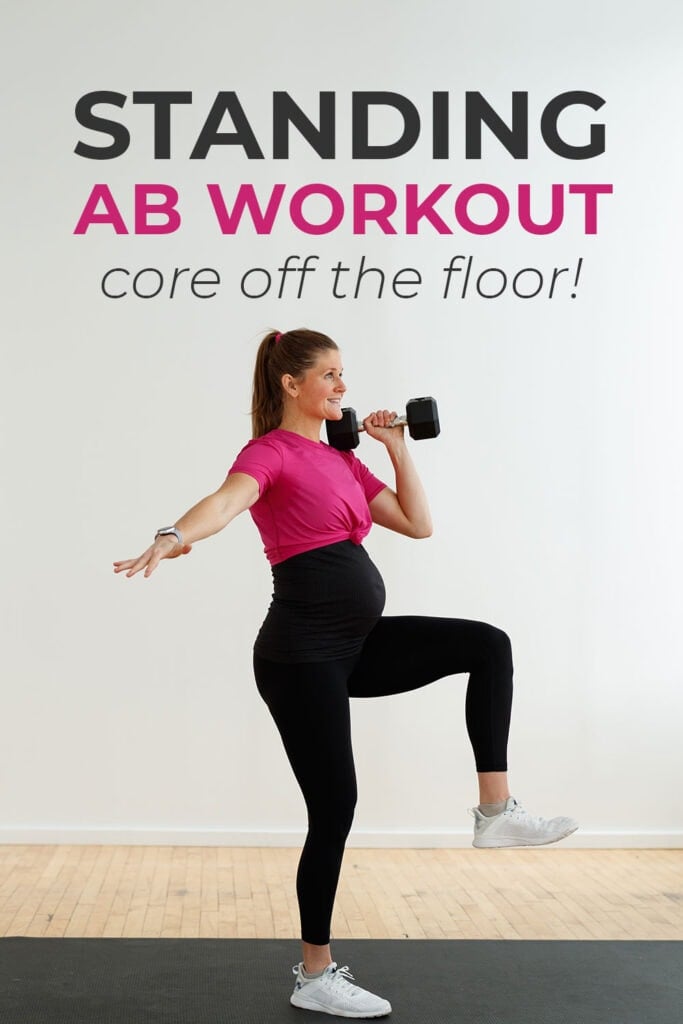
Strengthen and define the entire core with this standing ab workout. These five standing ab exercises are designed to target every muscle in your core. Intensify this standing ab workout by adding weights, or knock it out with just your bodyweight.
Build a strong core with this quick and effective standing ab workout.
You loved our standing ab circuit workout which targeted the core from a standing position using just your bodyweight.
Today’s workout challenges the core using a set of dumbbells.
I have found that standing core exercises with weights are particularly effective because they challenge our core muscles to stabilize the trunk of the body in the same way they do in many of our daily movements. This leads to improved coordination and better balance.
I especially love this workout because there are no crunches and no planks. In my opinion, it doesn’t feel like a traditional ab workout (and I love that)! These standing ab exercises will keep your mind busy as they sculpt and strengthen your midsection.
Timed Intervals (40 seconds of work, 20 seconds of rest)
Repeat All 5 Standing Ab Exercises x2 Sets
Workout Outline
Goblet Hold and March (or High Knee Lift)
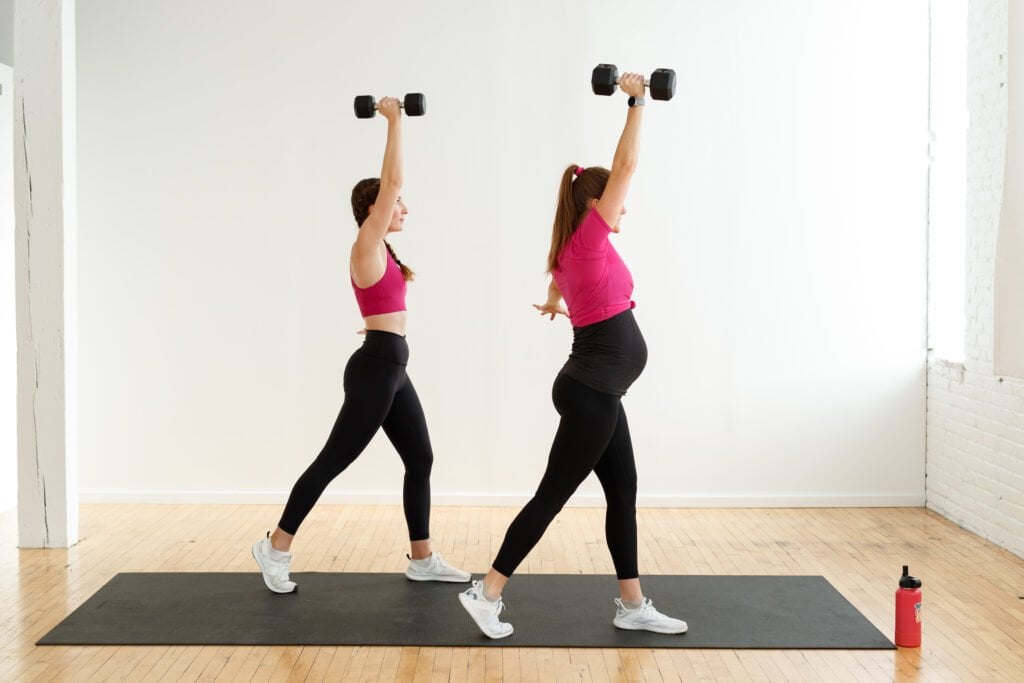
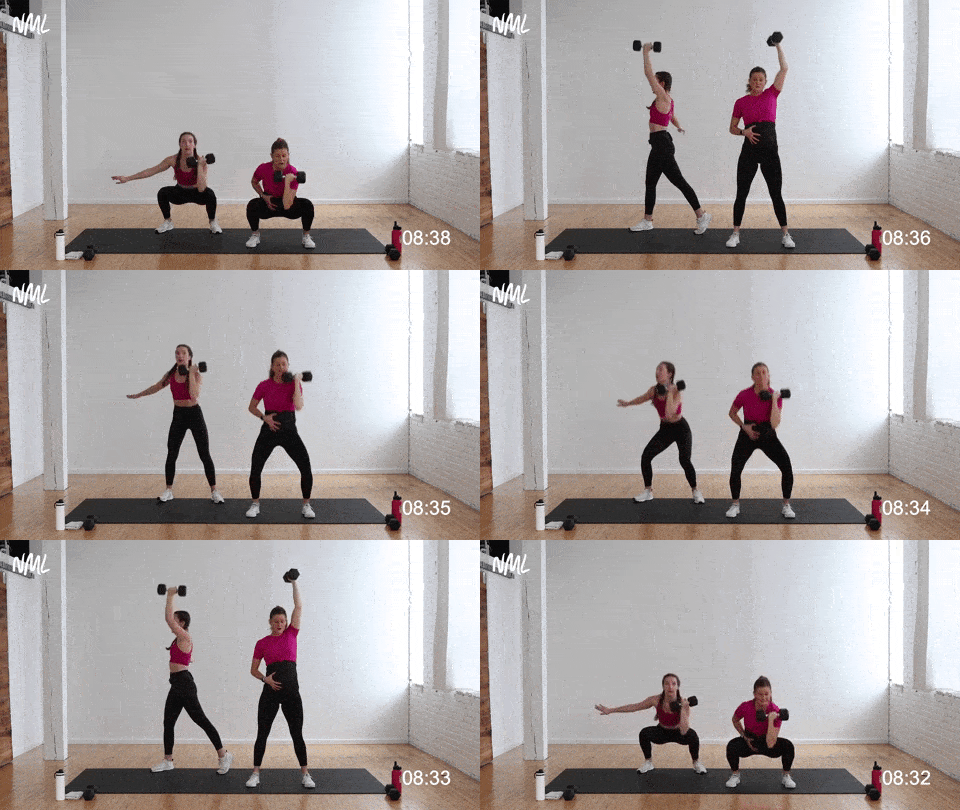
Uneven Front Squat and Pivot Press
Single Leg Balance Weight Pass
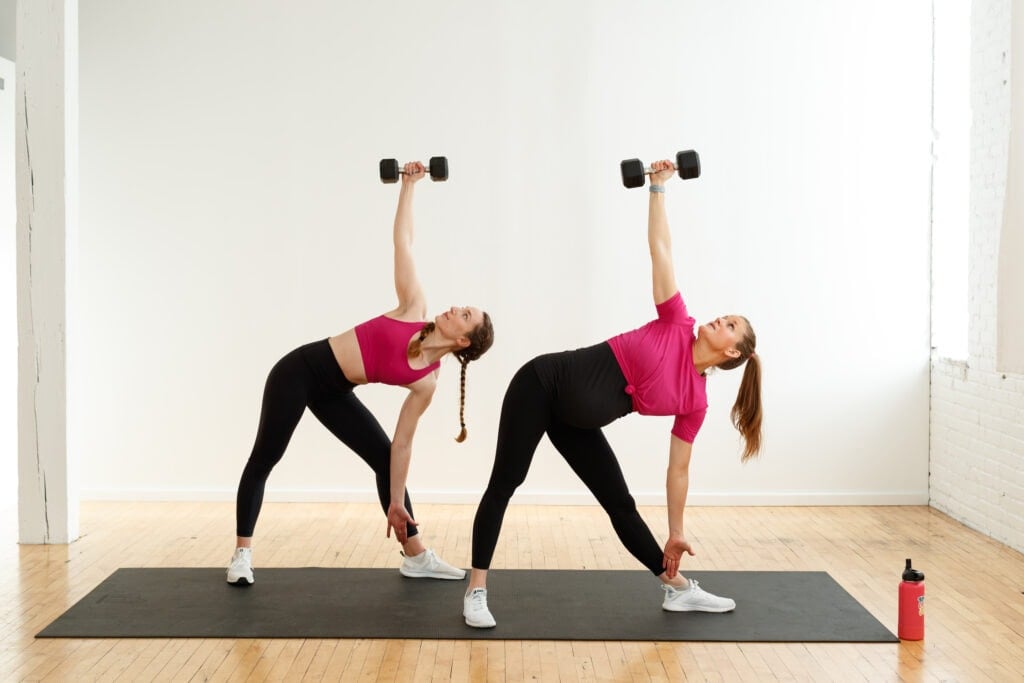
Windmills
Lateral Squat and Front Raise
5 Best Standing Ab Exercises
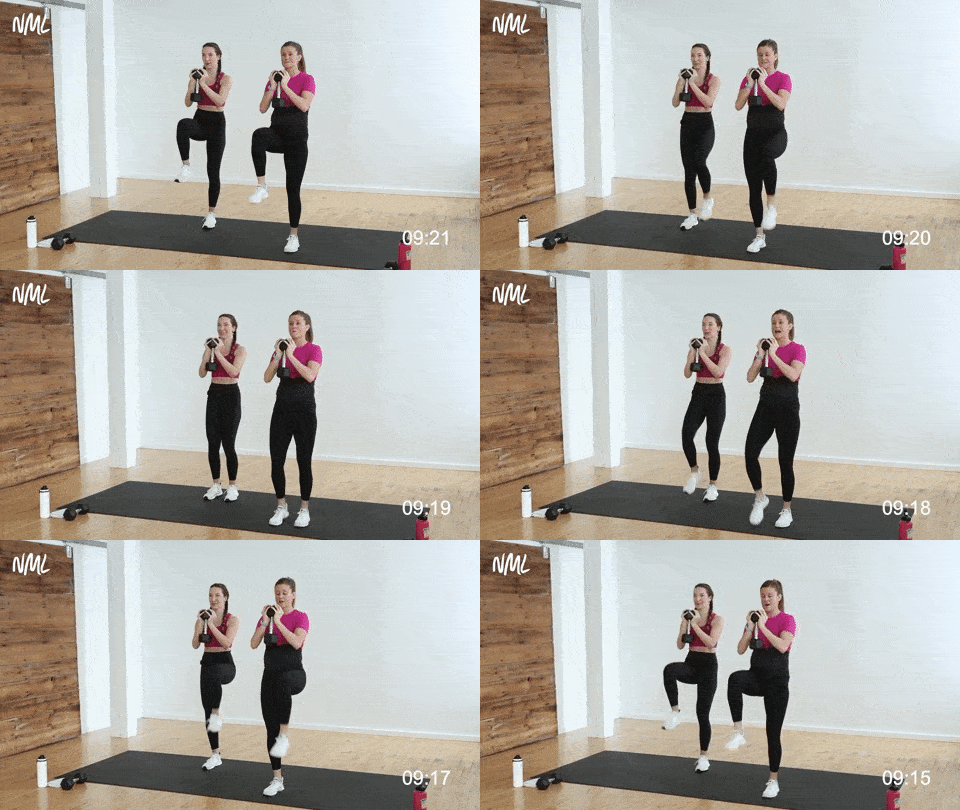
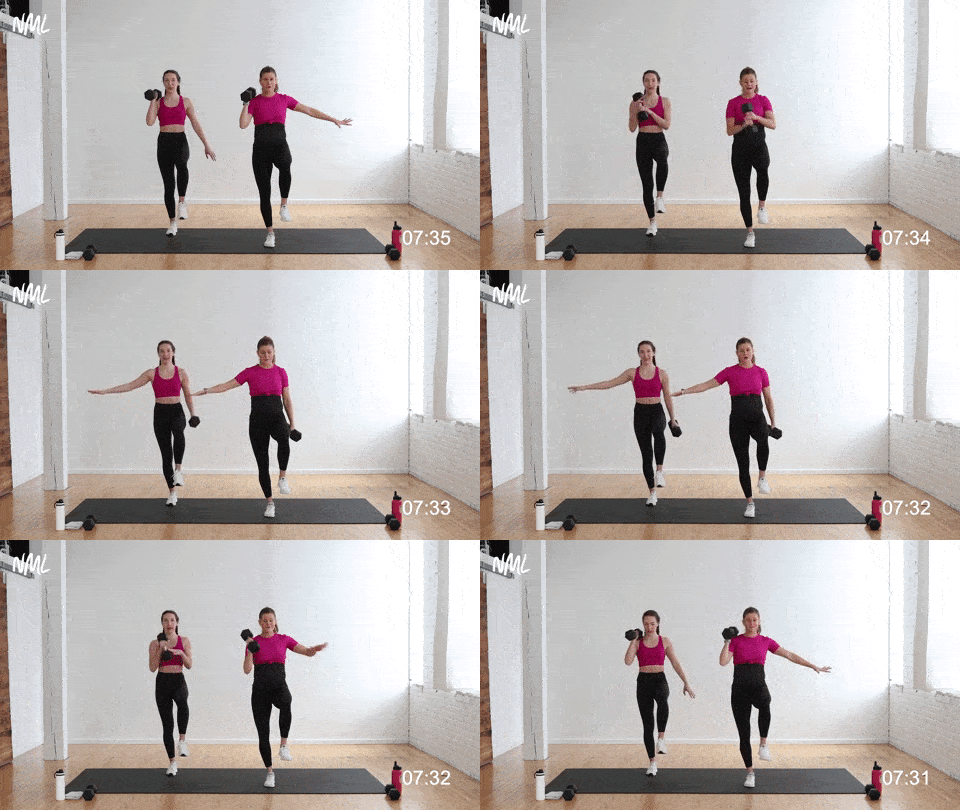
Goblet Hold and March
Targets: Low abs, obliques, glutes, hip flexors, chest and shoulders.
Note: the farther you hold the dumbbell out, away from your body, the harder your core will have to work.
How To Do A Goblet Hold and March
Start in a standing position, feet hip-width apart, holding a dumbbell vertically at your chest, elbows tucked in.
Engage your core, then drive your right knee up in line with your right hip. Right knee bent at a 90-degree angle.
Ground through your standing leg to remain stable, then return your right foot back to the ground.
Switch sides, driving your left knee up in line with your left hip. Return to starting position and repeat these alternating high knee lifts. Think of it as performing standing bicycle crunches.
Start in an athletic position, feet shoulder-width apart, holding a dumbbell in your right hand at shoulder height, palm facing in.
Sit your hips back as you lower into a squat, aiming to get your thighs parallel to the ground (both knees bent at 90 degrees).
Press through your heels to stand tall, rotating your hips to the left. Toes pointing to the left as your left heel pops off the mat. Use the power from your hips and glutes to drive the dumbbell in your right hand overhead.
Return the dumbbell to shoulder height as you reverse the rotation, both toes pointing forward, returning to starting position.
Modification: Follow Lindsey (on the right) and omit the pivot press performing a standing squat and overhead press.
Single Leg Balance Weight Pass
Targets: Low abs, obliques, transversus abdominis, glutes, hip flexors, arms and core.
Again, the farther the dumbbell travels away from your body, the harder your abs will have to work to stabilize your trunk.
How To Do A Single Leg Balance Weight Pass
Start standing feet shoulder-width apart, holding a dumbbell in your right hand at the side of your body.
Brace your core as you lift your right leg off the ground, aiming to get your right thigh parallel to the mat (bend your knee at a 90-degree angle). Ground through your left foot for balance.
Curl the dumbbell up and across your body, transferring it from your right hand at your side to your left hand at your left shoulder. Focus on keeping your torso and hips stable as you transfer weight to the opposite side of your body.
Return the dumbbell across your body, transferring the weight back to your right hand and end at your side, in the starting position.
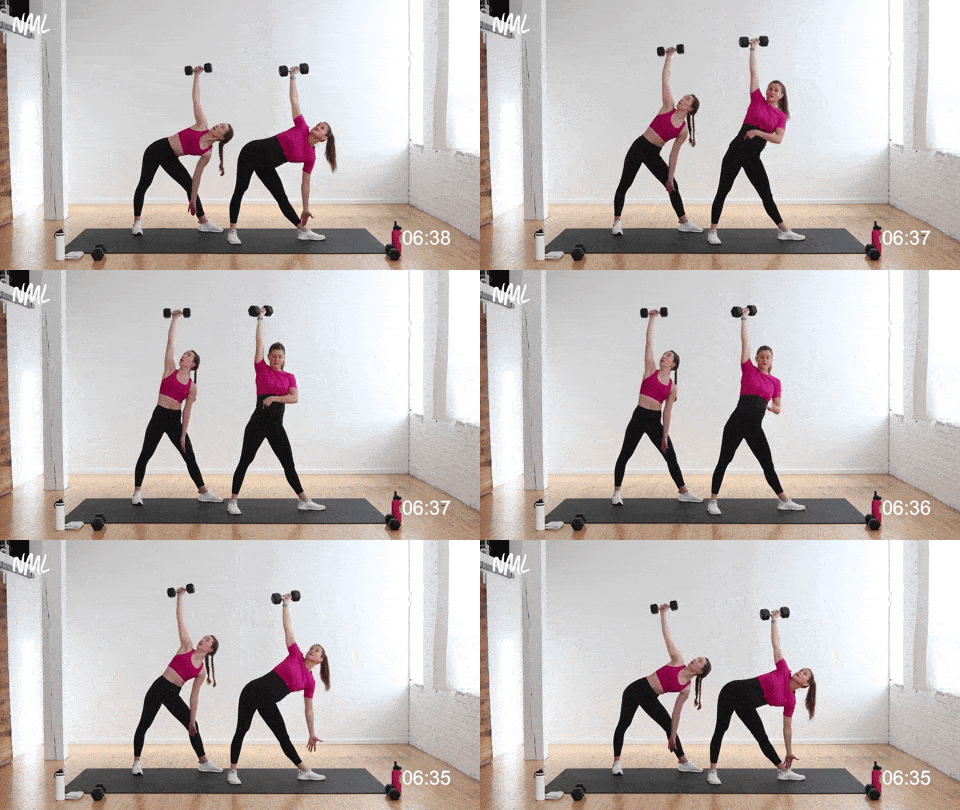
Windmills
Targets: Obliques, abs, upper back, outer glutes, inner thighs, hamstrings, upper body and shoulders.
The windmill is a full body exercise that strengthens the entire core; specifically the obliques (sides of the torso).
How To Do A Windmill
Start in a wide stance, holding a dumbbell (or kettlebell) in your left hand, directly above your shoulder.
Rotate your right foot out 90 degrees so your right toes are pointing towards the top of your mat, then pivot your left foot slightly inwards (about 45 degrees). Think right heel aligns with left arch.
Focus on creating and maintaining length through your waist as you hinge at the hips, sliding your right arm down your right leg. Keep your left hand directly above your left shoulder.
Then, squeeze through your obliques to pull your torso back to an upright position.
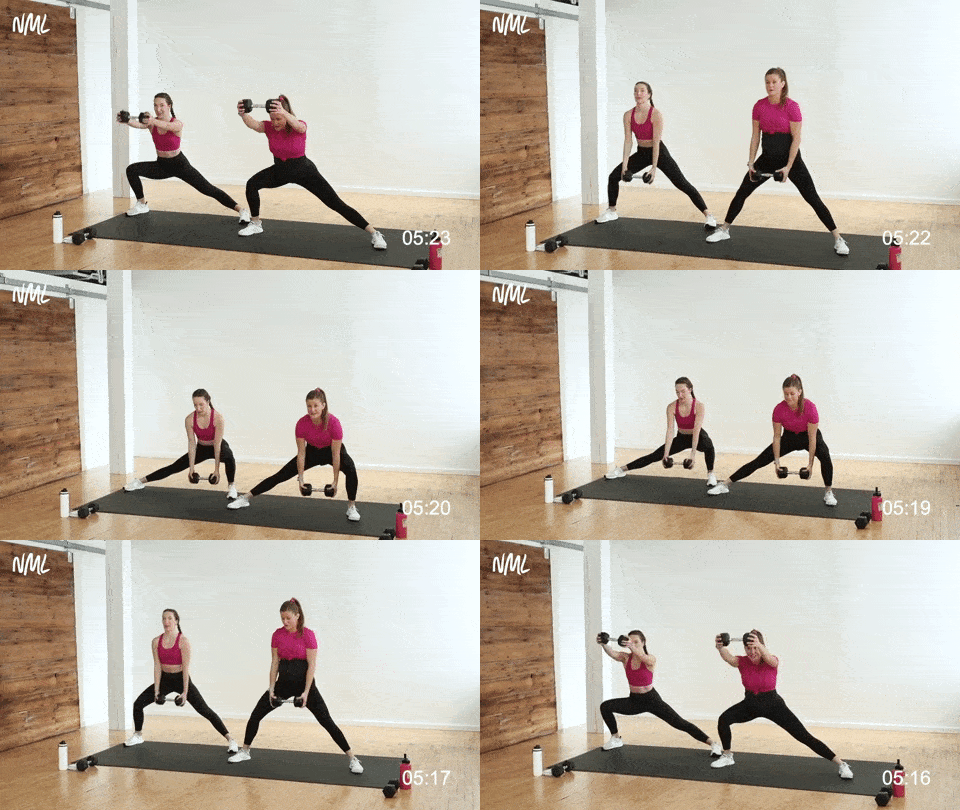
Lateral Squat and Front Raise
Targets: Gluteus medius (part of your butt used for side-to-side movements), quads, hips, inner thighs, shoulders, abs and core muscles.
How To Do A Lateral Squat and Front Raise
Start in a wide stance, holding a dumbbell horizontally between your hands, toes facing forward or slightly out.
Sit your hips back, bending your right knee while leaving your left leg straight. Think of performing a single leg squat on your right side.
At the bottom of your squat, brace your core and exhale as you lift the dumbbell up to shoulder height, arms straight in front of you. With control, lower the dumbbell back down to your thighs.
Then, push off your right foot to reverse the movement, returning to center.
Then, repeat the movement on your left: sitting your hips back and bending your left knee while leaving your right leg straight.
Raise the dumbbell to shoulder height, then control it back down to the starting position.
Push off your left leg to return to center.
Standing Ab Workout FAQs
Are Standing Ab Workouts Effective?
YES! I prefer standing ab circuits to “traditional” core exercises (like crunches) that have you lying on your back. Standing ab exercises more effectively mimic the way you move in everyday life. Functional core training requires your core muscles to work to stabilize your trunk as you move your limbs away from your body, twist and rotate.
What Are The Best Standing Exercises For Abs?
My favorite standing ab exercises involve a weight transfer – either with your bodyweight or with a dumbbell. This engages every muscle around your core. Examples include a cross body chop, standing high knee lifts, leaning obliques, and a standing side bend or side crunch.
Pin this Standing Ab Workout
This post includes affiliate links. I do earn a commission for products purchased using these links (at no additional cost to you). Thank you for supporting Nourish Move Love, making the content you see on this blog possible.
Booty. Ass. Buttocks. Cake. Okay, enough of the cheeky banter, and let’s get straight to the bottom of this article. When it comes to sculpting a rounder, firmer, and overall bigger derrière, there’s really no shortage of workout routines promising insane results.
The biggest thing to focus on when trying to work your butt is to focus on the correct exercises that deliver the biggest impact. As someone who is a part of the big butt club, I’ll show you the three glute exercises I do (spoiler: Step-Ups, Deadlifts, and Hip Thrusts) and potentially help you to achieve your goals efficiently and effectively.
Now, you may be shocked to see step-ups in the number one spot, instead of the often lauded squats, but hear me out. Not only is the range of motion on a step-up better than a lot of people can perform on a traditional squat, step-ups actually activate the glutes significantly more than most exercises. Just check out the chart below from a study published in 2020.¹
Figure 1:Neto, Walter Krause, et al. (2020)
Just from a simple glance, you can see step-ups have asignificantly higher muscle activation than all the other lower body exercises performed.
Why To Do It:
As if that chart above wasn’t reason enough, unlike other exercises, even those on this list, you don’t need any fancy equipment to perform this movement, just a sturdy raised surface. Step-ups can be performed almost anywhere, making these a versatile way to get booty work in without having to drag yourself to the gym.
Don’t get me wrong, as a trainer, I absolutely love squats and think they should be a part of most people’s training regimens. But when it comes to targeting the glutes, these are king.I teach my clients to get the most activation out of their glutes by having them focus on engaging them first before even starting the movement.
Those with knee problems may find that this technique of pushing with your glutes rather than your quads can take some strain off of your knees.
How To Do It
Start by facing a raised surface, like a weight bench, chair, or plyo box.
Next, stand with your feet roughly shoulder-width apart or slightly wider.
Put one foot onto the bench and engage your glutes.
Push through your heel to bring your body into a standing position on top of the bench.
In a controlled manner lower yourself back down to the floor.
Repeat for as many reps as desired and switch to the other leg.
Trainer Tip: Get comfortable with the movement before thinking about adding weight. You’ll be surprised how difficult it can be to balance while performing this exercise, especially on a weight bench that has some give to it. Once you’re comfortable with the motion, experiment with tempo, think explosive speed or a very slow, controlled pace. You’ll be surprised how difficult pacing can make this exercise. Shoot for at least 10 reps per leg for three sets.
Variations:
Dumbbell Step-Ups:This alternative requires you to grab a pair of dumbbells to increase the difficulty.
Crossover Step-Ups:Be forewarned, these are absolutely brutal. Instead of facing the bench, stand next to it. Use your outside foot to…wait for it…crossoverin front of your other foot onto the bench. Push off the leg on the bench to bring yourself to standing on the bench. Lower yourself down to the other side of the bench, still on one foot. Reset to both feet on the floor, and down the same motion for the other side. Once you get good at these, don’t be afraid to grab a set of light dumbbells to jack up the intensity.
LateralStep-Ups:Just like the crossover step-ups, you’ll be standing next to the bench rather than facing it. Lift your inside leg onto the bench, push yourself to standing, than lower yourself down. These are basically the same motion as a regular step-up, just rotated 90º.
2. Deadlift
Now it was a tight race whether I wanted to put the deadlift or Romanian deadlift (RDL) here as they both are hinge movements that primarily target the hamstrings and glutes while also engaging the lower back, quads, and core muscles. Ultimately, I went with deadlifts because the research is clear when it comes to which one of these exercises reigns supreme.²
Figure 2:Lee, Sangwoo, et al. (2018)
I did find it interesting though, when I gave a poll to my clients, the majority said that Romanian Deadlifts targeted their glutes the most.
Why To Do It:
Deadlifts have a somewhat intimidating reputation because they are a staple of a powerlifter’s routine, and it’s not uncommon to see the human equivalent of a water buffalo lifting the weight of a small car on a deadlift platform. While this can be off-putting to someone that just wants to put a little junk in their trunk, it’s well worth giving this exercise a shot.
Not only will it help you fill out your jeans, deadlifts can help build up core strength as well as several other benefits covered in our article on Deadlift Benefits.
How To Do It:
Stand with your feet shoulder-width apart behind a barbell.
Position your hands on the bar just outside of your legs, some people like to use a mixed grip, with their hands facing opposite ways. I prefer to use an overhand or hook grip.
Brace your core, keep your chest up, and sink your hips down to almost a squat position.
Keeping the bar close to your legs, squeeze your glutes, start pushing your hips forward.
Keep your back straight as the bar starts rising, aiming for your back and knees to be coming to a standing position at the same time.
Hold the top position for a second, then lower the weight to the floor in a controlled manner.
Trainer Tip: Start with a lighter weight, and really focus on using your glutes to drive the movement. Once you’re comfortable with the movement, then you can start adding some weight. To make that booty grow, you’re gonna want to be in the 8-10 rep range (lower reps will help make you stronger, but hypertrophy is what we’re aiming for). Because this is a compound exercise, you should be doing this toward the start of your workout.
Variations:
Romanian Deadlifts:This is a fantastic variation I do every other leg workout. To do it properly, keep your knees slightly bent, the bar tight to your legs, and really squeeze your glutes at the bottom of the movement the get the most out of it.
Sumo Deadlifts:With the same idea as the deadlift, the Sumo deadlift involves spreading your feet out into a wider stance, so your arms are grabbing the bar inside your legs. Once you start sinking into the stance, you’ll understand why these are a great alternate to add to your lower body workouts.
Banded Romanian deadlifts:A fan favorite amongst my clients, add a resistance band around your hips or under your feet to increase tension throughout the movement, especially at the top, where the glutes will be the most activated.
3. Hip Thrusters
On Instagram and TikTok, you will see mostly women performing this move, but don’t let that deter you, gentleman. Hip thrusters are one of the best ways to isolate and strengthen the posterior chain, especially the gluteus maximus, medius, and hamstrings. Going back toFigure 1, hip thrusts had the second highest muscle activation, which means they should be a mainstay in everyone’s butt workouts.
Why To Do It:
If you struggle with lower back pain but still want to lift heavy weights, then hip thrusters are an excellent exercise for you! Hip thrusters are great at isolating the glutes by placing them in a good position for maximum muscle activation while also reducing the strain on the lower back muscles.
Lifting the hips against resistance effectively stimulates muscle growth and strength development in the glutes, leading to better shape and definition.
How To Do It:
Start by sitting on the ground with your upper back against a bench and a barbell positioned across your hips.
Roll the barbell towards your body to rest just above your hip bones. I recommend using a pad on the bar to keep your hips from being bruised by weight.
Plant your feet flat on the ground, shoulder-width apart, and brace your core.
Drive through your heels, lifting your hips towards the ceiling while squeezing your glutes at the top of the movement.
Slowly lower your hips back down under control, maintaining tension on the glutes throughout the movement.
Trainer Tip:I’ll occasionally start out my leg days with three or four heavy sets of 6 reps to hit my glutes while they’re fresh. But whatI really like doing is throwing these in at the end of my leg days, to fully burn out my glutes. I’ll usually go for higher reps, around 20, for three sets.
Variations:
Single-leg hip thrusters:If you’re looking for a fun challenge and want to work your oblique more, do hip thrusters with one leg elevated. Focus on driving through the heel of the working leg to engage the glutes unilaterally.
Weighted hip thrusters:Instead of using a barbell like most people do, you can also use a dumbbell, kettlebell, or a weight plate across your hips to increase resistance and challenge the glutes in a slightly different way.
Band-resisted hip thrusters:Loop a resistance band around your hips and anchor it to a sturdy object in front of you to add extra resistance throughout the movement, particularly at the top where the glutes are fully contracted.
Why Should You Build Bigger & Stronger Glutes?
Besides the obvious benefits of having a fuller, rounder set of buns, there are several other great reasons to prioritize glute development in your fitness routine:
Improved athletic performance:I don’t know about you guys, but I have been really getting into pickleball lately, and I’ve noticed that working on my glutes has played a big part in my explosive power. This is because strong glutes play a vital role in athletic movements such as running, jumping, and lifting by enhancing power, speed, and agility.
Reduced risk of injury:Those of you who think that having good glutes is pointless probably don’t realize that having weak glutes can contribute to imbalances and force other muscles to try and compensate in movement patterns, which increases the risk of injuries such as lower back pain, knee pain, and hip issues.
Enhanced functional strength:Strong glutes are essential for everyday activities like walking, climbing stairs, and lifting objects, improving overall functional capacity and quality of life.
Muscle Anatomy of the Glutes
(Image credit to original owner)
While it may not seem important, understanding theglutes’ anatomy canprovide valuable insight into their function and the best ways to train them optimally. The gluteal muscles consist of three main components:
Gluteus maximus:Thelargest and most powerful musclein the gluteal group. It is responsible for hip extension and supports the extended knee through the iliotibial tract and rotation. Basically, it helps you skip, run, walk, and jump. It is also the muscle that makes up the bulk of the form and shape of the butt and hip area.
Gluteus medius:This is an interesting muscle because it isshaped likea hand fan. It is located on the outer surface of the pelvis; this muscle supports hip abduction and stabilization of the pelvis during movement.
Gluteus minimus:Situatedbeneath the gluteus medius and the smallest of the three muscles, this fan-shaped muscle also aids in hip abduction and stabilization, especially in weight-bearing activities.
Despite what you see all over social media, building a bigger, more muscular butt doesn’t require a complicated array of exercises and equipment. Working out just the glutes for hours at a time isn’t even necessary.
Instead, by focusing on the three powerhouse moves outlined in this article—step-ups, deadlifts, and hip thrusters—you can efficiently and effectively sculpt the ass cheeks of your dreams. So, prioritizing glute development can yield impressive results if you aim to enhance your physique, improve athletic performance, or simply look caked up when out in public.
Now that you’re on your way to beefing up your backside, it may be time to think about adding some muscle to the rest of your body, and the perfect way to do that is the SFS Hypertrophy Program.
Citations:
Neto, Walter Krause, et al. “Gluteus Maximus Activation during Common Strength and Hypertrophy Exercises: A Systematic Review.”Journal of Sports Science & Medicine, vol. 19, no. 1, 24 Feb. 2020, pp. 195–203, www.ncbi.nlm.nih.gov/pmc/articles/PMC7039033/.
Lee, Sangwoo, et al. “An Electromyographic and Kinetic Comparison of Conventional and Romanian Deadlifts.”Journal of Exercise Science & Fitness, vol. 16, no. 3, Dec. 2018, pp. 87–93, https://doi.org/10.1016/j.jesf.2018.08.001.
While Intermittent Fastinghas long been a concept adopted by fitness aficionados, the idea of fasting itself spans civilizations such as the ancient Greeks, Romans, and Egyptians. In addition to theories around detoxing and boosting the immune system, some people undertake extended fasts in the hopes of harnessing potential metabolic effects such as improving insulin sensitivity and better cell health. But what happens when an individual abstains from food for 7 whole days? A new study has the answers.
The Effects of Fasting for 7 Days
The study, published in Nature Metabolism,hoped to understand the positive and negative effects of a seven-day fast, in order to determine its suitability as a therapeutic intervention. Twelve volunteers who were in good health consumed just water for 7 days. As expected, one of the initial reactions to the fasting was for the body to switch energy sources, from glucose to body fat. Within three days, the participants lost an average of 12 pounds (5.7 kilograms) in body mass. But perhaps more surprising was rate at which the mass returned following the fast. While a resumption of eating for three days returned the lean body mass, the body fat stayed off.
In addition to the findings relating to body mass, the scientists also found that specific proteins were restructured during the fast, such as those proteins that support the structure of brain neurons. While more work needs to be done to understand the consequences of these protein changes, and ideal fasting durations, the researchers also uncovered beneficial reactions that could aid in the treatment of rheumatoid arthritis and heart disease. “Our results advance our understanding of prolonged fasting in humans beyond a merely energy-centric adaptions towards a systemic response that can inform targeted therapeutic modulation,” reads the report.
Still, the study was also keen to point out that there are adverse effects associated with fasting that also need further understanding. Prolonged fasting is not something that one should attempt at home without proper medical advice and supervision, since it can cause electrolyte imbalances and negative consequences due to nutrient deficiencies. Always consult a health care provider before undertaking any type of fast.
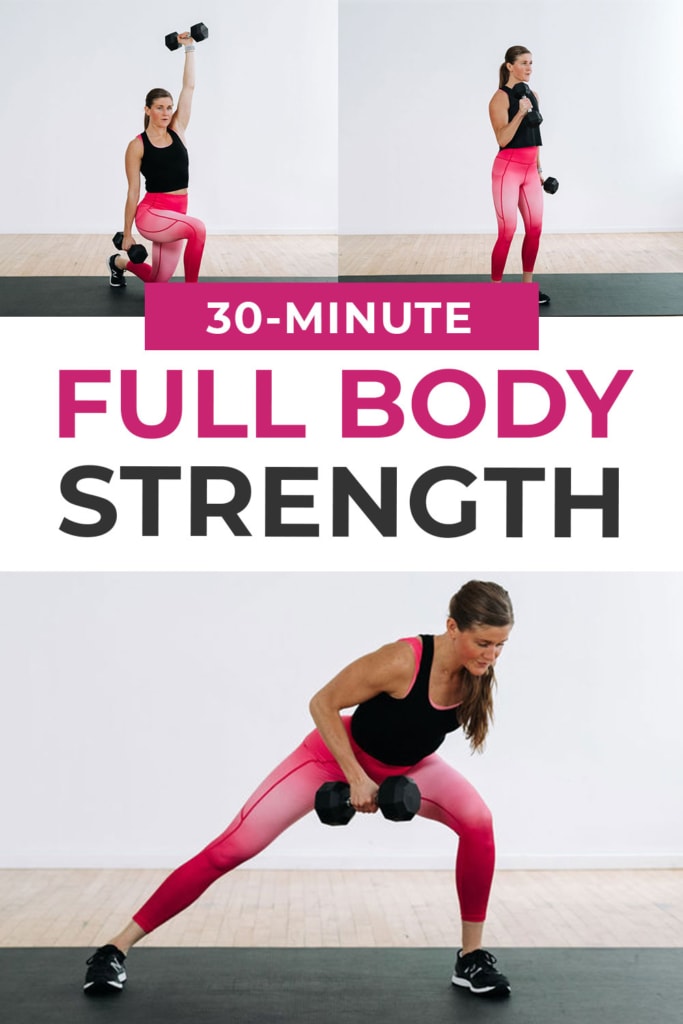
Build total body strength in just 30 minutes with this full body workout at home. Each circuit contains four exercises targeting the lower body, upper body and core. A complete dumbbell workout designed to build strength and challenge your endurance.
All you need is a set of dumbbells and 30 minutes to challenge your total body strength and muscular endurance in this full body workout at home.
I have been a personal trainer for over a decade, and when I taught in-person fitness classes, I loved to structure them in this full body circuit format.
The combination of an upper body, lower body, total body and core exercise in each circuit provides an effective way to build strength and grow muscle at home.
Personally, this is one of my favorite formats because I find it prioritizes compound exercises, or exercises that engage multiple muscle groups at once.
Compound exercises allow you to lift heavier weights, increase calorie-burn, improve core strength and stability, and build muscle.
4 Exercises Per Circuit(upper body, lower body, full body and core)
Timed Intervals(perform each exercise for 40 seconds of work, then rest 20 seconds)
Repeat Each Circuit x2 Sets
Workout Outline
CIRCUIT ONE:
Upper Body: 3-Way Back Row
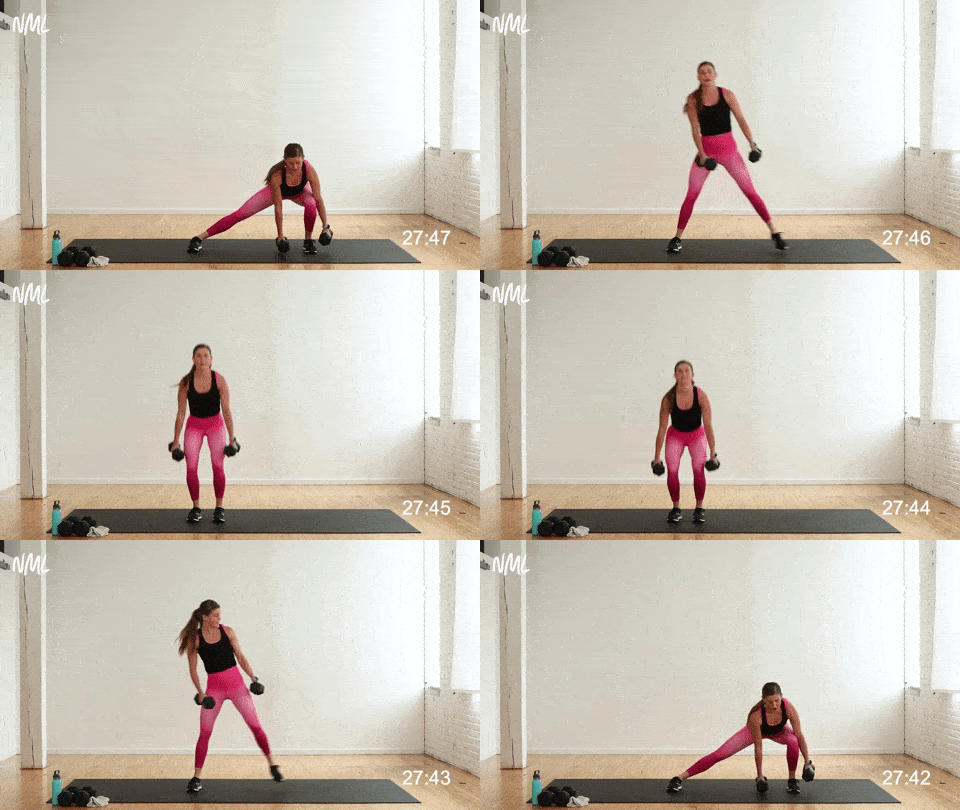
Lower Body: Lateral Lunge and Narrow Squat
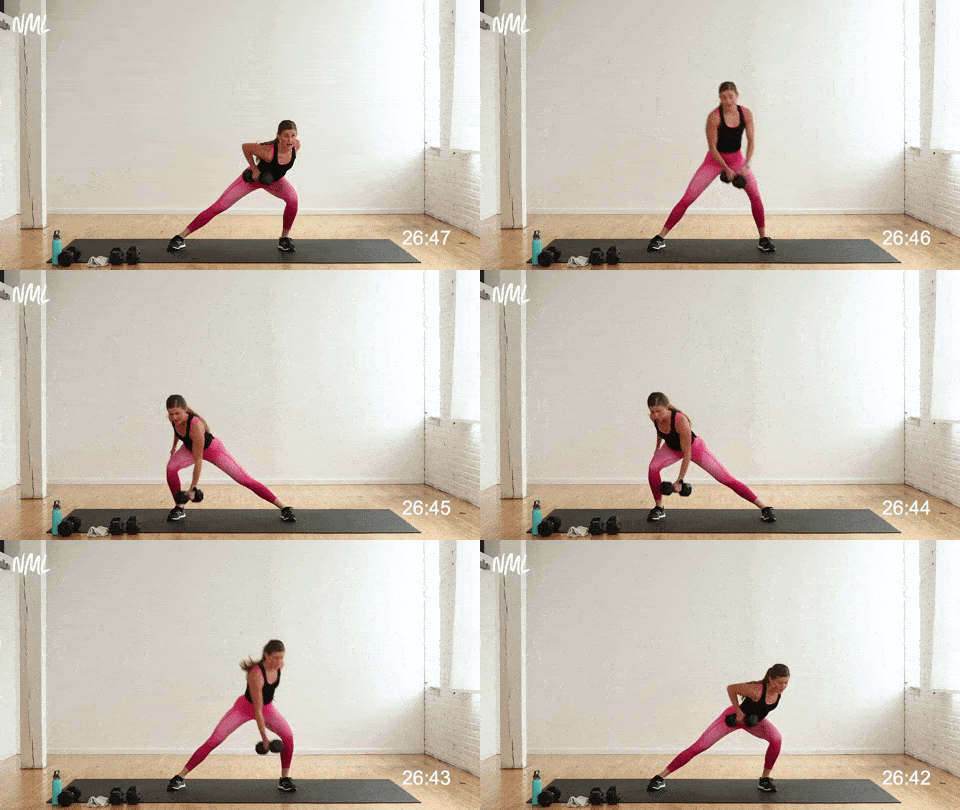
Full Body: Lateral Squat and Single Arm Row
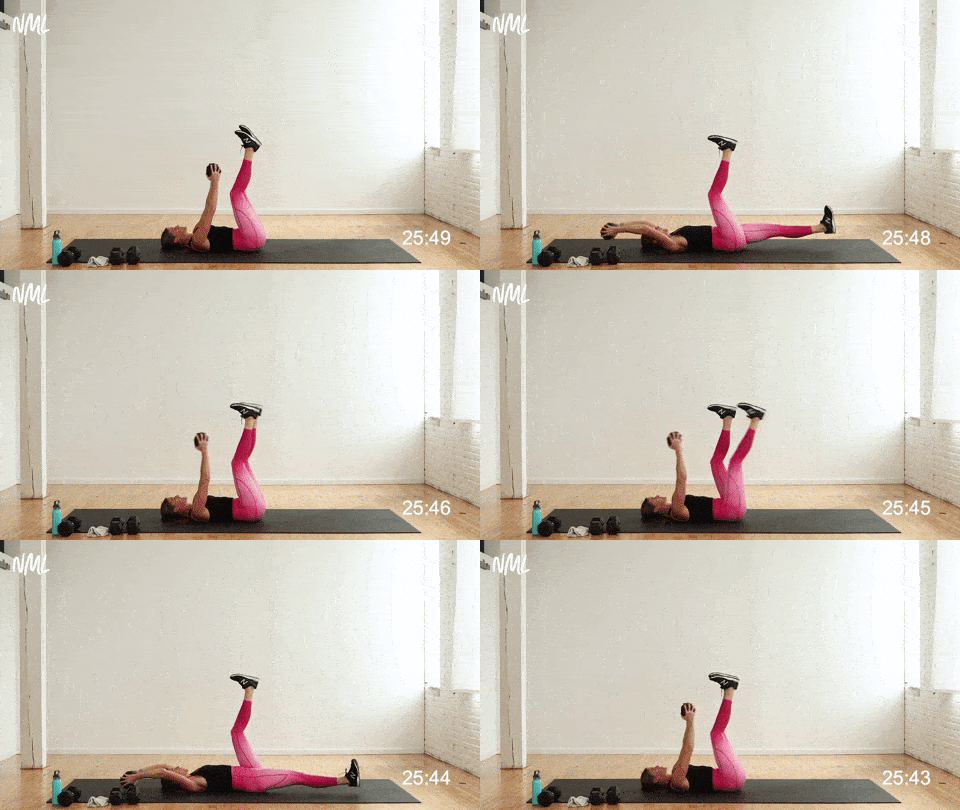
Core: Dumbbell Pullover and Leg Lower
CIRCUIT TWO:
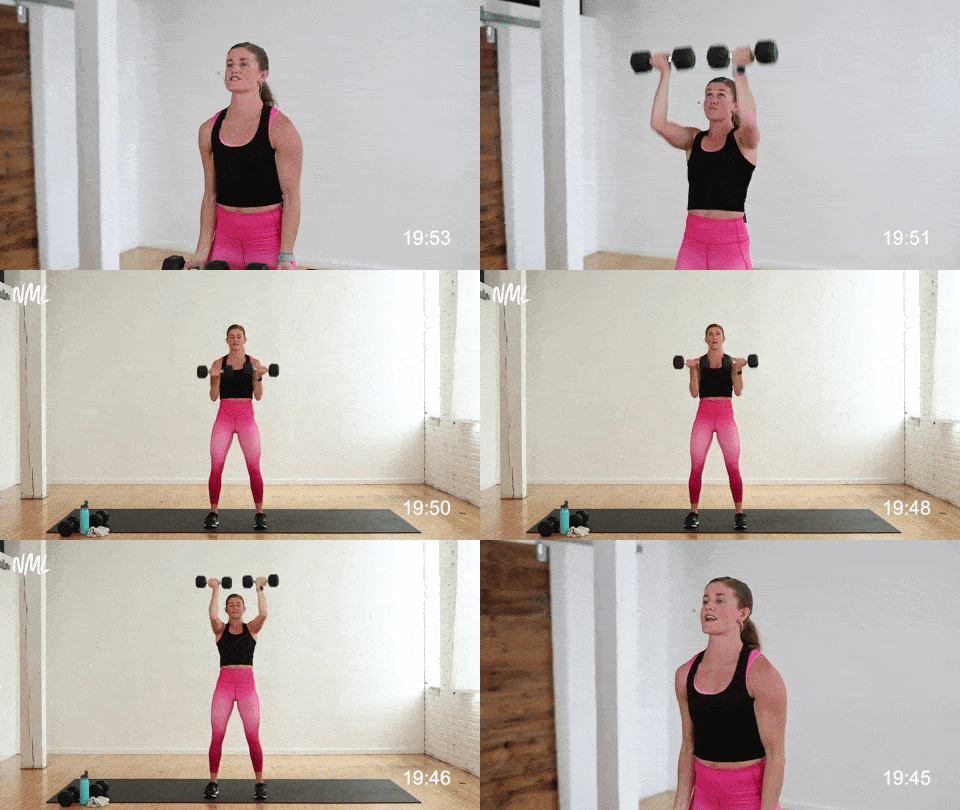
Upper Body: Bicep Curl and Reverse Overhead Press
Lower Body: Split Lunge
Full Body: Alternating Front Lunge and Single Arm Curl Press
Core: Plank and Dumbbell Pass
CIRCUIT THREE:
Upper Body: Chest Fly and Skull Crusher
Lower Body: Staggered Deadlift and Squat
Full Body: Push Up and Dumbbell Burpee
Core: Seated Twist with Dumbbell
12 Full Body Exercises with Dumbbells
3-Way Back Row (Wide Row, Narrow Row, Reverse Row)
Targets:Upper back, mid-back, lower back (latissimus dorsi, rhomboids, trapezoids and rear deltoid muscles), and biceps.
How To Do A 3-Way Back Row
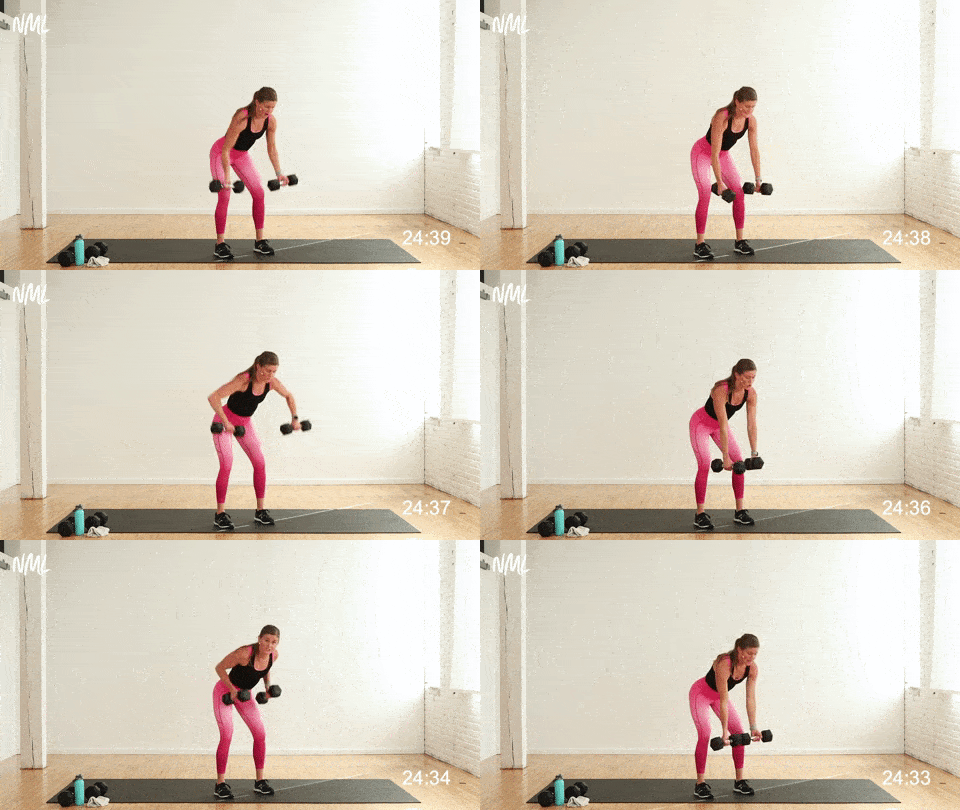
Stand with your feet slightly wider than shoulder width apart, knees slightly bent.
Hinge forward at the hips with a neutral spine, core engaged.
Grip a set of dumbbells, palms facing in towards your body (wide row position).
Pull your elbows wide towards the ceiling, squeezing your shoulder blades together as you bring your elbows parallel to shoulders. Control the dumbbells back down to the starting position.
Rotate your palms to face in towards each other (narrow row position). Pull the weights back towards your hips, elbows parallel to ribcage. Return to starting position.
Rotate your palms to face outwards (reverse row position). Then pull the weights back towards your hips, elbows parallel to ribcage. Return to starting position and repeat this 3-way row pattern.
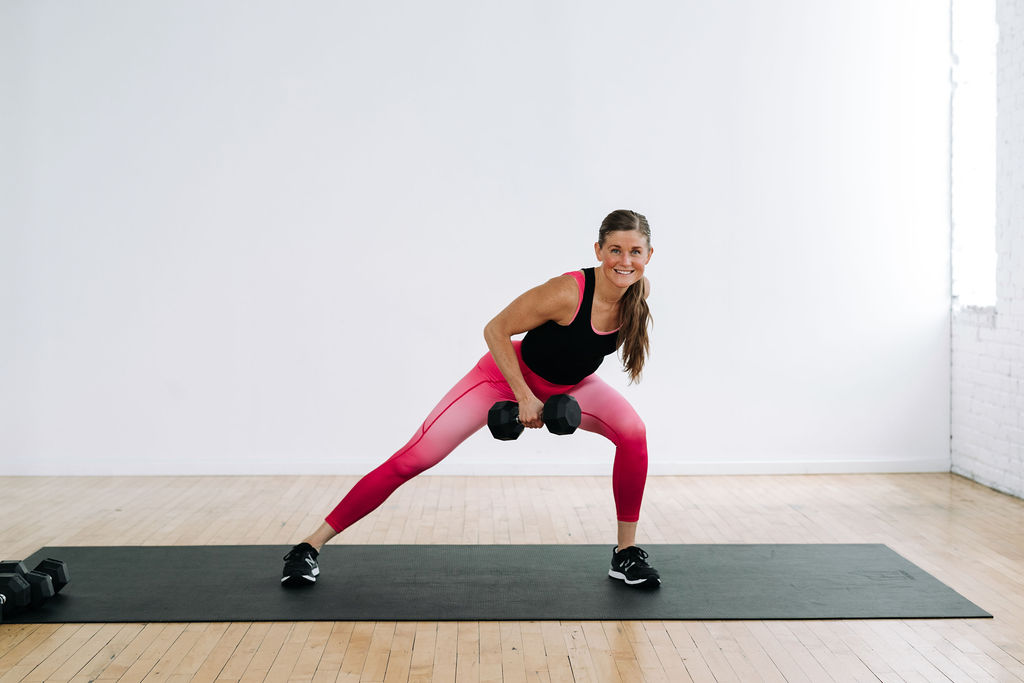
Start standing, feet hip width apart, slightly bent knees. Hold one dumbbell in each hand at your sides.
Step your right leg out to the side as you push your hips back, bending your right knee while leaving your left leg straight. Think of performing a single leg squat with your right leg while your left leg remains straight. Dumbbells frame right foot with knees and toes pointing forward.
Then, drive off your right foot to reverse the movement, pushing back to center.
Lower into a narrow squat (feet no wider than hip distance apart), sitting your hips back as you lower down. Push through your heels to stand tall returning to the starting position.
Lateral Squat And Single Arm Row
Targets: Legs, quads, outer glutes (gluteus medius), back (lats) and core.
How To Do A Lateral Squat And Single Arm Row
Start standing in a wide-stance squat, feet outside of shoulders, knees softly bent. Hold a dumbbell in your left hand between your legs.
Transfer your weight into your right leg as you sit your hips back and to the right. Bending your right knee while leaving your left leg straight. Think of performing a single leg squat on your right leg while your left leg remains straight. Knees and toes pointing forward.
Hold your lateral squat on the right as you perform a single arm row with the dumbbell in your left hand, pulling your elbow towards your rib cage.
Then, drive off your right foot to reverse the movement, pushing back to center. Transfer the weight to your right hand as you push your hips back towards the left, sitting into a lateral squat on your left leg.
Perform a single arm row with your right arm. Repeat this pattern.
Dumbbell Pullover And Leg Lower
Targets: Back (lats), chest (pecs), core and lower abs.
How To Do A Dumbbell Pullover And Leg Lower
Lay flat on your back with legs fully extended overhead (modification: bent at 90 degrees). Hold a dumbbell horizontally between your hands, arms extended overhead.
With a slight bend in the elbows, slowly lower the dumbbell overhead towards the ground. Try to keep your low back pressed into the mat/ground. As you lower the dumbbell, lower one or both of your legs towards the ground.
Then exhale as you pull the dumbbell back overhead while also pulling your legs back to center. Think of pulling your armpits down towards your hips to return back to the starting position.
Bicep Curl And Reverse Overhead Press
Targets:Biceps, shoulders (specifically the front head of the shoulders), back and core.
How To Do A Bicep Curl And Reverse Press
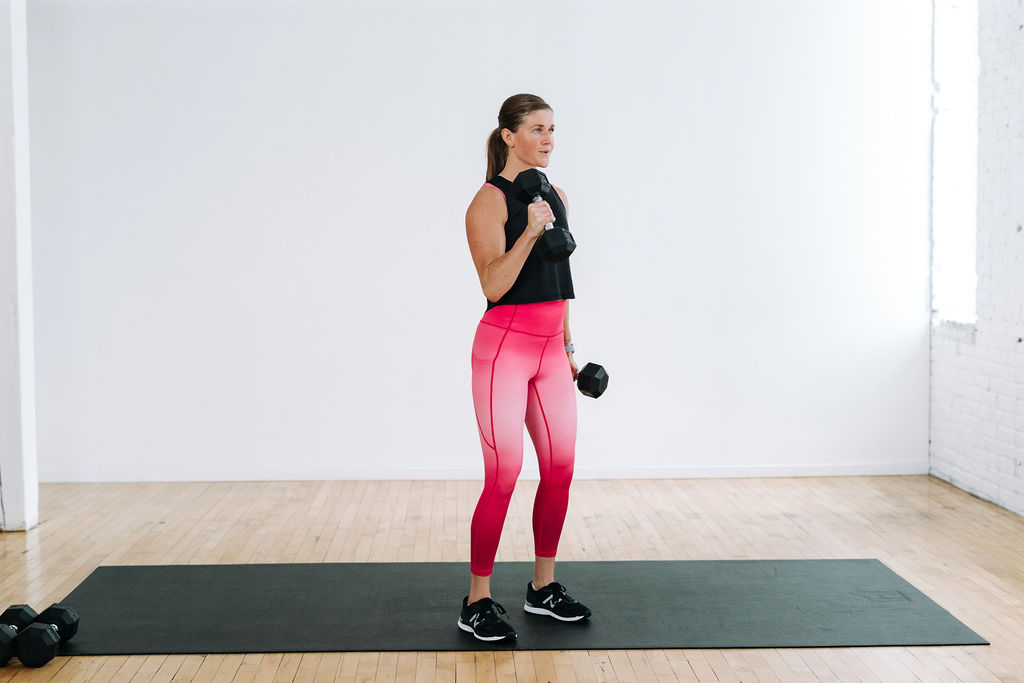
Start standing, feet under hips, core engaged, soft bed in the knees. Holding a dumbbell in each hand with palms facing out.
Squeeze your biceps to pull the dumbbells up to shoulder height.
Then press the dumbbells straight overhead, palms still facing in towards your body (reverse press).
With control, lower the dumbbells back to shoulder height and then back down to the starting position.
Split Lunge
Targets: Legs, quads, glutes, hamstrings and calves.
How To Do A Split Lunge
Start standing feet hip-distance apart, holding a dumbbell in each hand at your sides, palms facing your body.
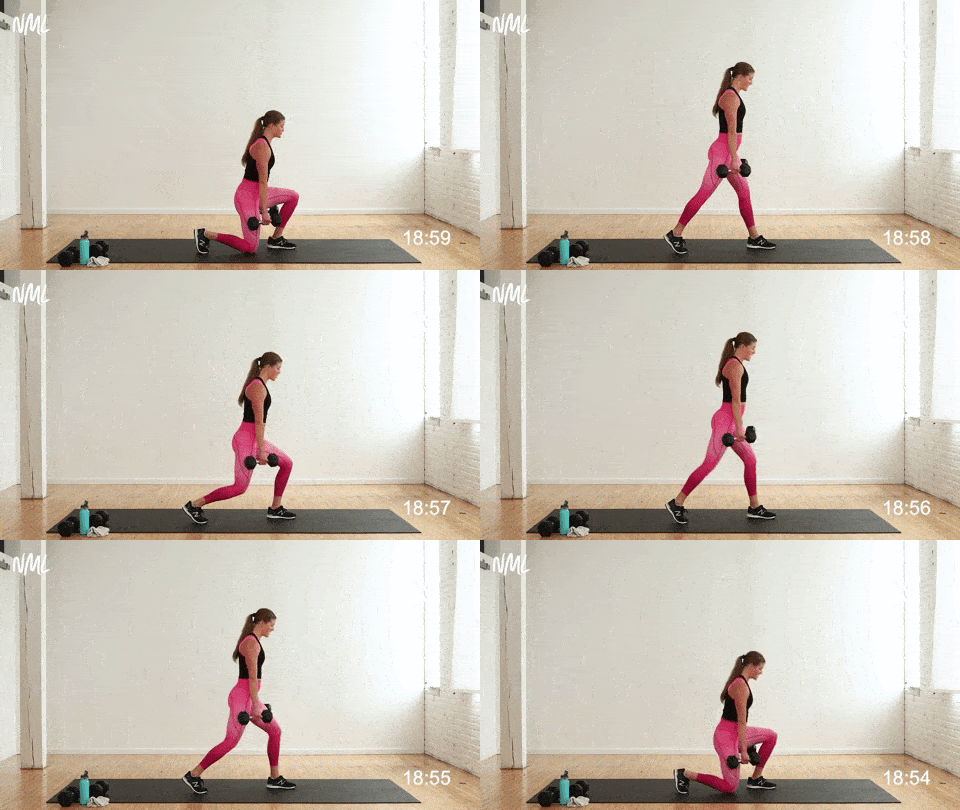
Step your right leg forward, then drop your back left knee towards the ground. Lowering your hips until both knees reach a 90 degree angle, front right thigh parallel to the floor. Shoulders remain stacked over hips throughout the entire exercise.
Press into your front right heel to stand tall, returning to the starting position.
Alternating Front Lunge And Single Arm Curl Press
Targets: Legs, quads, hamstrings, biceps, shoulders, abs and all the stabilizing muscles in the core.
How To Do A Front Lunge And Single Arm Press
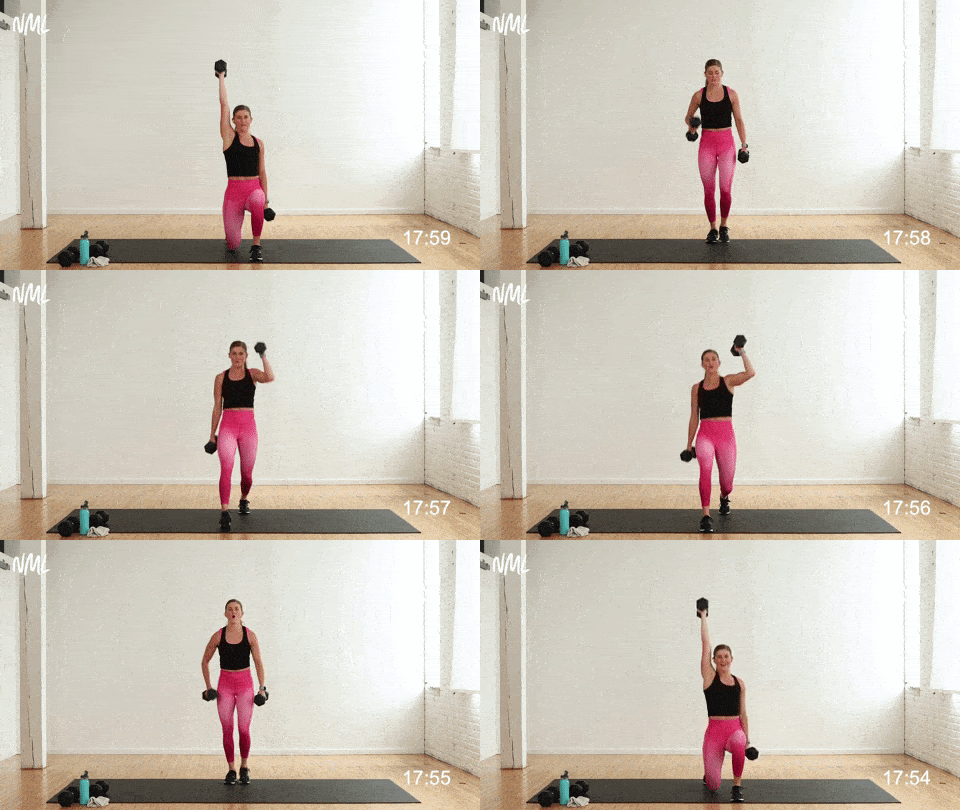
Start standing, feet shoulder-width apart with a soft bend in knees. Hold one dumbbell in each hand (palms facing in towards the body).
Step your right foot forward, lowering down until both knees reach a 90 degree angle or right thigh is parallel with the ground. As you step the right foot forward, curl the dumbbell in your left hand up to shoulder height, then press overhead.
With control, reverse the shoulder press, lowering the dumbbell back to shoulder height and back to the starting position. As your arm lowers, press through your right heel to drive back to starting position. Switch sides, repeating on the other side of the body.
Plank And Dumbbell Pass
Targets: Entire core, back, shoulders and arms.
How To Do A Plank And Dumbbell Pass
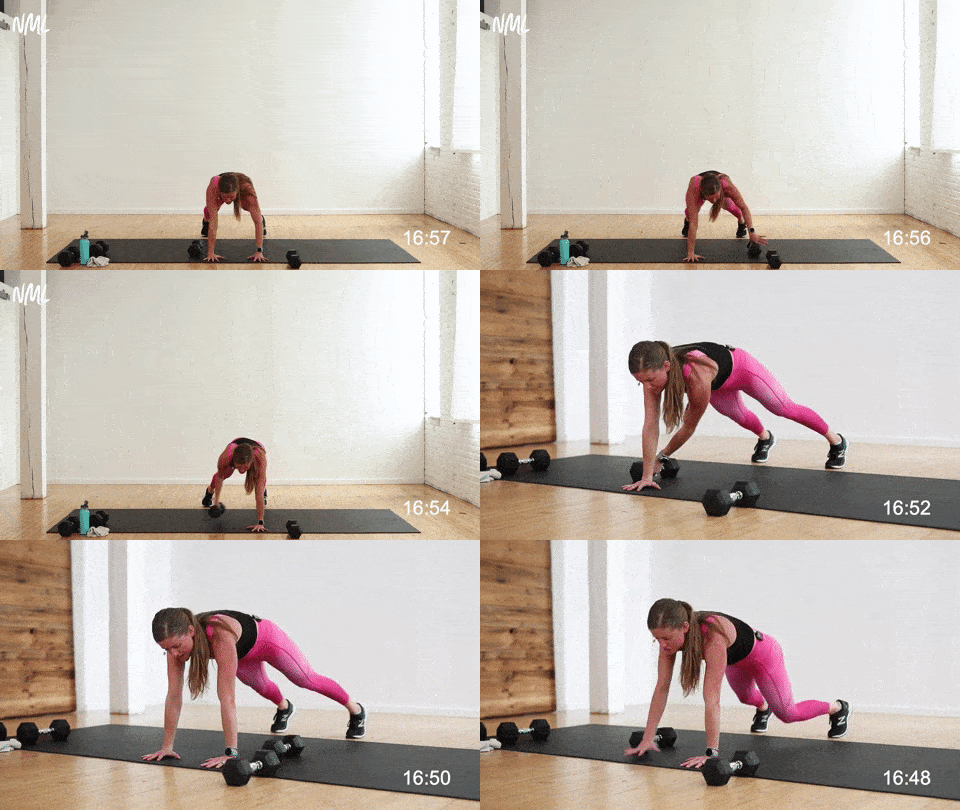
Start in a high plank position, shoulders over wrists, core engaged. Place a dumbbell outside your right hand.
Engage your core, then reach your left hand underneath your body to grab the dumbbell and pull it through to the left side. Place the dumbbell on the mat just outside where you’ll plant your left hand when you return to high plank.
Switch sides, pulling the dumbbell back to the right with the right hand. Repeat this pattern while holding a high plank.
Chest Fly And Skull Crusher
Targets:Chest (pecs), shoulders and triceps.
How To Do A Chest Fly And Skull Crusher
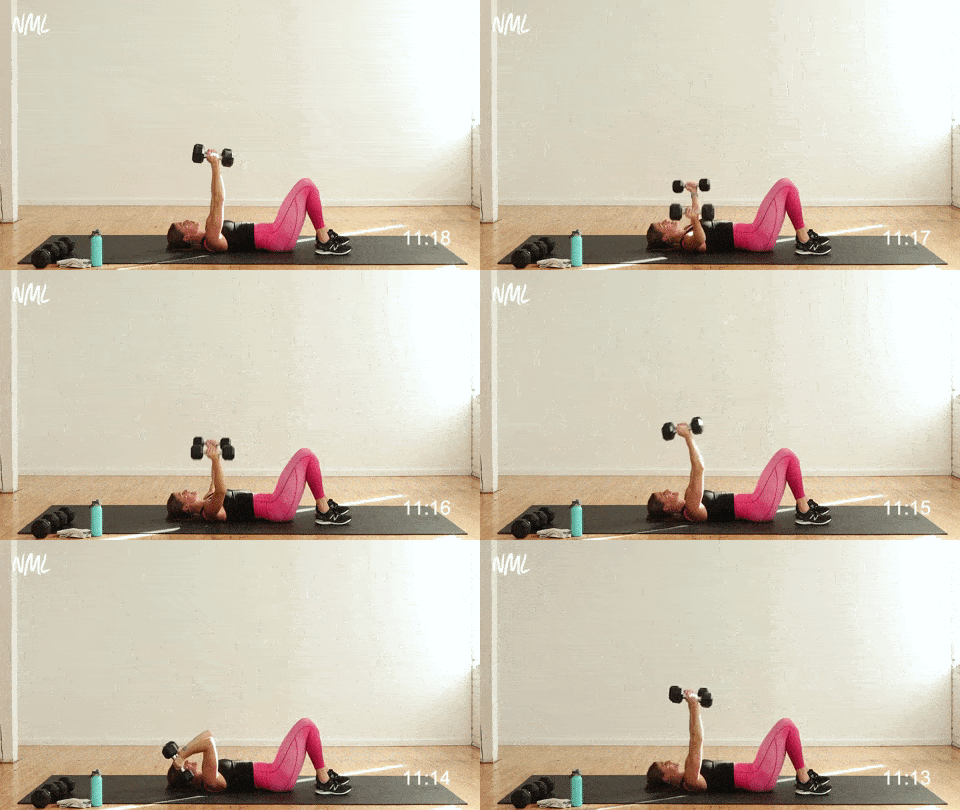
Lay flat on your back, legs bent at 90 degrees, arms straight overhead holding one dumbbell in each hand, palms facing in.
With a soft bend in the elbows slowly open your arms, lowering the dumbbells in a wide arc until they reach shoulder level (or the ground).
Exhale as you pull the dumbbells back to starting position, keeping your chest puffed out. This is a chest fly.
Once back to the starting position, perform a skull crusher by bending at the elbows to lower the dumbbells towards your forehead. Then squeeze the back of your arm (triceps) to press the dumbbells back overhead to return to the starting position.
Alternate performing one chest fly and one skull crusher.
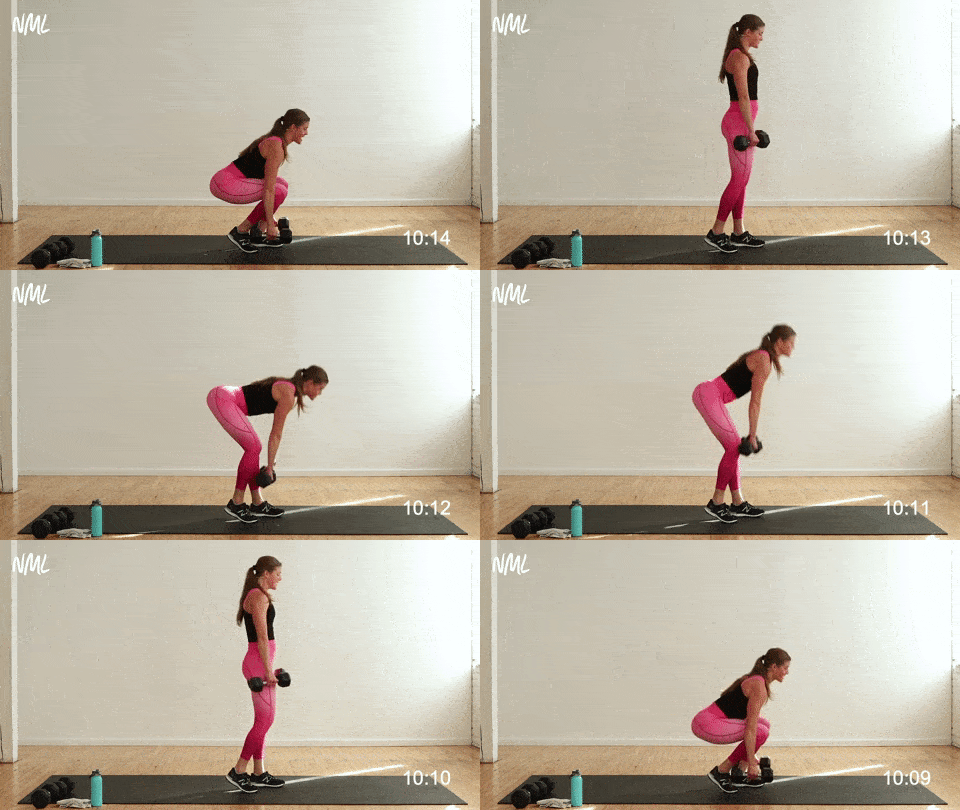
Staggered Deadlift And Squat
Targets: Legs, hamstrings, glutes, hips, quads and core.
How To Do A Staggered Deadlift And Narrow Squat
Stand with feet hip-width apart, hold one dumbbell in each hand at your thighs, palms facing your body.
Stagger your feet, so your right leg is slightly in front of your left foot. Kickstand your back left foot, left heel floating off the ground.
Keep 80% of your weight in your front right foot, 20% in your back left toe.
With a soft bend in the knees, hinge at your hips to lower your torso as you slide the dumbbells down your legs. Think about pushing your hips back behind you.
Hinge until you feel a stretch in the back of your front right leg (range of motion will be different for everyone). Then drive through your front right heel to stand up straight; returning to the starting position.
Maintain a staggered stance as you lower your hips down, sitting back into a staggered squat. Push through the heel of your right foot to return to standing.
Continue to alternate one staggered deadlift and one staggered squat.
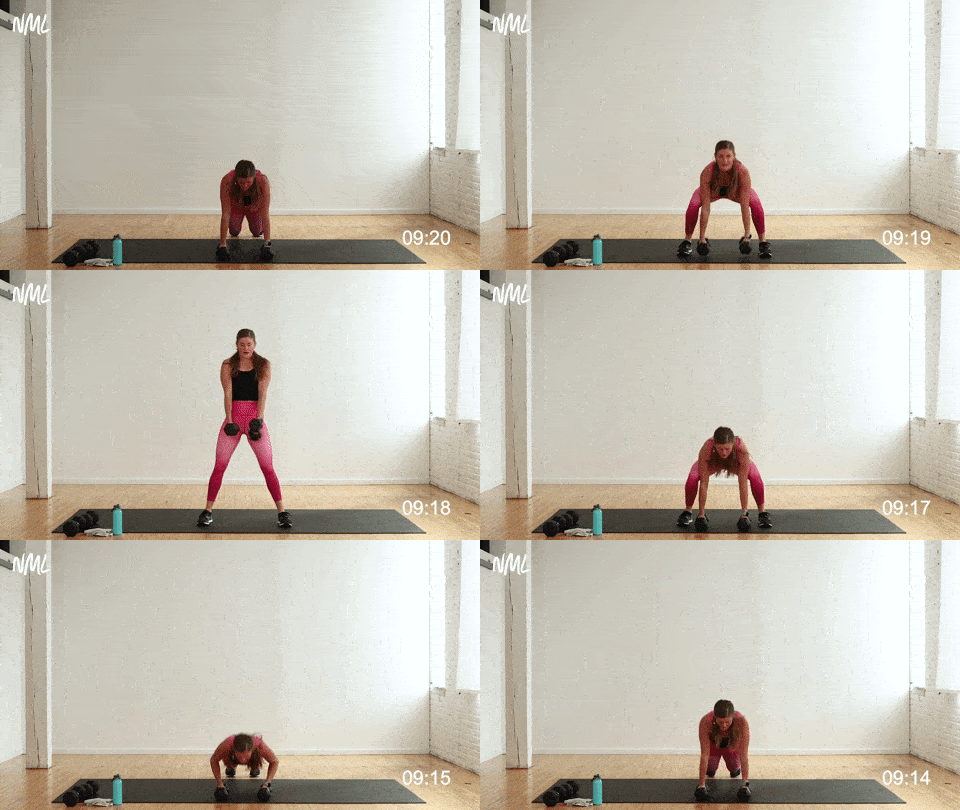
Push Up And Dumbbell Burpee
Targets:Chest, shoulders, triceps, legs, glutes, quads, hamstrings, abs and core. A compound dumbbell exercise to build full body strength.
How To Do A Push Up And Dumbbell Burpee
Start in a high plank position, hands on dumbbells, core engaged.
Elbows fall back towards your body as you lower your chest towards the ground for a push up. Press back up to high plank.
Step or jump your feet outside of your hands, landing in a loaded squat position.
Then drive through your heels to stand, holding one dumbbell in each hand (palms face in).
Lower into a squat to return the dumbbells to the mat; then step or jump your feet back to high plank position.
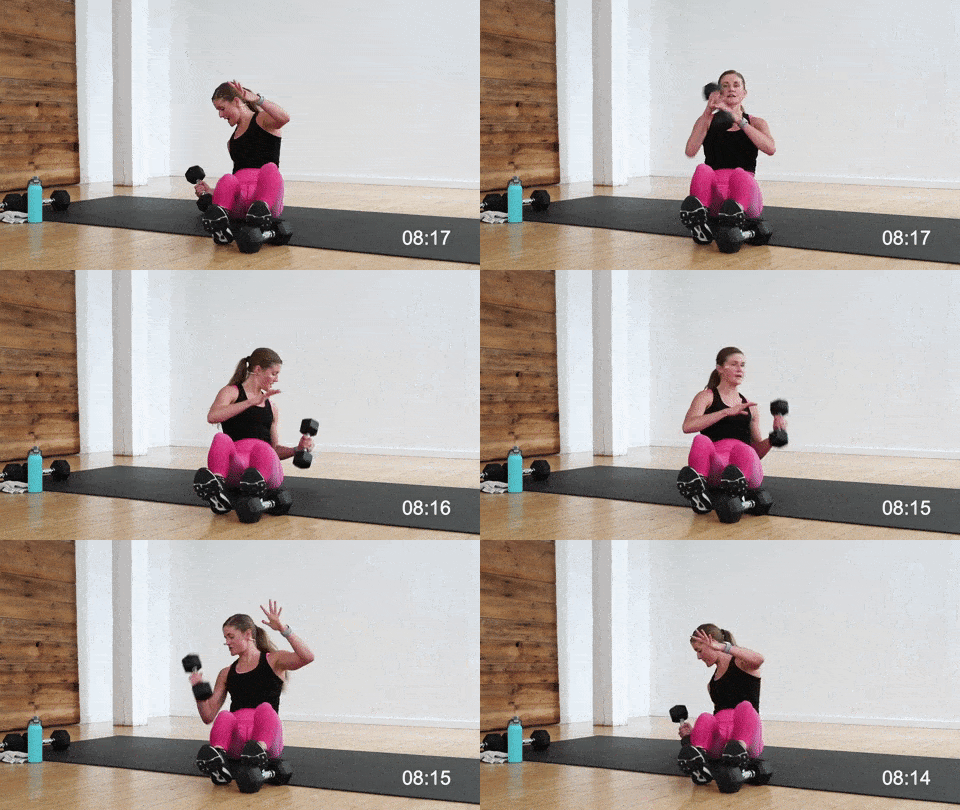
Seated Twist with Dumbbell
Targets:Upper abs, lower abs, obliques, core and hips.
How To Do A Seated Twist With Dumbbell
Start in a seated position, sitting on your sit bones as you lean back; heels resting on the ground (option to float one or both feet to increase intensity).
Holding a dumbbell in your right hand, pull your right elbow back towards your right hip as you rotate through your torso to tap the dumbbell to the mat near your right hip.
Use your obliques and abs to return to center. Then transfer the dumbbell to your left hand.
Pull your left elbow back towards your left hip as you rotate through your torso to tap the dumbbell to the mat near your left hip.
Free 2-Week Strength Program
Full Body Workout At Home FAQs
What Is The Best Full Body Workout At Home?
The best full body workout includes a combination of upper body exercises, lower body exercises and core exercises. Effective full body workouts will include a variety of compound exercises and will challenge you to move in different planes of motion, mimicking real life movement patterns.
Are Full Body Workouts At Home Effective?
Yes, dumbbell workout routines offer an effective way to build muscle definition, increase strength and improve endurance. Full body workouts are particularly effective for beginners who need to build a solid strength base. They’re also effective for those who want to maximize muscle build and calorie burn.
Is 30 Minutes Enough For A Full Body Workout?
Yes! Effective full body workouts will target all muscle groups through compound exercises. If you choose heavy weights and prioritize efficient exercises that target multiple muscle groups at once, a 30 minute workout is enough.
Pin this Full Body Workout
This post includes affiliate links. I do make a small commission for products purchased using these links (at no additional cost to you). Thank you for supporting Nourish Move Love, making the content you see on this blog possible.


 Gold and real estate are two of the most popular physical assets used for portfolio diversification. When investors are looking for protection from inflation, volatility, and economic uncertainty, these tangible investments commonly spring to mind. Here are some distinctions between gold and real estate that investors could consider before they invest in these assets.